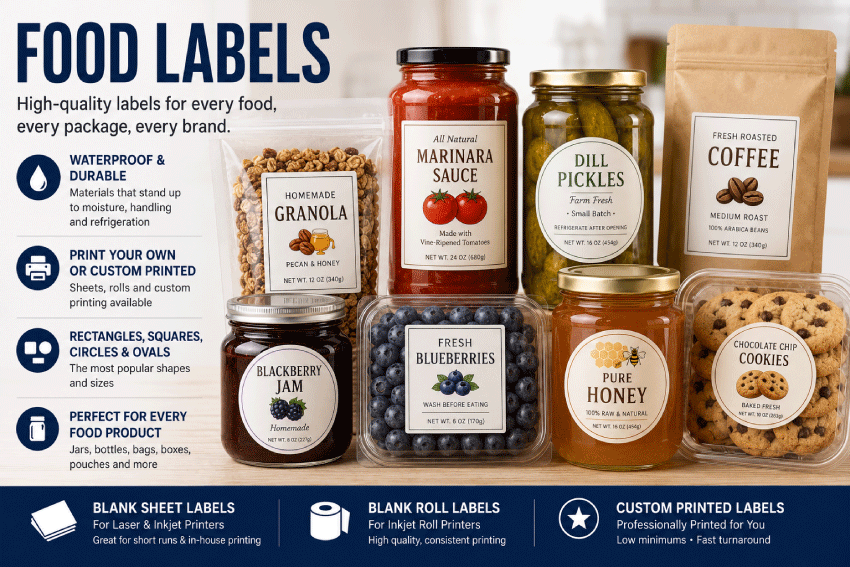
Food labels help products stand out on shelves, communicate important information, and give customers confidence before they buy. Whether you package sauces, snacks, baked goods, candy, coffee, spices, frozen foods, refrigerated products, jars, bottles, bags, boxes, clamshells, tubs, or specialty foods, the right label can bring together branding, ingredients, nutrition details, barcodes, storage instructions, batch information, and required product statements.
Choose from blank labels on 8.5" x 11" sheets, blank roll labels for compatible Epson, Primera, and Afinia inkjet label printers, or custom printed roll labels produced with your artwork. Food labels are available in true rectangle, square, circle, and oval shapes, with material options including white matte, semi-gloss, high gloss, clear, brown kraft, removable, waterproof film, fluorescent, recycled, and other specialty finishes.
Because food packaging varies widely in shape, surface, temperature, moisture exposure, and handling, always test the exact label material on the actual container before placing a large order.
Shop Food Labels
Choose the format that fits your printer, production volume, packaging type, and application process.
Shop Blank Sheet Labels Shop Blank Roll Labels Shop Custom Printed Labels
Why Choose Our Food Labels?
Sheet & Roll FormatsChoose standard sheets for desktop printers or rolls for compatible production label printers and applicators. |
Laser & Inkjet CompatibleSelect materials manufactured for desktop laser printers, desktop inkjet printers, or dedicated inkjet roll-label printers. |
Many Sizes & ShapesChoose true rectangles, squares, circles, and ovals for fronts, backs, lids, bottoms, wraps, seals, and information panels. |
Waterproof OptionsUse durable film materials for refrigerated foods, frozen products, condensation, spills, oils, sauces, and frequent handling. |
Short or Large RunsPrint small batches in-house or support larger production with roll labels and custom printed options. |
Samples AvailableTest size, material, print quality, adhesion, moisture resistance, and appearance on your actual packaging. |
Need help choosing a label size? Visit our Label Size Guides for measuring help across jars, bottles, bags, boxes, and other product containers.
Sheet Labels, Roll Labels or Custom Printed Food Labels?
| Feature | Blank Sheet Labels | Blank Roll Labels | Custom Printed Labels |
|---|---|---|---|
| Best for | Startups, short runs, seasonal products, samples, and changing recipes | Growing production, variable printing, and larger in-house runs | Established artwork, retail packaging, and ready-to-apply labels |
| Who prints the labels? | You print them | You print them | We print them for you |
| Typical printer | Desktop laser or inkjet printer | Epson ColorWorks, Primera, or Afinia | No printer required |
| Production flexibility | Excellent for frequent design and product changes | Excellent for variable data and production runs | Best when designs remain consistent |
| Application | Usually applied by hand | Applied by hand or with compatible equipment | Applied by hand or with compatible equipment |
| Shop | Shop Sheet Labels | Shop Roll Labels | Shop Custom Printed Labels |
Food Labels by Packaging Type
Different packages require different label sizes, materials, adhesives, and layouts. The usable label area, surface shape, moisture exposure, storage temperature, and application process should all be considered before ordering.
| Packaging Type | Common Label Placement | Popular Material Choices |
|---|---|---|
| Glass and plastic jars | Front label, back label, wraparound label, lid label, or tamper seal | White matte, semi-gloss, high gloss, clear, kraft, waterproof film |
| Bottles | Front-and-back labels, wraparound label, neck label, or cap seal | High gloss, clear, waterproof film, semi-gloss |
| Pouches and bags | Front panel, back information panel, or seal area | White matte, semi-gloss, kraft, clear, waterproof film |
| Boxes and cartons | Front panel, side panel, top seal, or barcode panel | White matte, high gloss, clear, fluorescent, tamper-evident options |
| Clamshells and deli containers | Top label, front label, side label, or closure seal | Clear, white matte, high gloss, removable, waterproof film |
| Tubs and cups | Side label, lid label, bottom label, or wraparound label | Waterproof film, high gloss, semi-gloss, clear |
| Frozen food packaging | Front panel, back panel, carton label, or bag label | Freezer-tested waterproof film or compatible durable material |
Labels for Jars & Canning Products
Jar labels are commonly used for jam, jelly, pickles, salsa, sauces, honey, spices, soup, preserves, and specialty foods. Common placements include the front, back, lid, bottom, or a wraparound layout.
For canning and mason jars, avoid embossed lettering, seams, ridges, and sharply curved shoulder areas. A paper test printed at actual size is the easiest way to confirm fit.
Browse Jar Labels
Browse Canning Labels
Labels for Bottles
Food and beverage bottles may require front-and-back labels, a wraparound label, a neck label, or a cap seal. Sauces, syrups, oils, dressings, beverages, condiments, and specialty foods often benefit from gloss or waterproof materials because bottles are frequently handled around moisture, spills, oils, and refrigeration.
Measure the bottle at the exact label height because taper, shoulders, curves, and panel width can change from one section to another.
Labels for Bags, Pouches & Flexible Packaging
Stand-up pouches, coffee bags, snack bags, bakery bags, candy bags, and flexible packages often use a large front label for branding and a separate back label for ingredients, nutrition details, preparation instructions, or barcodes.
- Apply labels to the flattest panel available
- Avoid folds, gussets, seals, and zipper tracks
- Test adhesion on coated, textured, or flexible packaging
- Leave enough room for the package to flex without lifting the label
Labels for Boxes, Cartons & Clamshells
Boxes and clamshells can use labels for branding, product names, ingredients, nutrition information, barcodes, price codes, closure seals, and tamper evidence. Clear labels can help maintain visibility through plastic clamshells, while paper labels are often suitable for dry cartons and bakery boxes.
A rectangle or square label generally provides the most usable space for food information. Circle and oval labels work well for lids, seals, logos, and smaller branding areas.
Bakery & Dessert Labels
Food labels for bakeries, home bakers, cafes, caterers, and dessert businesses can be used on cookie bags, bread bags, cake boxes, pastry boxes, clamshells, jars, cups, and gift packaging.
Common information includes the product name, flavor, ingredients, allergen statements, preparation date, best-by date, storage instructions, producer information, and barcode.
Candy, Chocolate & Confectionery Labels
Candy labels can be applied to bags, boxes, jars, wrappers, tins, and gift containers. Bright gloss, clear, kraft, fluorescent, and custom printed materials can help products stand out while still leaving room for ingredients, allergens, net contents, and branding.
For oily, waxed, or flexible packaging, request samples and test adhesion before ordering.
Coffee, Tea & Dry-Goods Labels
Coffee, tea, spices, herbs, grains, baking mixes, snack foods, nuts, and other dry goods are commonly packaged in bags, pouches, jars, canisters, tins, and boxes. Labels may include the product name, roast or blend, flavor, origin, ingredients, net weight, preparation instructions, lot code, and barcode.
Refrigerated & Frozen Food Labels
Refrigerated and frozen foods need labels that can withstand low temperatures, condensation, moisture, frequent handling, and possible exposure to oils or sauces. Waterproof film or another durable material is usually the better choice.
Apply labels to clean, dry packaging at the recommended temperature and allow the adhesive time to bond before exposing the package to cold or moisture.
Choose the Right Food Label Shape
| Label Shape | Best Uses |
|---|---|
| Rectangle | Front branding, ingredient panels, nutrition facts, barcodes, wraparound labels, and general product information |
| Square | Modern branding, boxes, lids, jars, pouches, clamshells, and compact information panels |
| Circle | Lids, seals, logos, flavor identification, small packages, and tamper-evident applications |
| Oval | Jars, bottles, bakery products, preserves, honey, specialty foods, and decorative branding |
Choose a shape that fits the smooth usable area and provides enough space for both branding and required product information.
Food Labels on Sheets
Blank sheet labels are a practical choice for startups, home-based food businesses, farms, bakeries, caterers, test kitchens, seasonal products, gift packaging, samples, and short production runs. They are supplied on standard 8.5" x 11" sheets for compatible desktop laser or inkjet printers.
- Print small quantities as needed
- Change recipes, flavors, ingredients, dates, or product names
- Use compatible desktop laser or inkjet printers
- Choose from many standard shapes, sizes, and materials
- Print nutrition panels, barcodes, batch codes, and variable information
- Use downloadable templates for many popular layouts
Browse Blank Food Labels on Sheets
Food Labels on Rolls
Blank roll labels are designed for compatible inkjet roll-label printers such as Epson ColorWorks, Primera, and Afinia. They are useful for commercial kitchens, food manufacturers, co-packers, farms, bakeries, specialty food producers, and growing businesses that need to print labels in-house.
- Print one label at a time or in larger batches
- Print variable barcodes, dates, lot numbers, SKUs, and recipes
- Choose paper, gloss, clear, kraft, and waterproof film materials
- Apply labels by hand or with compatible application equipment
- Support changing products without storing large preprinted inventories
For roll labels, the first dimension is the width across the roll and the second dimension is the length into the roll. Confirm your printer model, maximum roll width, core size, outside diameter, label gap, sensing method, and orientation before ordering.
Browse Blank Food Labels on Rolls
Custom Printed Food Labels
Custom printed food labels are a strong choice for established products, retail distribution, wholesale programs, co-packed goods, and businesses that want labels delivered fully printed and ready to apply.
- Full-color printing using supplied artwork
- Professional appearance for retail and wholesale packaging
- Available in indoor and weather-resistant materials
- Suitable for jars, bottles, bags, boxes, tubs, clamshells, and other food packages
- Delivered on rolls for convenient hand or machine application
Shop Custom Printed Food Labels
Choose the Right Food Label Material
| Label Material | Appearance and Recommended Use |
|---|---|
| White matte paper | A versatile, economical choice for dry goods, short runs, bakery products, boxes, bags, jars, and general food labeling. |
| White semi-gloss | Provides a smoother, more polished appearance with better resistance to handling and light moisture. |
| White high gloss | Creates a bright retail appearance with strong color reproduction for sauces, candy, beverages, specialty foods, and gift products. |
| Clear gloss | Allows the food or package to remain visible through unprinted areas and creates a premium printed-on-container appearance. |
| Brown kraft | Provides a natural, rustic, handmade, farm-style, organic, or vintage look for bakery products, coffee, tea, spices, preserves, and dry goods. |
| Removable | Useful for reusable containers, short-term identification, samples, gifts, deli containers, and packages where clean removal is important. |
| Waterproof film | Recommended for refrigerated foods, frozen products, condensation, oils, sauces, spills, and frequent handling. |
| Fluorescent colors | Bright materials for warnings, batch identification, clearance pricing, promotions, or products designed to attract attention. |
Waterproof & Moisture-Resistant Food Labels
Waterproof or moisture-resistant food labels are recommended when packaging may be refrigerated, frozen, exposed to condensation, handled with wet hands, splashed with water, or exposed to sauces, oils, grease, or product residue.
| Food Environment | Recommended Material Type |
|---|---|
| Dry, room-temperature storage | Standard matte or coated paper |
| Light refrigerator moisture | Semi-gloss, high gloss, or water-resistant paper |
| Condensation or frequent handling | Waterproof film |
| Frozen storage, oils, sauces, or spills | Durable waterproof film tested with the actual package and conditions |
Waterproof performance depends on the face stock, adhesive, ink type, printer, package surface, application temperature, storage conditions, and exposure. Test the complete printed label before placing a large order.
Browse Waterproof Label Options
Nutrition Facts, Ingredient & Allergen Labels
Food packaging often needs space for nutrition facts, ingredients, allergen statements, net contents, storage instructions, preparation directions, producer information, and required disclosures. A rectangle or square label usually provides the most usable area for dense information.
Businesses are responsible for determining which laws, disclosures, formatting rules, and statements apply to their products and sales channels.
Barcode, QR Code & Variable-Data Food Labels
Food labels can include UPC barcodes, QR codes, lot numbers, batch codes, SKUs, best-by dates, production dates, prices, and other variable information. Blank sheet and roll labels make it easier to update this information without ordering separate preprinted inventory for every variation.
For best barcode performance, use high-contrast artwork, sufficient quiet zones, a suitable material, and a printer capable of producing sharp, readable output. Test scans before production.
Tamper-Evident & Package-Sealing Labels
Rectangle, square, circle, and oval labels can also be used to close boxes, seal clamshells, bridge lids and containers, or show whether a package has been opened. The best shape and adhesive depend on the package material, opening point, surface area, and handling conditions.
Test the seal on the actual package because paperboard, plastic, glass, coatings, texture, and refrigeration can affect adhesion.
How to Measure Food Packaging for Labels
- Measure the smooth, usable area where the label will be applied
- Avoid seams, folds, gussets, ridges, embossed areas, zipper tracks, and sharply curved surfaces
- Measure circumference for full-wrap labels
- Decide whether wraparound label edges should meet, leave a gap, or overlap
- Choose a label slightly smaller than the usable panel
- Keep important text away from seams and curved edges
- Print a paper test at actual size before ordering
- Test the label after the package is filled, sealed, refrigerated, or frozen
Application Tips for Food Labels
- Apply labels to clean, dry packaging whenever possible
- Remove dust, oil, grease, moisture, food residue, and fingerprints
- Apply at the recommended temperature for the adhesive
- Start at one edge and smooth the label gradually across the package
- Avoid placing labels over seams, folds, ridges, or sharply curved areas
- Allow the adhesive time to bond before refrigeration, freezing, or moisture exposure
- Test the full application process before labeling a large batch
Need help selecting a size or material? Visit our Label Size Guides or request free samples to test the label on your actual packaging and printer.
Frequently Asked Questions
What type of label is best for food packaging?
The best label depends on the package surface, storage temperature, moisture exposure, handling, printer type, and required information. Standard paper may work for dry goods, while waterproof film is often better for refrigerated, frozen, oily, or moisture-prone products.
Are food labels available on both sheets and rolls?
Yes. Many sizes and materials are available on standard 8.5" x 11" sheets and on rolls for compatible inkjet label printers.
What shapes are available for food labels?
Food labels are available in true rectangles, squares, circles, and ovals. These shapes can be used for fronts, backs, lids, bottoms, wraps, seals, and information panels.
Do refrigerated foods need waterproof labels?
Waterproof film is usually the better choice when labels may be exposed to condensation, wet handling, spills, sauces, oils, or frequent refrigeration.
What labels should I use for frozen foods?
Use a durable material and adhesive tested for the expected freezer temperature, moisture, package surface, and application conditions. Testing on the actual package is essential.
Can I print nutrition facts and ingredient labels myself?
Yes. Blank sheet and roll labels can be used to print nutrition panels, ingredients, allergen statements, net contents, dates, and other product information. You are responsible for ensuring the content and formatting meet applicable requirements.
Can I print barcodes and QR codes on food labels?
Yes. Use high-contrast artwork, adequate quiet zones, suitable material, and sharp printer output. Test every barcode or QR code before production.
Can I print food labels with an inkjet or laser printer?
Yes. Choose label material specifically designed for your printer type. Do not run inkjet-only materials through a laser printer.
Do your roll labels work with Epson ColorWorks printers?
Many blank roll labels are available in configurations compatible with Epson ColorWorks printers. Confirm the printer model, roll width, core size, outside diameter, label gap, sensing method, and orientation before ordering.
Do your labels work with Primera and Afinia printers?
Yes. Blank roll labels are available for many Primera and Afinia inkjet roll-label printers. Verify the exact printer requirements before ordering.
Can you custom print my food labels?
Yes. Custom printed food labels are available using supplied artwork and are delivered ready to apply.
Should I request samples before ordering?
Yes. Packaging surfaces, coatings, moisture, temperature, oils, handling, ink, and storage conditions can affect label performance. Samples help confirm size, adhesion, print quality, and appearance.
Ready to Create Professional Food Labels?
Whether you package sauces, snacks, baked goods, coffee, candy, spices, refrigerated foods, frozen products, jars, bottles, bags, boxes, tubs, or clamshells, we offer blank sheet labels, blank roll labels, and custom printed options to fit your production process.
Choose Your Food Label Format
Shop Blank Sheet Labels Shop Blank Roll Labels Shop Custom Printed Labels