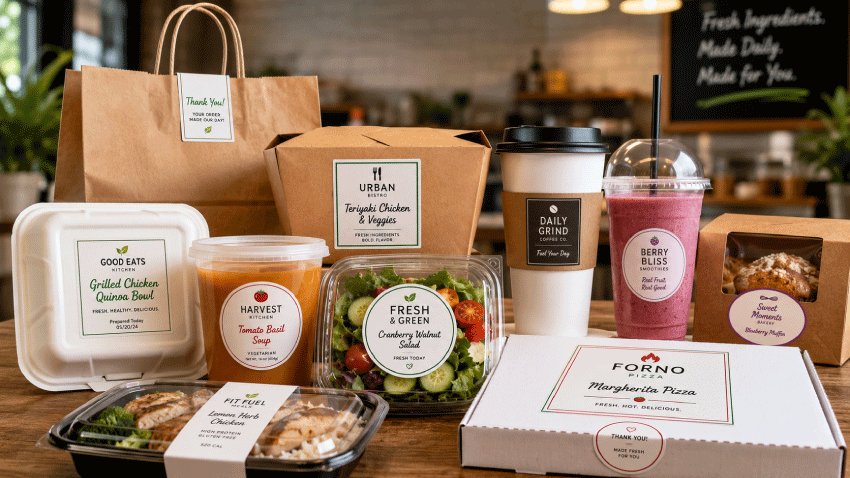
Restaurant labels help organize, identify, seal, promote, and protect food packaging throughout the preparation and delivery process. They can be used on takeout containers, delivery bags, pizza boxes, sandwich wrappers, bakery boxes, drink cups, soup containers, salad bowls, catering trays, meal-prep containers, grab-and-go foods, and many other types of restaurant packaging.
Choose from blank labels on 8.5" x 11" sheets, blank roll labels for compatible Epson, Primera, and Afinia inkjet label printers, or custom printed roll labels produced with your artwork. Restaurant labels are available in true rectangle, square, circle, and oval shapes, with material choices that include white matte, semi-gloss, high gloss, clear, brown kraft, removable, waterproof film, and other specialty options.
Whether you operate a restaurant, café, coffee shop, bakery, deli, food truck, ghost kitchen, meal-prep business, catering company, convenience store, grocery prepared-food department, or farmers market booth, labels can make food packaging easier to identify and more professional for customers.
Because restaurant packaging may be paper, cardboard, plastic, glass, metal, coated, refrigerated, frozen, greasy, moist, or frequently handled, always test the exact label material on the actual package before placing a large order.
Shop Restaurant Labels
Choose the format that fits your printer, packaging, production volume, and application process.
Shop Blank Sheet Labels Shop Blank Roll Labels Shop Custom Printed Labels
Why Choose Our Restaurant Labels?
Sheet & Roll FormatsChoose standard sheets for desktop printers or rolls for compatible production label printers and applicators. |
Laser & Inkjet CompatibleSelect materials manufactured for desktop laser printers, desktop inkjet printers, or dedicated inkjet roll-label printers. |
Many Sizes & ShapesChoose true rectangles, squares, circles, and ovals for boxes, bags, cups, bowls, clamshells, jars, bottles, and trays. |
Waterproof OptionsUse moisture-resistant or waterproof materials for refrigerated, frozen, greasy, damp, or frequently handled packages. |
Short or Large RunsPrint small batches for daily specials or seasonal menus, or support larger production with roll labels and custom printing. |
Samples AvailableTest size, material, print quality, adhesion, refrigeration performance, and appearance on the actual food package. |
Need help choosing a restaurant label? Consider the package material, application temperature, storage conditions, moisture, grease, refrigeration, and how much product information must fit on the label.
Sheet Labels, Roll Labels or Custom Printed Restaurant Labels?
| Feature | Blank Sheet Labels | Blank Roll Labels | Custom Printed Labels |
|---|---|---|---|
| Best for | Small restaurants, daily specials, seasonal menus, samples, and short runs | Growing production, variable printing, delivery operations, and larger in-house runs | Established branding, repeat packaging, retail foods, and ready-to-apply labels |
| Who prints the labels? | You print them | You print them | We print them for you |
| Typical printer | Desktop laser or inkjet printer | Epson ColorWorks, Primera, or Afinia | No printer required |
| Production flexibility | Excellent for changing dates, menu items, prices, ingredients, and order details | Excellent for variable data, order identification, and repeat production | Best when the main artwork and branding remain consistent |
| Application | Usually applied by hand | Applied by hand or with compatible equipment | Applied by hand or with compatible equipment |
| Shop | Shop Sheet Labels | Shop Roll Labels | Shop Custom Printed Labels |
Restaurant Labels by Application
| Restaurant Application | Common Label Placement | Popular Label Styles |
|---|---|---|
| Takeout containers | Lid, front panel, closure edge, or sidewall | Rectangle, square, oval, or circle labels |
| Food delivery bags | Bag opening, handle area, front panel, or receipt area | Rectangle seals, branding labels, and order labels |
| Pizza boxes | Top panel, front flap, side panel, or box seal | Large rectangles, circles, and promotional labels |
| Soup cups and containers | Lid, sidewall, or closure area | Circle lid labels and rectangle side labels |
| Drink cups | Sidewall, lid, sleeve, or cup seal | Circle, oval, square, or small rectangle labels |
| Sandwiches and wraps | Wrapper seam, bag closure, box, or ingredient panel | Rectangle seals and product-identification labels |
| Bakery boxes and bags | Top panel, bag closure, window edge, or side panel | Rectangle, square, circle, and oval labels |
| Salad and deli containers | Lid, sidewall, bottom, or closure edge | Rectangle, oval, and circle labels |
| Meal-prep containers | Lid, front panel, side panel, or sleeve | Large rectangles for nutrition, ingredients, and reheating directions |
| Catering trays | Lid, tray cover, foil wrap, or outer carton | Large rectangles and color-coded identification labels |
| Grab-and-go foods | Front panel, lid, sidewall, or package seal | Product labels, price labels, barcode labels, and freshness labels |
| Take-home beverage bottles | Bottle body, neck, cap, bag seal, or closure area | Rectangle, oval, and circle labels |
To-Go Labels for Carryout & Food Delivery
To-go labels help identify, seal, organize, and promote carryout orders. They can be applied to clamshell containers, paper bags, plastic bags, pizza boxes, drink carriers, soup cups, bakery boxes, and other packages used for pickup or delivery.
Restaurants can use to-go labels to display:
- Restaurant name and logo
- Customer name or order number
- Menu item name
- Special instructions
- Allergy or ingredient alerts
- Pickup or delivery platform
- Prepared time
- Employee initials
- Reheating or storage directions
- Promotional messages and coupon codes
- QR codes for menus, ordering, reviews, or loyalty programs
Blank labels make it easy to print variable order information in-house, while custom printed labels provide consistent branding for every takeout and delivery package.
Labels for Delivery Bags
Delivery-bag labels can identify the restaurant, customer, order number, delivery service, and special instructions. A rectangle label placed across the bag opening can also act as a visible closure seal.
For third-party delivery services such as DoorDash, Uber Eats, and Grubhub, clear order identification can help reduce mix-ups between multiple bags or customers. Color coding, large order numbers, and clearly printed names can make busy pickup areas easier to manage.
When using a label as a bag seal, test the adhesive on the exact paper, plastic, coated, or recycled bag material. Some low-surface-energy or textured bags may require a more aggressive adhesive than standard paper packaging.
Restaurant Container Seals
Labels can be used to close or bridge the opening of takeout boxes, clamshell containers, soup cups, bakery boxes, sandwich wrappers, and other packages. A visible closure label can reassure customers that the package has remained closed after leaving the restaurant.
A container-seal label may include:
- Restaurant branding
- Order or customer name
- “Prepared for You” messaging
- Handling instructions
- Allergy alerts
- Promotional offers
- QR codes
Labels used as seals should be tested for package adhesion, opening behavior, and whether they tear, lift, or remove cleanly. Standard pressure-sensitive labels can provide a visible closure, but they should not automatically be described as certified tamper-evident packaging unless the material and application have been specifically designed and tested for that purpose.
Freshness, Date & Food Rotation Labels
Freshness and date labels help restaurant employees identify when food was prepared, opened, packaged, placed into storage, or scheduled for use. They can be applied to ingredient containers, prepared foods, grab-and-go items, bakery products, sauces, dressings, deli containers, meal-prep packages, and refrigerated products.
Common freshness-label fields include:
- Prepared date
- Prepared time
- Use-by date
- Sell-by date
- Discard date
- Opened date
- Employee initials
- Product name
- Batch or lot number
- Storage instructions
Blank sheet or roll labels allow restaurants to print dates and product information as needed. Removable labels may be useful for reusable storage containers when clean removal is important, while permanent materials may be more appropriate for retail packages that remain with the product.
Day-of-the-Week Restaurant Labels
Day-of-the-week labels can support food rotation and storage organization by providing quick visual identification. Restaurants may use a different color, icon, or printed day name for each day of the week.
These labels can be used on:
- Ingredient bins
- Sauce containers
- Deli products
- Prepared foods
- Bakery items
- Grab-and-go packaging
- Meal-prep containers
- Refrigerated and frozen storage containers
When labels will be removed from reusable containers, test the adhesive to confirm that it removes as expected after refrigeration, freezing, moisture exposure, and washing.
Promotional Labels for Carryout Orders
Restaurant labels can turn ordinary takeout packaging into an additional marketing opportunity. A promotional label can be placed on food containers, delivery bags, receipts, pizza boxes, bakery boxes, drink carriers, and catering packages.
Promotional restaurant labels may feature:
- Coupon or discount codes
- Loyalty program information
- QR codes for online ordering
- Social-media accounts
- Review requests
- Catering information
- Limited-time menu items
- Upcoming events
- Holiday specials
- New location announcements
Blank labels allow promotions to change frequently, while custom printed labels are useful for recurring loyalty programs, standard review requests, branded seals, and long-running offers.
Labels for Take-Home Wine & Beverage Packaging
Restaurants may use labels on take-home beverage bottles, growlers, sealed beverage containers, and outer bags to identify the contents, customer, order, date, or restaurant. Labels can also be placed across a bag opening or closure area as a visible seal.
The restaurant is responsible for following the laws and packaging requirements that apply to alcoholic beverages, take-home containers, transportation, and local sales. A standard pressure-sensitive label should not be assumed to satisfy a specific legal sealing or tamper-evident requirement unless the complete packaging system has been evaluated for that use.
Meal Prep Labels
Meal prep labels help identify individual meals, ingredients, portion sizes, nutrition details, preparation dates, storage instructions, and reheating directions. They are useful for meal-prep companies, fitness-focused food services, restaurants offering weekly meal packages, personal chefs, caterers, and grab-and-go food programs.
Depending on the container size and the amount of information required, meal-prep labels may be placed on the lid, front edge, sidewall, bottom, or a paper sleeve wrapped around the package.
Common information printed on meal-prep labels includes:
- Meal name
- Main ingredients
- Allergen information
- Nutrition facts
- Calories and macronutrients
- Net weight or portion size
- Prepared date
- Use-by date
- Refrigeration or freezing instructions
- Microwave or oven reheating directions
- Customer name or subscription plan
- Barcode, QR code, lot number, or batch code
Large rectangle labels are often useful because they provide enough room for branding, product information, ingredients, nutrition details, and reheating directions. Smaller circle, square, or oval labels can be used for logos, flavor identification, meal categories, or color-coded diet plans.
Waterproof or moisture-resistant film labels may be helpful when containers will be refrigerated, frozen, exposed to condensation, or handled repeatedly.
Drink Cup Labels
Drink cup labels can help identify customer orders, flavors, milk selections, sweetener choices, add-ons, temperatures, and special instructions. They are commonly used by coffee shops, cafés, smoothie bars, juice bars, bubble tea shops, milkshake stands, bakeries, food trucks, and quick-service restaurants.
Drink labels may be applied to:
- Hot coffee cups
- Cold drink cups
- Smoothie cups
- Juice bottles
- Bubble tea cups
- Milkshake cups
- Drink sleeves
- Cup lids
- Sealed beverage containers
- Drink carriers
A drink cup label can display the customer name, order number, beverage type, size, temperature, dairy or non-dairy choice, flavor additions, toppings, and allergy notes. Branded labels can also display a restaurant logo, social-media information, loyalty message, or QR code.
Because cold cups may develop condensation and hot cups may be warm when labels are applied, test the selected material on the actual cup under normal service conditions. Adhesion can vary on plastic, paper, coated, textured, compostable, and waxed cup surfaces.
Coffee Shop & Café Labels
Coffee shops and cafés may use labels throughout the business, from customer-order identification to retail coffee packaging and bakery displays. Blank labels make it possible to print variable information as orders are prepared, while custom printed labels provide consistent branding for cups, bags, boxes, jars, and retail products.
Common café label applications include:
- Customer names and drink instructions
- Coffee cup branding
- Cold brew bottles
- Retail coffee bags
- Tea packaging
- Pastry bags and bakery boxes
- Sandwich and salad containers
- Syrup and ingredient containers
- Prepared and use-by dates
- Loyalty-program QR codes
For retail coffee bags, labels can identify the roast, origin, flavor notes, grind, net weight, roast date, and brewing recommendations. Visit our Coffee Bag Labels page for more packaging guidance.
Bakery Labels
Bakery labels can be used on bread bags, cookie bags, pastry boxes, cake boxes, cupcake containers, donut boxes, clamshells, jars, tins, and gift packaging. They can provide branding, product identification, ingredient information, allergens, storage instructions, freshness dates, and pricing.
Common bakery products that may require labels include:
- Bread and rolls
- Cookies
- Brownies and bars
- Donuts
- Cupcakes
- Cakes
- Pies
- Pastries
- Muffins
- Bagels
- Candy and confections
- Seasonal gift assortments
Rectangle labels work well for ingredient panels and bakery-box seals. Circle and oval labels are popular for logos, flavor names, windowed bakery packages, and decorative branding. Square labels can provide a balanced layout for logos, product names, and short descriptions.
Brown kraft labels can complement rustic, handmade, organic, and farm-style bakery branding. Clear labels can allow the package and baked goods to remain visible, while gloss labels can create a brighter retail appearance.
Deli & Prepared Food Labels
Deli and prepared-food labels help identify salads, sandwiches, meats, cheeses, sides, sauces, dips, soups, desserts, and grab-and-go meals. They can be used by restaurants, grocery stores, convenience stores, delis, markets, and institutional food-service operations.
Common deli-label information includes:
- Product name
- Ingredients
- Allergen statements
- Net weight
- Price
- Prepared date
- Sell-by or use-by date
- Storage instructions
- Barcode or PLU information
- Employee initials
Labels may be placed on clamshell lids, deli-cup lids, sidewalls, wrappers, bags, paperboard sleeves, or outer cartons. For products stored under refrigeration, test the label after the container has cooled and developed normal condensation.
Grab-and-Go Food Labels
Grab-and-go labels are used on prepackaged foods displayed in refrigerated cases, counter displays, vending areas, cafés, markets, and convenience stores. These labels may need to communicate more information than a standard restaurant order label because the customer selects the product without speaking directly to an employee.
Grab-and-go labels may include:
- Product name and description
- Ingredients and allergen information
- Nutrition information
- Net weight
- Price
- Prepared date
- Sell-by or use-by date
- Storage instructions
- Barcode
- QR code
- Restaurant or brand contact information
Choose a label size that allows important information to remain readable without covering too much of a clear package window. A separate front branding label and back ingredient label may work better than placing all information on one oversized label.
Pizza Box Labels
Pizza box labels can be used for branding, order identification, closure seals, coupon codes, reheating instructions, special offers, and customer messages. They can be placed on the top panel, front flap, side panel, or across the box opening.
Popular pizza-box label messages include:
- Restaurant name and logo
- Customer name
- Order number
- Pizza type and size
- Special topping instructions
- Allergen alerts
- Reheating instructions
- Review-request QR codes
- Loyalty-program information
- Future-order coupons
Pizza boxes may be warm, textured, recycled, dusty, or exposed to oil and steam. Test the label on the exact box material and apply it to a clean, dry area whenever possible.
Food Truck Labels
Food trucks often work with limited space, changing menus, high order volume, and multiple packaging types. Labels can help organize orders and create consistent branding without requiring every cup, bag, box, and container to be custom manufactured.
Food truck labels may be used for:
- Customer names and order numbers
- Menu item identification
- Special instructions
- Takeout bag seals
- Drink cups
- Sauce containers
- Ingredient and allergen warnings
- Social-media promotion
- QR-code menus
- Event-specific branding
Blank sheet labels are useful for short runs and changing events, while roll labels can support faster printing during high-volume service. Custom printed labels work well for standard logos, bag seals, and branded packaging used throughout the season.
Ghost Kitchen & Virtual Restaurant Labels
Ghost kitchens and virtual restaurant brands may prepare multiple concepts from the same kitchen. Clear package labeling can help employees, drivers, and customers distinguish one brand or menu from another.
Labels can identify:
- Virtual brand name
- Customer name and order number
- Delivery platform
- Menu item
- Special instructions
- Bag count
- Pickup shelf or staging area
- Allergy information
- Restaurant contact details
Different label colors, shapes, or layouts can help distinguish brands operating from the same facility. Consistent label placement can also make order verification faster before packages are handed to delivery drivers.
Catering Labels
Catering labels help identify trays, pans, boxes, beverage containers, serving supplies, and individual meals for events. They can be used for corporate lunches, weddings, private parties, school events, conferences, church functions, and other catered gatherings.
Catering labels may display:
- Event or customer name
- Menu item
- Serving quantity
- Dietary category
- Allergen information
- Hot or cold designation
- Setup instructions
- Serving time
- Reheating directions
- Tray or box number
- Delivery destination
Large rectangle labels provide room for detailed instructions and are easy to read on catering trays and cartons. Smaller color-coded labels can identify vegetarian, vegan, gluten-conscious, dairy-free, spicy, or other menu categories. Any dietary or allergen statement should accurately reflect the ingredients and preparation practices used by the restaurant.
Restaurant Labels on Sheets
Blank restaurant labels on 8.5" x 11" sheets are a practical choice for businesses that use desktop laser or inkjet printers. They are especially useful for short runs, changing menu items, daily specials, seasonal promotions, customer-order labels, freshness labels, and low-volume packaging.
Advantages of Sheet Labels
- Print labels with a common desktop printer
- Order many standard sizes and shapes
- Print a full sheet or selected labels as needed
- Change dates, prices, ingredients, and promotions frequently
- Support several menu items without ordering large quantities of each design
- Useful for start-up restaurants and smaller production runs
- Easy to apply by hand
Sheet labels are available for different printer technologies. Select a material designed for the printer you will use. Laser materials must tolerate the heat used by laser printers, while inkjet materials must accept and properly dry ink.
Restaurant Labels on Rolls
Blank roll labels are useful for restaurants and food businesses that need to print labels more frequently or in larger quantities. Compatible color inkjet roll-label printers can produce full-color branding, variable text, barcodes, QR codes, dates, order information, and product details on demand.
Advantages of Roll Labels
- Efficient printing for frequent or larger production runs
- Print one label at a time without wasting a sheet
- Useful for variable data and changing food information
- Available in many widths, lengths, shapes, materials, and roll configurations
- Can support hand application or compatible label applicators
- Suitable for growing meal-prep, catering, deli, bakery, and grab-and-go operations
Our inkjet roll labels are available in configurations for many Epson ColorWorks, Primera, and Afinia printers. Printer compatibility depends on the label width, roll width, core size, outside diameter, gap, sensing method, and unwind direction.
Before ordering, confirm:
- Printer model
- Maximum and minimum media width
- Core size
- Maximum roll outside diameter
- Gap or black-mark sensing requirements
- Label orientation
- Material compatibility
Custom Printed Restaurant Labels
Custom printed restaurant labels are delivered with your artwork, logo, colors, and standard message already printed. They are a good choice when the primary design remains consistent and the restaurant wants professional labels ready to apply without printing them in-house.
Custom printed labels can be used for:
- Restaurant logos and branding
- Takeout bag seals
- Food container labels
- Pizza box labels
- Bakery and deli packaging
- Catering boxes and trays
- Retail sauces, dressings, spice blends, and packaged foods
- Coffee cups and beverage bottles
- Promotional offers
- QR codes and loyalty programs
- Review requests
- Standard handling or reheating instructions
Custom printing is especially useful when every package needs the same logo or message. Blank labels may be a better choice when the restaurant must add frequently changing information such as order numbers, customer names, dates, prices, ingredients, or batch codes.
Some businesses use both options: a custom printed label for the main brand and a smaller blank label for variable product or order information.
Choosing the Best Restaurant Label Material
The best restaurant label material depends on the package surface, printer, storage environment, moisture exposure, grease, temperature, handling, and desired appearance. A label that performs well on a dry paper bakery box may not be the best choice for a cold plastic container covered with condensation.
| Material | Appearance | Common Restaurant Uses |
|---|---|---|
| White Matte | Non-gloss white finish with easy-to-read text | Order labels, ingredient labels, freshness labels, bakery boxes, and general food packaging |
| Semi-Gloss | Smooth finish with moderate shine | Branded takeout packaging, retail foods, deli containers, and promotional labels |
| High Gloss | Bright, polished appearance | Retail food packaging, beverage products, sauces, bakery items, and premium branding |
| Brown Kraft | Natural brown paper appearance | Bakeries, cafés, farm-to-table restaurants, handmade foods, and rustic packaging |
| Clear | Allows the package or product to show through | Clear cups, bakery windows, jars, bottles, and minimal product branding |
| Waterproof Film | Durable film surface | Refrigerated meals, frozen foods, beverage bottles, moist containers, and frequently handled packages |
| Removable | Designed for cleaner removal on suitable surfaces | Reusable food-storage containers, temporary date labels, and short-term identification |
White Matte Restaurant Labels
White matte labels provide a clean, easy-to-read surface for text, barcodes, dates, ingredients, and simple graphics. They are commonly used for everyday restaurant identification, kitchen organization, bakery boxes, food bags, ingredient containers, and takeout packaging.
Semi-Gloss Restaurant Labels
Semi-gloss labels provide a smoother and slightly more polished appearance than matte paper. They are useful for branded food containers, deli packaging, bakery items, promotional labels, and retail products where a moderate sheen is preferred.
High-Gloss Restaurant Labels
High-gloss labels can create a bright retail appearance for sauces, beverages, packaged foods, desserts, and premium takeout products. Glossy surfaces can enhance color and graphics, but the selected material must be compatible with the intended printer and ink system.
Learn More About High-Gloss Labels
Brown Kraft Restaurant Labels
Brown kraft labels provide a natural paper appearance that can complement bakery boxes, coffee bags, paper takeout containers, farmers-market packaging, farm-to-table branding, and handmade food products.
Print colors may appear differently on brown kraft than on white material because the label background affects the final appearance. Light colors and white areas in the artwork may not reproduce the same way unless the printing process specifically supports white ink.
Clear Restaurant Labels
Clear labels allow the food package, cup, jar, bottle, or printed box to remain visible through unprinted portions of the label. They can create a clean, minimal appearance on transparent containers and windowed packaging.
Transparent labels do not make printed ink opaque. Dark package colors, food colors, or background graphics may show through the printed design. Test artwork on the actual package before ordering a large quantity.
Removable Restaurant Labels
Removable labels may be useful for temporary identification, date coding, food rotation, reusable ingredient bins, and storage containers. Removal performance depends on the container surface, adhesive, application time, temperature, moisture, washing, and length of use.
A label described as removable should still be tested under the restaurant’s actual conditions. Refrigeration, freezing, heat, grease, and long-term application can affect how cleanly a label removes.
Waterproof Restaurant Labels
Waterproof restaurant labels are useful when packaging may be exposed to condensation, refrigeration, freezing, spills, ice, steam, grease, or frequent handling. Film-based materials generally offer better moisture resistance than standard paper labels, but the complete label system—including the adhesive, ink, printer, package surface, and application conditions—must be suitable for the intended use.
Common applications include:
- Refrigerated meal-prep containers
- Frozen food packaging
- Cold beverage bottles and cups
- Salad and deli containers
- Sauce and dressing bottles
- Soup and liquid-food containers
- Seafood packaging
- Catering trays stored in coolers
- Products displayed on ice
- Frequently handled grab-and-go foods
Apply labels to a clean, dry surface whenever possible. Even a waterproof face material may not adhere properly if the package is already wet, greasy, frosted, or covered with condensation at the time of application.
What Information Should Be Included on Restaurant Labels?
The information needed on a restaurant label depends on whether the package is being used for an immediate customer order, internal kitchen storage, delivery, catering, meal prep, or retail sale. A simple takeout label may only require a customer name and order number, while a packaged retail food may require ingredients, allergens, net contents, nutrition information, dates, and business identification.
Branding Information
- Restaurant name
- Logo
- Tagline
- Website
- Phone number
- Social-media accounts
- Location information
Product Information
- Menu item or product name
- Flavor or variety
- Ingredients
- Allergen information
- Net weight or portion size
- Nutrition information
- Dietary characteristics
- Preparation or serving instructions
- Storage directions
- Reheating instructions
Operational Information
- Customer name
- Order number
- Pickup or delivery time
- Delivery platform
- Prepared date and time
- Use-by, sell-by, or discard date
- Employee initials
- Batch or lot number
- Container or tray number
- Special instructions
Marketing Information
- Coupon code
- Loyalty-program message
- Review request
- QR code
- Online-ordering information
- Catering promotion
- Seasonal offer
- Upcoming event
Restaurants and food businesses are responsible for determining which labeling laws, food-safety rules, allergen requirements, alcohol regulations, and packaging standards apply to their products and location.
Ingredient & Allergen Labels
Ingredient and allergen labels can help customers and employees identify what is contained in a prepared food. They are especially important for meal-prep containers, bakery products, deli foods, catering meals, grab-and-go products, sauces, dressings, and other packaged foods.
Depending on the product and applicable requirements, the label may need to identify ingredients or allergens such as:
- Milk
- Eggs
- Fish
- Crustacean shellfish
- Tree nuts
- Peanuts
- Wheat
- Soy
- Sesame
Do not rely on label color alone to communicate an allergy or dietary warning. Important information should be stated clearly in readable text and verified against the actual recipe and preparation process.
Dietary & Special-Order Labels
Restaurants can use labels to help identify special orders and dietary requests during food preparation, packaging, pickup, and delivery. Common categories include vegetarian, vegan, gluten-conscious, dairy-free, nut-free, low-sodium, spicy, mild, keto-style, and high-protein meals.
Labels may use words, icons, colors, or a combination of these methods. Printed text should remain the primary identifier, especially when similar colors could be confused in a busy kitchen.
A dietary label should accurately reflect the ingredients and preparation practices used. For example, a menu item prepared without gluten-containing ingredients may still be exposed to cross-contact in a shared kitchen. Restaurants should use wording that accurately represents their procedures.
Barcode Labels for Restaurant & Retail Foods
Barcodes can be printed on restaurant labels for grab-and-go products, retail sauces, packaged desserts, coffee bags, deli items, meal-prep containers, and other foods sold through a point-of-sale system.
Barcode labels may support:
- Checkout scanning
- Inventory tracking
- Product identification
- Price lookup
- Batch tracking
- Production records
- Expiration management
For reliable scanning, use a high-contrast barcode, adequate quiet space around the code, and a label size large enough to reproduce the bars clearly. Avoid placing barcodes over package seams, curves, wrinkles, transparent areas with changing backgrounds, or highly reflective surfaces unless the design has been tested.
QR Code Labels for Restaurants
QR codes allow restaurants to connect physical packaging with online information. A QR code can be printed on takeout bags, food containers, drink cups, pizza boxes, bakery boxes, menus, catering packages, and retail food labels.
Restaurant QR codes may link to:
- Online ordering
- Digital menus
- Loyalty programs
- Customer reviews
- Social-media pages
- Catering information
- Reheating instructions
- Ingredient details
- Nutrition information
- Promotional offers
Test every QR code at the final printed size using multiple phones before placing a large order. The code should have strong contrast, adequate clear space, and enough size to scan easily from the expected distance.
Choosing the Best Restaurant Label Shape
The best label shape depends on the package, available space, amount of information, and desired appearance. LaserInkjetLabels.com offers true rectangles, squares, circles, and ovals for restaurant packaging.
| Shape | Best Uses | Advantages |
|---|---|---|
| Rectangle | Ingredient panels, order labels, seals, meal-prep containers, bags, boxes, and trays | Provides the most usable space for text, barcodes, instructions, and branding |
| Square | Logos, bakery boxes, deli containers, cups, jars, and retail foods | Balanced shape that works well for centered branding and short product descriptions |
| Circle | Cup lids, soup lids, bakery packages, jars, bottles, and logo labels | Creates a strong focal point and fits many round lids and containers |
| Oval | Salad containers, bakery packaging, bottles, jars, and decorative branding | Provides a softer appearance while offering more horizontal space than a circle |
Do not assume the package shape determines the label shape. A rectangle label may work better than a circle on a round lid when more ingredient information is required, while a small circle may be ideal for a simple logo or flavor identifier.
How to Measure Restaurant Packaging for Labels
Measure the actual container rather than relying only on dimensions provided by the packaging supplier. Manufacturing tolerances, curves, seams, ridges, handles, windows, tapers, and closure areas can reduce the usable labeling space.
1. Identify the Labeling Area
Choose a clean, reasonably flat area that will remain visible after the package is filled, closed, stacked, refrigerated, or placed into a delivery bag.
2. Measure the Usable Width
Measure from edge to edge of the flat area. Leave space around hinges, seams, corners, ridges, handles, folds, vents, and package openings.
3. Measure the Usable Height
Measure only the area where the label can remain flat. On tapered cups, bowls, jars, and bottles, the usable height may be smaller than the overall wall height.
4. Account for Curves
Labels applied to curved containers may wrinkle or lift if they are too large. Smaller labels or more flexible film materials may perform better on tight curves.
5. Check Package Closure
For labels used as seals, measure the distance across the opening, flap, lid edge, or bag fold. Confirm that enough label area will adhere securely on both sides.
6. Print a Paper Mockup
Print the proposed design at actual size on plain paper, cut it out, and place it on the package. Confirm that the text is readable and the label does not interfere with opening, stacking, barcodes, windows, or required package information.
7. Test Samples
Apply sample labels to filled containers and evaluate them under actual operating conditions, including refrigeration, freezing, warming, condensation, delivery, stacking, and customer handling.
Restaurant Label Application Tips
Apply Labels to Clean, Dry Surfaces
Food residue, flour, oil, grease, steam, condensation, frost, and dust can prevent proper adhesion. Wipe the package and allow it to dry before applying the label whenever possible.
Apply at the Recommended Temperature
Many adhesives bond best when the label and package are applied at room temperature. Applying a standard label directly to a frozen, wet, or very cold container may reduce adhesion.
Allow the Adhesive Time to Bond
Pressure-sensitive adhesives may strengthen after application. When possible, apply labels before the package enters refrigeration or freezing so the adhesive has time to develop a stronger bond.
Use Firm, Even Pressure
Press across the full label surface, especially along edges and corners. For labels used as seals, press firmly on both sides of the closure.
Avoid Seams and Ridges
Package seams, molded ridges, wrinkles, corners, and curved transitions reduce the amount of adhesive touching the surface. Choose a flat area whenever possible.
Do Not Apply Over Grease or Condensation
Waterproof material does not compensate for a wet or greasy surface during application. The adhesive still needs direct contact with the package.
Test After Refrigeration or Freezing
Evaluate whether the label remains attached, readable, and scannable after the product reaches its normal storage temperature.
Test Reusable Containers Separately
When labels will be applied to reusable food containers, test whether they remove as desired after refrigeration, freezing, washing, and repeated use.
Restaurant Label Printing Tips
- Use a label material designed for your exact printer type.
- Confirm that the sheet or roll dimensions fit the printer.
- Print one test sheet or a few test labels before running the full job.
- Use dark text on a light background for important operational information.
- Keep small text large enough to read under typical restaurant lighting.
- Leave adequate margins around barcodes and QR codes.
- Use consistent placement for customer names, order numbers, and allergy alerts.
- Store labels in a clean, dry area away from excessive heat and humidity.
- Allow ink to dry fully before stacking or applying labels.
- Verify that dates, ingredients, prices, and promotional codes are current before printing.
Frequently Asked Questions About Restaurant Labels
What are restaurant labels used for?
Restaurant labels are used to identify, organize, seal, brand, date, and promote food packaging. Common applications include takeout containers, delivery bags, meal-prep packages, bakery boxes, deli containers, drink cups, catering trays, pizza boxes, ingredient bins, and grab-and-go foods.
Can I print restaurant labels myself?
Yes. Blank restaurant labels are available on sheets for compatible desktop laser and inkjet printers and on rolls for compatible Epson ColorWorks, Primera, and Afinia inkjet label printers.
Are custom printed restaurant labels available?
Yes. Custom printed labels can be produced with your restaurant logo, artwork, colors, standard text, QR code, promotional message, or other supplied design and delivered ready to apply.
Should I use sheet labels or roll labels?
Sheet labels are often best for smaller quantities, changing menu items, daily specials, and desktop printing. Roll labels are useful for more frequent production, one-at-a-time printing, variable data, and compatible production label printers.
What is the best label material for takeout containers?
The best material depends on the container surface, temperature, moisture, grease, storage conditions, and printer. White matte paper may work well for dry paper packaging, while waterproof film may be more suitable for refrigerated, frozen, damp, or frequently handled containers.
Can restaurant labels be refrigerated or frozen?
Some restaurant label materials and adhesives are designed for refrigerated or frozen applications. Performance depends on the package surface, application temperature, moisture, adhesive, and storage conditions, so samples should be tested on the actual container.
Are waterproof labels good for food containers?
Waterproof film labels can be a good choice for containers exposed to condensation, spills, refrigeration, freezing, ice, or frequent handling. Apply them to a clean, dry surface and test the complete label and package combination.
Can labels be applied to cold or wet containers?
Adhesion is usually more reliable when labels are applied to clean, dry containers at a suitable temperature. Applying a label to condensation, frost, grease, or moisture may prevent the adhesive from bonding properly.
Can I use labels to seal takeout bags and containers?
Yes. Rectangle labels can bridge the opening of bags, boxes, clamshells, cups, and other packages as visible closure seals. Test the label on the actual packaging to confirm adhesion and opening performance.
Are standard labels tamper-evident?
A standard pressure-sensitive label may provide a visible closure, but it should not automatically be described as certified tamper-evident packaging. A tamper-evident claim depends on the material, adhesive, package design, application, and testing of the complete system.
What size label should I use for a restaurant container?
Measure the flat usable area of the actual container and leave clearance around seams, ridges, hinges, curves, windows, and closures. Print a full-size paper mockup and test samples before ordering a large quantity.
Can restaurant labels include ingredients and allergens?
Yes. Labels can be printed with ingredients, allergen statements, nutrition information, storage directions, and other product details. The restaurant is responsible for ensuring that all information is accurate and complies with applicable requirements.
Can I print barcodes on restaurant labels?
Yes. Barcodes can be printed on compatible sheet and roll label materials for packaged foods, inventory, pricing, checkout, and product identification. Test the barcode at the final printed size and on the actual package.
Can I print QR codes on restaurant labels?
Yes. QR codes can link customers to online ordering, digital menus, loyalty programs, reviews, reheating instructions, ingredients, promotions, or social-media pages. Test the final printed code with several phones before production.
What label shapes are available?
Restaurant labels are available in true rectangles, squares, circles, and ovals. The best shape depends on the package, available space, amount of information, and desired appearance.
Are removable restaurant labels available?
Yes. Removable materials may be useful for temporary date labels and reusable food-storage containers. Removal performance should be tested after refrigeration, freezing, moisture exposure, washing, and the expected application period.
Do roll labels work with Epson, Primera, and Afinia printers?
Many roll-label configurations are available for compatible Epson ColorWorks, Primera, and Afinia printers. Confirm the printer model, media width, core size, maximum outside diameter, sensing method, label gap, material, and orientation before ordering.
Should I request samples before ordering?
Yes. Samples allow you to test label size, appearance, print quality, adhesion, refrigeration, freezing, condensation, grease exposure, barcode scanning, and removal on the actual restaurant package.
Find the Right Labels for Your Restaurant
Choose blank sheet labels for flexible desktop printing, blank roll labels for compatible production printers, or custom printed labels delivered with your restaurant branding ready to apply.
Shop Blank Sheet Labels Shop Blank Roll Labels Shop Custom Printed Labels
Not sure which material or size to choose? Request samples and test them on the actual container before ordering a full production quantity.
Related Restaurant Label Resources
- Product Labels – Explore labels for food, beverages, cosmetics, candles, jars, bottles, and other packaged products.
- Food Labels – Learn about labels for packaged foods, ingredients, nutrition information, retail products, and food containers.
- To-Go Labels – Browse label options for carryout containers, delivery bags, takeout orders, and food packaging.
- Coffee Bag Labels – Find labels for coffee shops, roasters, retail coffee bags, roast dates, and product branding.
- Candy Labels – Explore labels for candy bags, boxes, jars, wrappers, gift packaging, and confections.
- Waterproof Labels – Compare moisture-resistant label options for refrigerated, frozen, and frequently handled food packaging.
- Blank Sheet Labels – Shop labels for compatible desktop laser and inkjet printers.
- Blank Roll Labels – Shop roll labels for compatible Epson ColorWorks, Primera, and Afinia printers.
- Custom Printed Labels – Order professionally printed roll labels using your restaurant artwork and branding.
- Label Size Guides – Learn how to measure packages and choose practical label sizes for common containers.