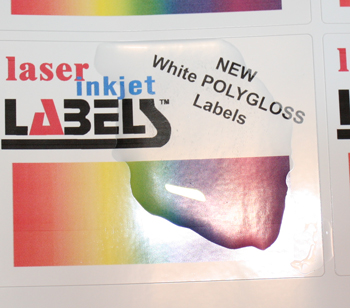
BOPP labels are polypropylene film labels used when a paper label may not provide enough moisture resistance, tear resistance, or durability. They are commonly selected for bottles, jars, food and beverage packaging, bath and body products, household products, and other containers that may be handled frequently.
The right BOPP label depends on more than the film itself. Choose the format, print coating, adhesive, finish, and printer compatibility for the actual package and use conditions.
Quick answer: BOPP stands for biaxially oriented polypropylene. Choose sheets for desktop printing and shorter runs, or rolls for compatible roll-label printers and higher-volume workflows. BOPP film is moisture-resistant, but the finished label is only as durable as its adhesive, printable coating, ink or toner, and exposure conditions.
What Are BOPP Labels?
BOPP is short for biaxially oriented polypropylene. During manufacturing, polypropylene film is stretched in two directions to improve its strength, clarity, and dimensional stability. In pressure-sensitive labels, BOPP is used as the face material and is paired with a printable coating, adhesive, and release liner.
Compared with ordinary paper labels, a suitable BOPP construction can provide better resistance to moisture, tearing, oils, and routine handling. Performance varies by product, so do not assume every polypropylene label uses the same adhesive, coating, printer technology, or environmental rating.
BOPP Label Sheets vs BOPP Roll Labels
| Format | Best For | Compatibility Checks | Shop |
|---|---|---|---|
| Sheeted BOPP labels | Desktop printing, prototypes, seasonal products, and short-to-medium runs | Confirm the sheet material is made for your inkjet or laser printer. For inkjet White PolyGloss, pigment ink provides the expected print adhesion and durability. | Shop White PolyGloss sheets |
| BOPP roll labels | Dedicated color roll printers, barcode printers, dispensers, applicators, and higher-volume production | Verify printer model, ink or ribbon system, label width, core size, outside diameter, unwind direction, and sensing method. | Shop blank roll labels |
| Custom printed BOPP rolls | Finished product labels supplied ready to apply | Confirm finish, adhesive, container surface, label dimensions, artwork, and real-use conditions. | Shop custom printed roll labels |

White, Clear, Gloss, or Matte BOPP?
- White gloss: provides an opaque white background and strong color contrast for product branding.
- White matte: reduces glare and gives text and muted designs a softer appearance.
- Clear: allows the container or product color to show through for a no-label look. White ink may be needed in professionally printed designs when opaque color is required.
- Specialty constructions: may add different adhesives, topcoats, or resistance properties. Check the individual product specifications rather than selecting by appearance alone.
Are BOPP Labels Waterproof?
BOPP film does not absorb water like paper, so it is a strong choice for moisture-resistant labels. That does not automatically make every finished label waterproof. Water can still affect an incompatible ink, toner layer, topcoat, or adhesive. Submersion, condensation, refrigeration, oils, chemicals, sunlight, and abrasion create different demands.
For wet or demanding applications, test the complete printed label on the actual container. Include the planned printer, ink or toner, drying time, application temperature, and exposure conditions in the test.
Common Uses for BOPP Labels
- Food jars, sauce bottles, beverage containers, and refrigerated packaging
- Candles, bath products, cosmetics, soaps, and personal-care packaging
- Cleaning products, household goods, and containers exposed to oils or splashes
- Product identification, barcodes, QR codes, ingredient panels, and branded packaging
Packaging requirements vary. If a label will be used on food, cosmetics, chemicals, or another regulated product, confirm that the complete label construction and printed information meet the requirements for that application.
How to Choose the Right BOPP Label
- Start with the printer and format. Determine whether you need desktop sheets, blank rolls, or finished custom-printed rolls.
- Measure the application area. Avoid seams, tight curves, shoulders, ridges, and other areas that can encourage edge lift.
- Identify the container surface. Glass, PET, HDPE, polypropylene, coated paperboard, and textured surfaces can require different adhesives.
- List the exposures. Consider moisture, refrigeration, oils, chemicals, sunlight, abrasion, and temperature changes.
- Choose the appearance. Compare white, clear, matte, and gloss finishes against the actual container and artwork.
- Request samples and test. Apply and print the exact material before ordering a large quantity.
Printing Tips for Blank BOPP Labels
- Use only material designed for the printer technology and model.
- For inkjet printing, confirm whether pigment ink is required and allow the print to dry before handling.
- For laser printing, use the media setting recommended for the label construction and avoid products not rated for laser heat.
- For roll printers, verify the media setting or color profile and check fine text, barcodes, solid colors, and gradients.
- Print one sample and test adhesion, smudging, water exposure, and edge lift before running the full job.
Request label samples if you need to test a BOPP material with your printer and package.
Frequently Asked Questions
What does BOPP stand for?
BOPP stands for biaxially oriented polypropylene, a polypropylene film stretched in two directions to improve strength, clarity, and dimensional stability.
What is the difference between BOPP and paper labels?
BOPP is a synthetic film that generally offers better moisture and tear resistance than ordinary paper. The exact performance still depends on the printable coating, adhesive, ink or toner, and exposure conditions.
Can BOPP labels be printed with inkjet and laser printers?
Yes, when the specific BOPP construction is made for that printer technology. Always check the product specifications. Inkjet White PolyGloss should be printed with pigment ink for the expected adhesion and durability.
Are BOPP labels waterproof?
The BOPP film itself is moisture-resistant, but the finished label is not automatically waterproof. Ink, toner, topcoat, adhesive, application surface, and exposure conditions all affect durability.
Should I choose BOPP label sheets or rolls?
Choose sheets for desktop printing and shorter runs. Choose rolls for compatible roll-label printers, dispensers, applicators, or higher-volume production.
Can I get BOPP labels custom printed?
Yes. Custom printed roll labels are available when you want finished labels supplied ready to apply. Confirm the finish, adhesive, size, artwork, and package surface before ordering.