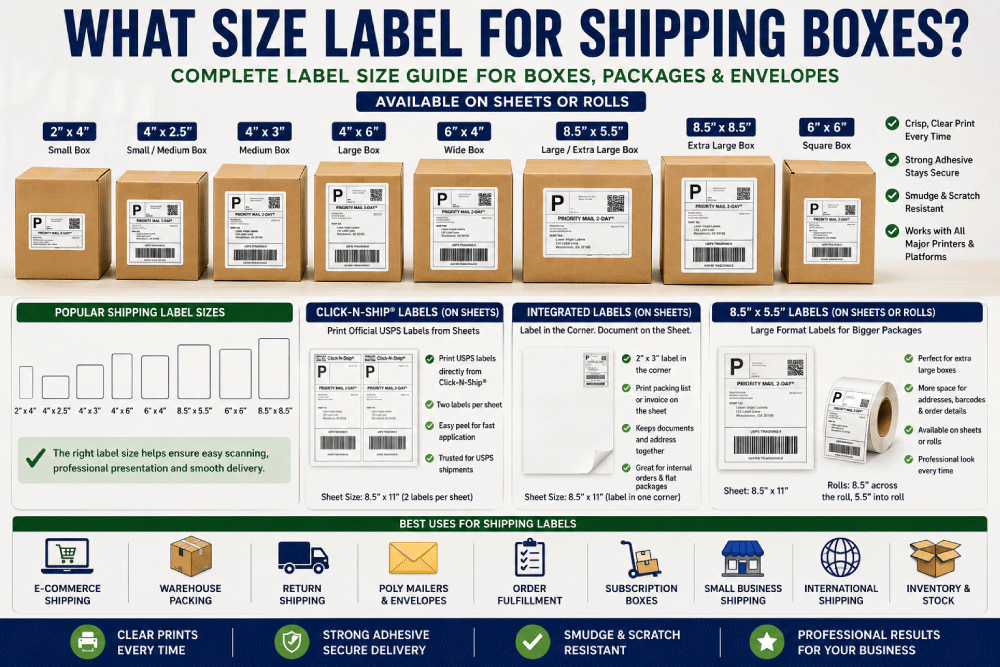
What Size Label for Shipping Boxes?
Shipping boxes, mailers, cartons, and fulfillment packages need labels that are easy to read, easy to scan, and sized correctly for the package. The best label size depends on the carrier, box size, shipping method, printer type, and whether the label is being used for postage, an address label, a barcode label, a packing slip, an inventory label, or a return label.
This guide covers common label sizes for small shipping boxes, ecommerce cartons, USPS Priority Mail boxes, UPS and FedEx packages, Click-N-Ship® style labels, integrated labels, return labels, packing list labels, and warehouse identification labels. Use these recommendations as a starting point, then measure your actual box or mailer before ordering labels.
Common Shipping Box Label Sizes
| Shipping Package Type | Common Label Sizes | Typical Label Use |
|---|---|---|
| Small shipping boxes | 2" x 4", 3" x 4", 4" x 3" | Address labels, product ID labels, barcode labels, small return labels |
| Standard ecommerce boxes | 4" x 6", 4" x 5", 3" x 5" | Carrier shipping labels, order labels, fulfillment labels |
| Large shipping cartons | 4" x 6", 5" x 6", 5" x 8", 6" x 6" | Large address labels, carton ID labels, pallet or warehouse labels |
| USPS Click-N-Ship® labels | Click-N-Ship Labels | Shipping labels printed from Click-N-Ship or similar postage platforms |
| UPS and FedEx shipping labels | 4" x 6", 5" x 6", 4" x 9" | Carrier-compliant labels with barcode, service level, and destination information |
| Integrated label forms | 8.5" x 11" sheet with peel-out label | Packing list printed on paper with a peel-off shipping, address, or return label |
| Return labels | 3" x 4", 4" x 5", 4" x 6" | Return shipping labels, exchange labels, customer service labels |
| Warehouse and inventory cartons | 2" x 4", 3" x 5", 4" x 6", 5" x 8" | Bin labels, carton ID labels, barcode labels, routing labels |

Shipping Box Labels by Package Type
| Shipping Package | Description | Recommended Label Sizes |
|---|---|---|
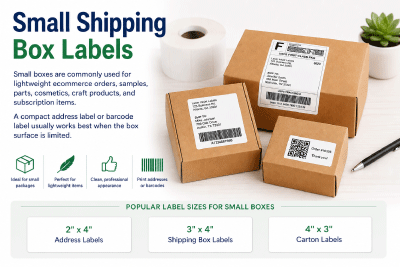 |
Small Shipping Box LabelsSmall boxes are commonly used for lightweight ecommerce orders, samples, parts, cosmetics, craft products, and subscription items. A compact address label or barcode label usually works best when the box surface is limited. |
|
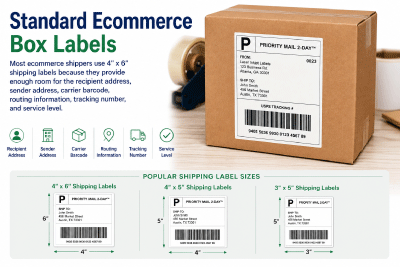 |
Standard Ecommerce Box LabelsMost ecommerce shippers use 4" x 6" shipping labels because they provide enough room for the recipient address, sender address, carrier barcode, routing information, tracking number, and service level. |
|
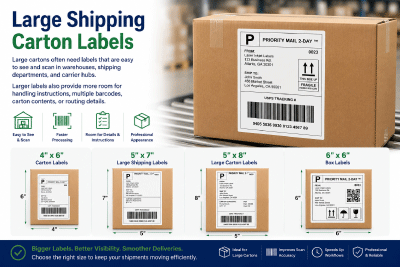 |
Large Shipping Carton LabelsLarge cartons often need labels that are easy to see and scan in warehouses, shipping departments, and carrier hubs. Larger labels also provide more room for handling instructions, multiple barcodes, carton contents, or routing details. |
Click-N-Ship® Labels for Shipping Boxes
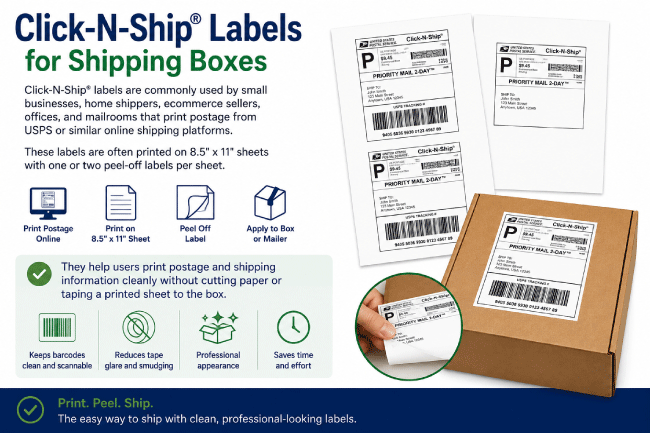
Click-N-Ship® labels are commonly used by small businesses, home shippers, ecommerce sellers, offices, and mailrooms that print postage from USPS or similar online shipping platforms. These labels are often printed on 8.5" x 11" sheets with one or two peel-off labels per sheet.
They help users print postage and shipping information cleanly without cutting paper or taping a printed sheet to the box. After printing, the label is peeled from the sheet and applied directly to the shipping box or mailer. This helps keep barcodes clean, reduces tape glare, and gives packages a more professional appearance.
Integrated Labels for Packing Lists and Shipping Documents
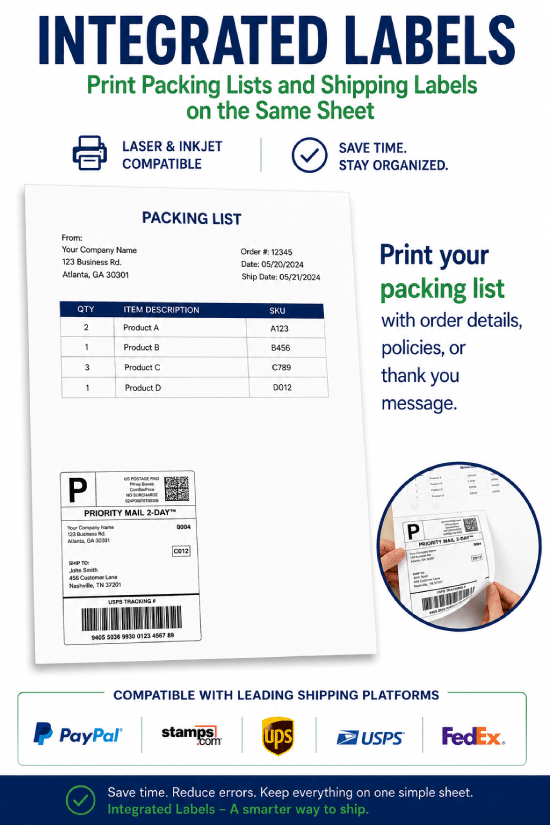
Integrated labels are full 8.5" x 11" sheets of paper with one or more peel-off labels built into the sheet. The packing list, invoice, or order details print on the paper portion, while the address, return, or shipping label prints on the peel-off label area.
Businesses use integrated labels to combine paperwork and labeling in one print step. This saves time, reduces mismatched orders, and helps keep the packing slip and shipping label connected to the same shipment. Integrated labels are especially useful for ecommerce fulfillment, warehouses, small business shipping, and companies that want the packing list and address label printed together.
- Packing list with peel-off address label
- Invoice with shipping label
- Order form with return label
- Warehouse pick sheet with carton label
- Fulfillment document with customer label

See All Label Sizes | See All Label Templates
Shipping Label Uses
- Shipping box labels
- Address labels
- Carrier shipping labels
- USPS postage labels
- Click-N-Ship style labels
- Integrated packing list labels
- Return shipping labels
- Packing slip labels
- Order fulfillment labels
- Barcode labels
- QR code labels
- Carton ID labels
- Warehouse routing labels
- Inventory labels
- Fragile and handling labels
- Batch and lot labels
- Product box labels
- Mailroom labels
Blank Sheet Labels vs. Roll Labels for Shipping Boxes
Blank sheet labels are a good choice for businesses that print shipping labels, address labels, return labels, Click-N-Ship style labels, or integrated packing documents using standard desktop inkjet or laser printers. Sheet labels are especially useful for lower-volume shipping, office mailrooms, home businesses, and ecommerce sellers who want to print labels as needed.
Blank roll labels are commonly used with compatible roll-fed label printers when shipping volume is higher or when the same size label is printed repeatedly. Roll labels are often preferred for warehouse barcode labels, carton labels, inventory labels, shipping labels, and fulfillment operations that need faster label printing.
The best choice depends on your printer, shipping volume, software, and workflow. If you print labels from a desktop printer, sheet labels and integrated labels may be the better fit. If you use a dedicated roll printer, roll labels are usually more efficient.
Shop Shipping Box Labels
LaserInkjetLabels.com offers blank sheet labels, blank roll labels, Click-N-Ship style labels, and integrated labels for shipping boxes, ecommerce packages, mailers, packing lists, return labels, warehouse labels, and fulfillment applications.
Frequently Asked Questions About Shipping Box Labels
What is the most common label size for shipping boxes?
The most common shipping label size is 4" x 6". It is widely used for USPS, UPS, FedEx, ecommerce, warehouse, and fulfillment labels because it provides enough room for addresses, tracking numbers, service information, and carrier barcodes.
What size label should I use for a small shipping box?
For small boxes, 2" x 4", 3" x 4", and 4" x 3" labels are common choices. If the label includes carrier postage and a scannable barcode, a 4" x 6" label is usually easier to read and scan.
What size label should I use for a large shipping carton?
Large cartons commonly use 4" x 6", 5" x 7", 5" x 8", or 6" x 6" labels. Larger labels are helpful when the package needs multiple barcodes, carton contents, routing details, or handling instructions.
What are Click-N-Ship labels?
Click-N-Ship labels are labels used to print USPS postage and shipping information from online shipping tools. Many small businesses use Click-N-Ship style labels on 8.5" x 11" sheets so they can print postage from a regular desktop printer and peel the label directly from the sheet.
Why use Click-N-Ship labels instead of plain paper?
Click-N-Ship labels eliminate the need to cut out a paper shipping label and tape it to the box. They save time, look more professional, reduce the chance of tape covering barcodes, and help make carrier scanning easier.
What are integrated labels?
Integrated labels are full sheets of paper with a peel-off label built into the sheet. The packing list, invoice, or order details print on the paper section, while the shipping label, address label, or return label prints on the peel-off label section.
Why do ecommerce businesses use integrated labels?
Integrated labels help combine paperwork and labeling into one print step. This can reduce packing errors, keep the packing slip and shipping label together, speed up order fulfillment, and simplify the shipping process for warehouses and ecommerce sellers.
Can integrated labels be used for return labels?
Yes. Some businesses print the customer packing slip on the paper portion and a return label on the peel-off label area. The return label can be included inside the package for easier exchanges, returns, or warranty shipments.
Are shipping labels available on sheets and rolls?
Yes. Shipping labels are available on sheets for desktop printers and on rolls for compatible roll label printers. Sheet labels are convenient for office and low-volume use, while roll labels are often better for repeated printing and higher-volume fulfillment.
Can I print shipping labels on an inkjet printer?
Yes, many sheet shipping labels can be printed on inkjet printers if the label material is inkjet-compatible. For roll labels, you need a compatible inkjet roll label printer and the correct roll specifications.
Can I print shipping labels on a laser printer?
Yes, many sheet shipping labels are available for laser printers. Be sure to choose labels made for laser printing so the adhesive and face stock can handle the printer heat.
Do I need waterproof shipping labels?
Water-resistant or weatherproof labels are helpful when boxes may be exposed to moisture, condensation, outdoor handling, or rough shipping conditions. For many indoor shipments, standard paper shipping labels are commonly used.
Can I use clear labels for shipping boxes?
Clear labels are generally not the first choice for carrier shipping labels because carrier barcodes and addresses need strong contrast for scanning and readability. White labels are usually better for postage, address, and barcode labels.
What should I measure before ordering labels for shipping boxes?
Measure the flat area where the label will be applied. Avoid seams, folds, box edges, tape lines, corners, and uneven surfaces. The label should sit flat so addresses and barcodes remain easy to read and scan.
Where should I place the shipping label on a box?
Place the shipping label on the largest flat surface of the box, away from seams, corners, folds, and tape. Barcodes should not wrap around an edge or be covered by tape, because that can make scanning difficult.
Can I use a 4" x 6" label for USPS, UPS, and FedEx?
In many cases, 4" x 6" is a standard and widely supported size for carrier shipping labels. Always check the settings in your shipping platform and printer software to confirm the exact label format required.
What is the difference between an address label and a shipping label?
An address label may only show the recipient and return address. A shipping label usually includes carrier barcodes, tracking numbers, service level, routing information, postage or billing information, and other shipment data.
Do shipping labels need to be scannable?
Yes. Carrier and warehouse shipping labels should be printed clearly so barcodes and tracking information can be scanned. Use a label size large enough for the barcode, avoid low-resolution printing, and keep tape or wrinkles away from the barcode area.
Related Label Size Guides
- Label Size Guides
- What Size Label for Coffee Bags?
- What Size Label for Honey Jars?
- What Size Label for Candle Jars?
- What Size Label for Mason Jars?
- What Size Label for Wine Bottles?
- What Size Label for Water Bottles?
- What Size Label for Vape Bottles?