What Size Label Fits an Essential Oil Bottle?
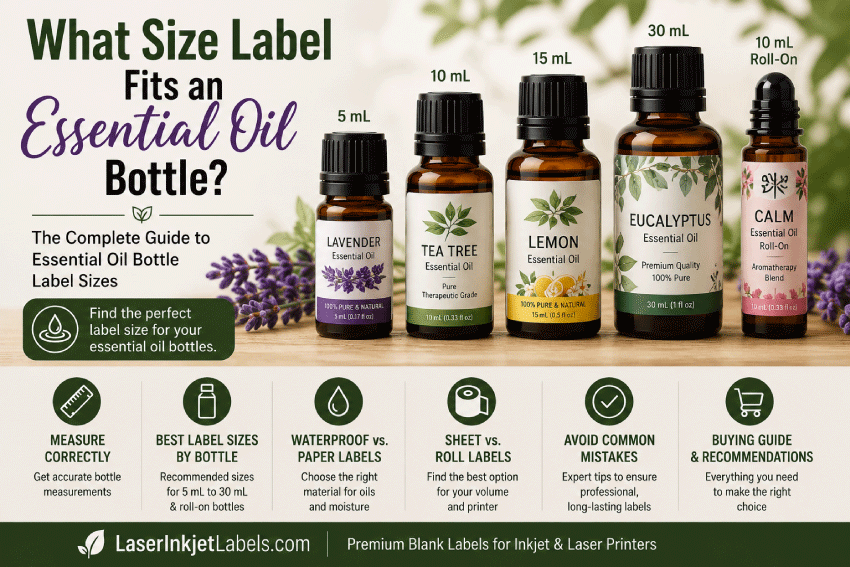
Whether you're selling handmade essential oils, aromatherapy blends, massage oils, fragrance oils or private-label wellness products, choosing the correct label size is one of the most important parts of creating a professional package. A label that is too large will wrinkle around the curved bottle, while one that is too small wastes valuable branding space.
This guide explains the most common essential oil bottle sizes, how to measure them correctly, and the best label sizes for each bottle. You'll also learn when to choose waterproof materials, whether sheet labels or roll labels are better, and which label shapes work best for different bottle styles.
At LaserInkjetLabels.com we manufacture blank labels compatible with inkjet and laser printers, giving small businesses and large manufacturers the flexibility to print professional labels on demand.
Quick Answer
The best label size depends on the bottle diameter and available straight labeling area.
| Bottle Size |
Recommended Label Size |
Common Shape |
| 5 mL |
1.25" × 1.5" |
Rectangle |
| 10 mL |
1.5" × 2" |
Rectangle |
| 15 mL |
1.5" × 2.25" |
Rectangle |
| 30 mL |
2" × 3" |
Rectangle |
| Roll-on Bottle |
1.25" × 2" |
Rectangle |
At-a-Glance Recommendations
| Best Material |
Waterproof Matte Poly |
| Indoor Products |
Premium Matte Paper |
| Oil Resistance |
Polypropylene (BOPP) |
| Best Finish |
Matte or Semi-Gloss |
| Most Popular Shape |
Rectangle with Rounded Corners |
| Recommended Printing |
Inkjet Roll Labels for production or Sheet Labels for smaller quantities |
Standard Essential Oil Bottle Sizes
Essential oils are sold in several standardized bottle sizes. Although bottle manufacturers differ slightly, most use common diameters that make selecting labels fairly straightforward.
| Bottle Size |
Typical Height |
Typical Diameter |
Common Uses |
| 5 mL |
2.4" |
0.88" |
Sample bottles, premium oils |
| 10 mL |
2.6" |
0.95" |
Most common retail size |
| 15 mL |
2.8" |
1.0" |
Therapeutic oils |
| 30 mL |
3.7" |
1.3" |
Carrier oils and blends |
| 10 mL Roll-On |
3.3" |
0.8" |
Roll-on fragrances and blends |
How to Measure an Essential Oil Bottle
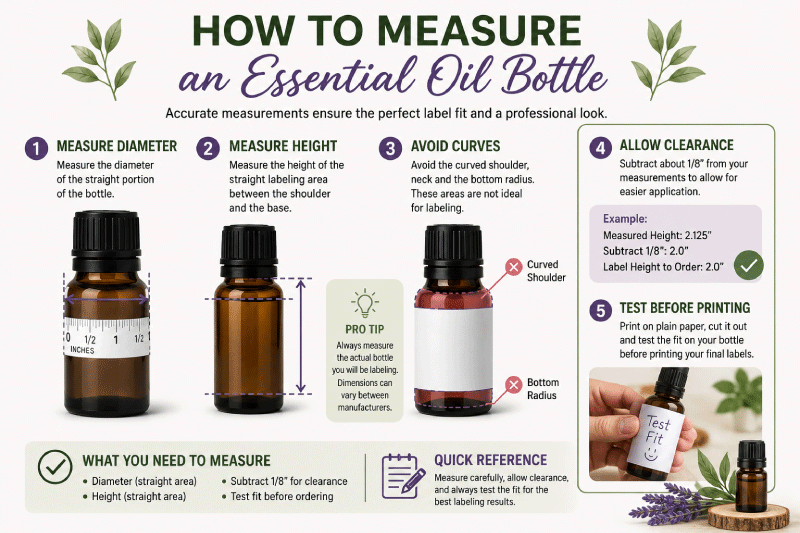
Before ordering labels, measure the bottle itself rather than relying on the advertised bottle size. Two 10 mL bottles from different manufacturers may have slightly different dimensions.
- Measure the diameter of the straight portion of the bottle.
- Measure the height available for the label.
- Avoid curved shoulders and the bottom radius.
- Subtract approximately 1/8" to allow for easier application.
- Test with plain paper before printing production labels.
Best Label Size for 5 mL Essential Oil Bottles
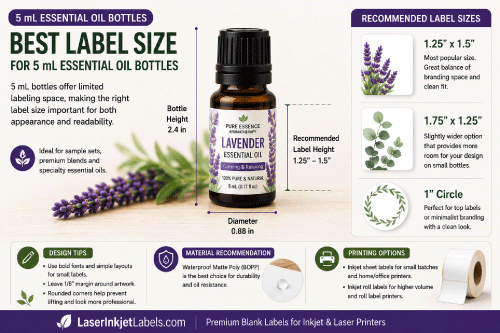
The 5 mL bottle offers limited labeling space and is commonly used for premium essential oils, sample kits and gift sets.
We recommend:
A matte waterproof material provides the best durability since bottles are frequently handled with oily hands.
Best Label Size for 10 mL Essential Oil Bottles
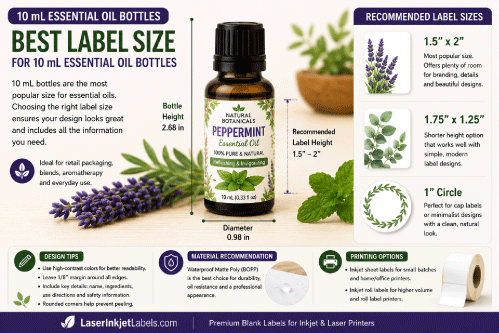
The 10 mL bottle is the industry's most popular size and offers enough surface area for branding, ingredients, safety information and barcodes.
Recommended label sizes include:
- 1.5" × 2"
- 1.25" × 1.75"
- 1" Circle (top labels)
This size balances readability while avoiding wrinkles around the bottle.
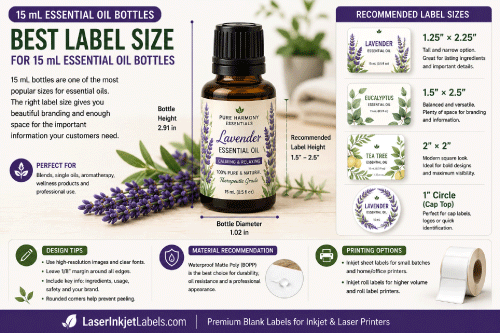
Best Label Size for 15 mL Essential Oil Bottles
Fifteen milliliter bottles are popular for therapeutic-grade essential oils and premium blends. The slightly larger bottle provides additional room for branding while still fitting comfortably in most retail displays.
Recommended label sizes:
These sizes allow enough room for product information, ingredients, directions, safety warnings and branding without wrapping excessively around the bottle.
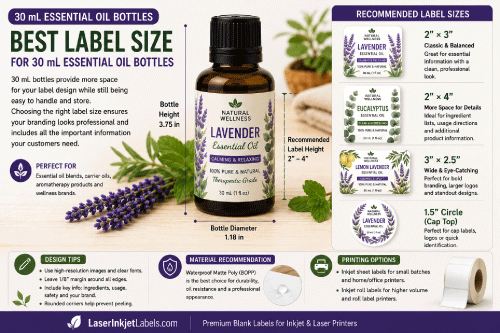
Best Label Size for 30 mL Essential Oil Bottles
Thirty milliliter bottles are commonly used for carrier oils, massage blends and larger aromatherapy products. Their increased diameter provides considerably more printable area.
Recommended label sizes:
Larger labels provide enough space for complete branding, ingredient panels, barcodes, directions and regulatory information.
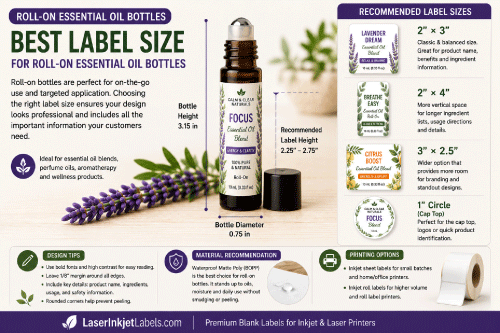
Best Label Size for Roll-On Essential Oil Bottles
Roll-on bottles are becoming increasingly popular for perfumes, aromatherapy blends and topical applications. Their narrow cylindrical shape benefits from tall, narrow labels.
Recommended sizes include:
Because these bottles are frequently handled, waterproof synthetic materials are highly recommended.
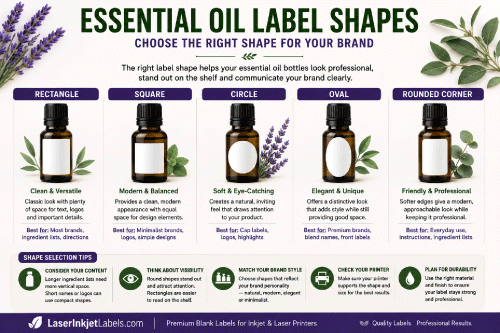
Rectangle vs. Circle Labels
Although rectangle labels are by far the most common choice for essential oil bottles, circle labels are useful for lids, caps and promotional seals.
| Label Shape |
Best Use |
| Rectangle |
Primary bottle label |
| Rounded Rectangle |
Premium appearance with easier application |
| Circle |
Cap labels and tamper seals |
| Oval |
Decorative front branding |
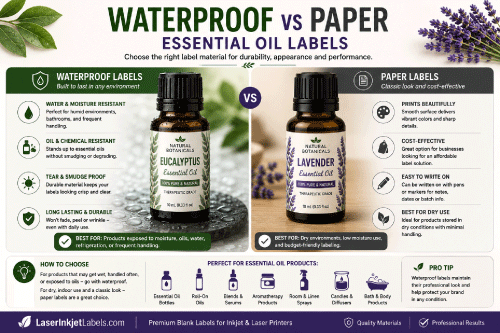
Waterproof Labels vs. Paper Labels
Essential oil bottles are regularly exposed to oils, moisture and repeated handling. Choosing the correct material significantly affects durability and appearance.
| Material |
Recommended For |
| Premium Matte Paper |
Indoor products with minimal moisture exposure |
| Semi-Gloss Paper |
Retail packaging |
| White Matte Poly BOPP |
Waterproof, oil-resistant labels |
| White PolyGloss BOPP |
Premium cosmetic appearance |
| Clear Poly |
"No-label" appearance on glass bottles |
For most essential oil manufacturers we recommend waterproof polypropylene materials because they resist moisture, oils and frequent handling much better than traditional paper labels.
Sheet Labels vs. Roll Labels
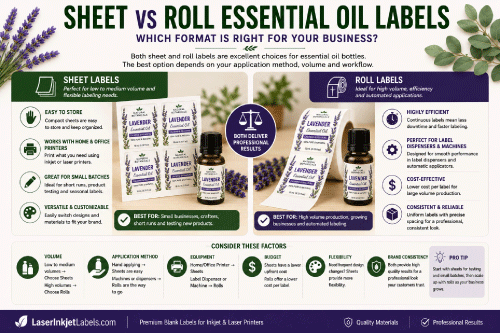
LaserInkjetLabels.com manufactures both sheet labels and roll labels. The best choice depends on your production volume.
| Sheet Labels |
Roll Labels |
| Small production runs |
Higher-volume production |
| Office inkjet & laser printers |
Dedicated roll-fed inkjet printers |
| Lower startup costs |
Faster production speeds |
| Manual application |
Manual or automatic application |
| Excellent for startups |
Excellent for growing businesses |
Common Label Design Mistakes
- Using labels that wrap onto curved bottle shoulders.
- Choosing paper materials for products exposed to oils.
- Leaving insufficient bleed around artwork.
- Using fonts that become unreadable on small bottles.
- Ignoring barcode quiet zones.
- Not testing labels on the actual bottle before production.
- Ordering large quantities before verifying printer compatibility.
Avoiding these common mistakes can dramatically improve both the appearance and durability of your finished product.
Buying Tips
Before ordering labels, verify:
- Your printer compatibility.
- The bottle dimensions.
- The required material.
- Indoor vs outdoor use.
- Whether waterproof labels are required.
- The desired finish (matte, gloss or clear).
- The application method.
Related Label Size Guides
Shop Blank Labels for Essential Oil Bottles
Whether you're printing ten bottles or ten thousand, LaserInkjetLabels.com offers premium blank sheet labels and roll labels compatible with today's leading inkjet and laser printers.
Browse Blank Labels Shop Waterproof Labels
Frequently Asked Questions About Essential Oil Bottle Labels
What is the most common essential oil bottle size?
The most common retail essential oil bottle is 10 mL. It provides enough room for branding, ingredients, directions and safety information while remaining compact and easy to ship.
What label size fits a 10 mL essential oil bottle?
A 1.5" × 2" label is one of the most popular choices. It provides excellent branding space without wrapping excessively around the bottle.
What size label fits a 5 mL bottle?
Most 5 mL bottles work well with labels measuring approximately 1.25" × 1.5" or 1" × 1.75". The exact dimensions depend on the bottle manufacturer.
Should essential oil labels be waterproof?
Yes. Since bottles are frequently handled with oily hands and may be exposed to moisture, waterproof polypropylene labels are generally the best choice.
What material is best for essential oil bottle labels?
White Matte Poly BOPP and White PolyGloss BOPP are excellent choices because they resist oils, moisture and abrasion while maintaining excellent print quality.
Can I print essential oil labels on my inkjet printer?
Yes. LaserInkjetLabels.com offers blank sheet labels and roll labels specifically designed for compatible inkjet printers.
Can I use laser printers?
Yes. Many of our sheet materials are compatible with both laser and inkjet printers. Always verify compatibility before ordering.
Are clear labels a good option?
Clear labels create an attractive "no-label" appearance on glass bottles but generally require waterproof synthetic materials.
Should I choose roll labels or sheet labels?
Sheet labels are ideal for startups and smaller production runs. Roll labels are preferred for larger production volumes and automatic application equipment.
Can I order waterproof roll labels?
Yes. Waterproof poly materials are available in several roll configurations compatible with Epson ColorWorks, Primera, Afinia and other inkjet roll-label printers.
Do essential oil labels need rounded corners?
Rounded corners are recommended because they resist lifting and provide a more professional finished appearance.
What finish looks best?
Matte finishes provide an upscale natural appearance, while gloss finishes produce brighter colors and more contrast.
Can I print QR codes?
Yes. QR codes work well on essential oil bottles provided sufficient quiet space is left around the code.
Can I print barcodes?
Absolutely. Linear barcodes should be tested with your scanner before production to ensure readability.
How much space should I leave around the edge?
Most label designs include approximately 1/8 inch of margin between the artwork and the edge of the label.
Can labels wrap completely around the bottle?
They can, but most manufacturers leave a small gap to prevent overlap and make application easier.
Do you offer custom printed labels?
Yes. LaserInkjetLabels.com offers both blank printable labels and professionally printed custom labels.
Do you offer samples?
Yes. Samples are available to help verify printer compatibility, label fit and material selection before placing larger orders.
What adhesive works best?
A permanent pressure-sensitive adhesive works well for most glass essential oil bottles.
How do I know if my printer accepts roll labels?
Check your printer's specifications for supported media width, core size and maximum outside roll diameter before ordering.


Browse all label size guides