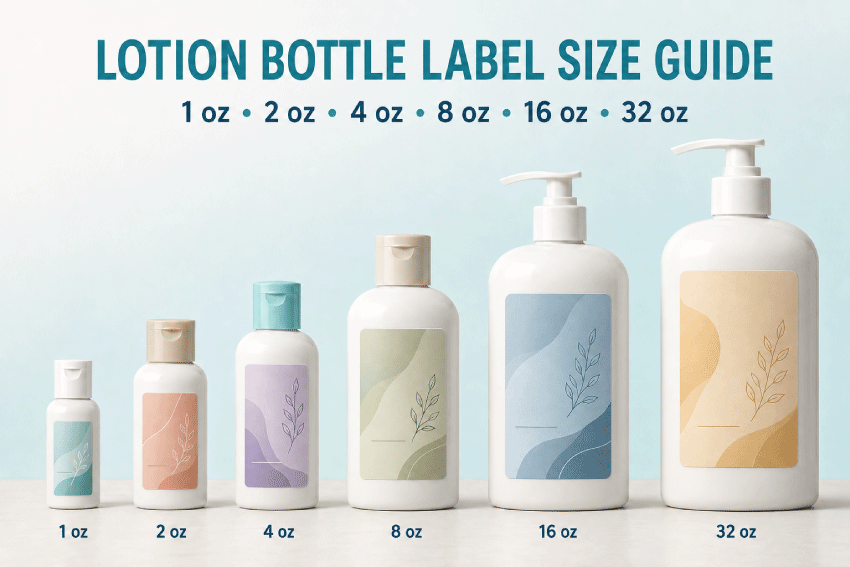
Whether you package hand lotion, body lotion, moisturizer, massage lotion, sunscreen or salon products, choosing the correct lotion bottle label size is essential for a clean, professional package. A label that extends onto curved shoulders or tapered sides can wrinkle and lift. A label that is too small may not provide enough room for branding, ingredients, directions, warnings and required business information.
This guide covers popular label sizes for 1 oz, 2 oz, 4 oz, 8 oz, 16 oz and 32 oz lotion bottles. It also explains how bottle shape affects label fit, how to measure the usable label panel, when waterproof materials are recommended, and whether sheet labels or roll labels are the better choice.
Important: Bottle capacity alone does not determine the correct label. Lotion bottles with the same listed capacity may be round, oval, rectangular, tapered or flat-sided. Always measure the actual container and test the proposed label size before ordering.
Quick Answer: Popular Lotion Bottle Label Sizes
| Bottle Capacity | Popular Starting Size | Other Common Options |
|---|---|---|
| 1 oz | 1.5" × 2" | 1.5" × 3" |
| 2 oz | 1.5" × 3" | 2" × 3" |
| 4 oz | 2" × 3" | 2" × 4" or 3" × 4" |
| 8 oz | 3" × 4" | 3" × 5" or 4" × 5" |
| 16 oz | 4" × 6" | 4" × 5" or 5" × 8" |
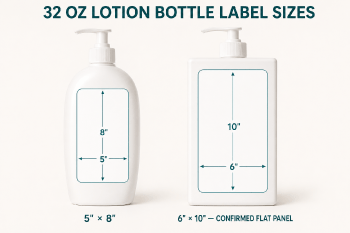
| 32 oz | 5" × 8" | 6" × 10" on sufficiently large flat panels |
These dimensions are starting points rather than universal specifications. The correct label must fit inside the bottle's smooth, usable panel without reaching the shoulder, base radius, side seam or strongly tapered areas.
At-a-Glance Recommendations
| Best Overall Material | White Matte Poly BOPP |
|---|---|
| Best Gloss Finish | White PolyGloss BOPP |
| Best Paper Option | Premium White Matte for dry indoor use |
| Most Popular Shape | Rectangle with rounded corners |
| Small Production Runs | Blank sheet labels |
| Higher Production Volumes | Inkjet roll labels |
| Most Important Fit Rule | Keep the label entirely within the smooth label panel |
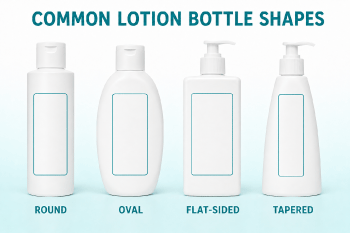
Common Lotion Bottle Shapes
Lotion bottles vary more than many other packaging types. Two bottles with identical capacities can require very different labels because of their shapes.
| Bottle Shape | Labeling Considerations | Common Approach |
|---|---|---|
| Round cylindrical | Usually provides a continuous sidewall, but the shoulder and base may curve quickly. | Front-and-back labels or a partial-wrap rectangle. |
| Oval | Front and back may be relatively flat while the sides curve sharply. | Separate front and back labels sized within the flat panels. |
| Rectangular or flat-sided | Provides the most predictable label panel. | Larger rectangles with rounded corners. |
| Tapered bottle | The width changes from top to bottom, increasing the risk of wrinkles. | Use a smaller front label and test carefully. |
| Travel or sample bottle | Limited space around caps, shoulders and bottom radiuses. | Small vertical rectangles with concise text. |
| Pump bottle | The pump does not determine the label size; the bottle body does. | Measure below the shoulder and above the base radius. |
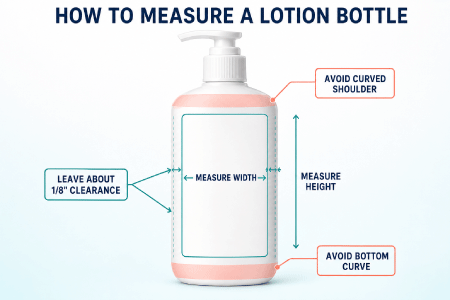
How to Measure a Lotion Bottle for a Label
- Fill the bottle first when possible. Flexible plastic bottles may change shape slightly when filled.
- Find the smooth label panel. Do not include the shoulder, bottom radius, molded grip, seam or strongly curved side edge.
- Measure the usable width. On oval or flat-sided bottles, measure only across the flat face unless you intentionally want a partial wrap.
- Measure the usable height. Measure from below the shoulder to above the bottom curve.
- Allow clearance. A label approximately 1/8 inch smaller than the usable panel on every side is generally easier to apply.
- Test at actual size. Print the outline at 100% scale, cut it out and place it on the bottle.
- Test filled bottles under normal use. Squeeze, handle and store the bottle in the environment where customers will use it.
Best Label Size for 1 oz Lotion Bottles
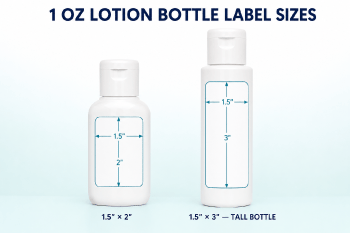
One-ounce lotion bottles are commonly used for samples, hotels, travel kits, gift sets and premium trial products. Because the shoulder and base consume much of the bottle height, compact labels are usually the safest choice.
Recommended starting sizes:
Use the smaller option when the bottle is oval, tapered or heavily rounded. A taller label may work on a narrow cylindrical travel bottle with a long straight panel.
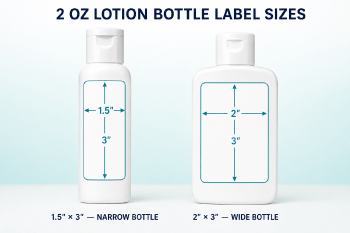
Best Label Size for 2 oz Lotion Bottles
Two-ounce bottles are popular for travel lotion, hotel amenities, massage products and sample-size skincare. They provide more room than 1-ounce bottles but still require careful attention to the curved shoulder.
Recommended starting sizes:
A vertical orientation often works well for narrow travel bottles. If the container has a broad front panel, a wider rectangle provides additional room for ingredients and directions.
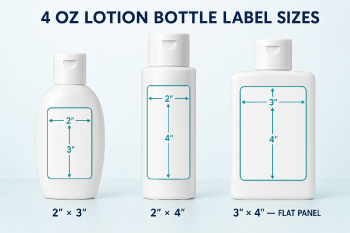
Best Label Size for 4 oz Lotion Bottles
Four-ounce bottles are widely used for travel products, boutique skincare, massage lotion, sunscreen and specialty body-care products. Depending on the bottle shape, they may accept a compact front label or a larger rectangular panel.
Recommended starting sizes:
For oval bottles, separate front and back labels may fit more cleanly than one large label extending toward the curved sides.
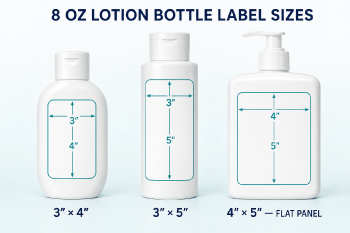
Best Label Size for 8 oz Lotion Bottles
Eight-ounce bottles are a common retail size for hand lotion, body lotion, moisturizers and salon products. Their larger panels provide room for branding, benefits, directions, ingredients and barcodes.
Recommended starting sizes:
If the bottle is tapered, reducing the label width can improve application and prevent bubbles or wrinkles near the side edges.
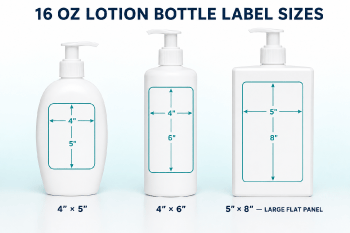
Best Label Size for 16 oz Lotion Bottles
Sixteen-ounce pump bottles are commonly used for full-size body lotions, massage products, salon products and professional skincare. These bottles often provide enough space for a strong front presentation and a separate back information label.
Recommended starting sizes:
Do not assume every 16-ounce bottle will accept a 5" × 8" label. Many oval or tapered pump bottles require a smaller front label to avoid wrapping onto curved sides.
Best Label Size for 32 oz Lotion Bottles
Thirty-two-ounce lotion bottles are frequently used for salon, spa, massage, hospitality and professional back-bar products. Large flat-sided bottles can accommodate substantial labels, but rounded gallon-style or handled containers may have smaller molded label panels.
Recommended starting sizes:
Because bottle designs vary widely at this capacity, a physical test is especially important. A front-and-back label system may fit better than a single oversized wraparound label.
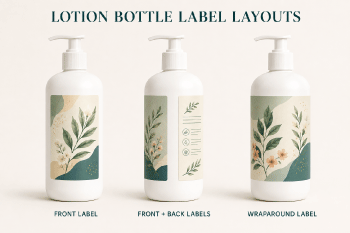
Front Label, Back Label or Wraparound Label?
| Format | Best For | Advantages | Watch For |
|---|---|---|---|
| Front label only | Simple products and small bottles | Fast application and a clean presentation | Limited room for ingredients and directions |
| Front and back labels | Oval and flat-sided bottles | Separates branding from regulatory and instructional copy | Requires consistent alignment during application |
| Partial wrap | Round bottles with straight sidewalls | Provides more printable area while leaving an application gap | Must remain within the straight sidewall |
| Full wrap | Uniform cylindrical bottles | Maximum design area and strong shelf impact | Overlap, taper and curved shoulders can cause application problems |
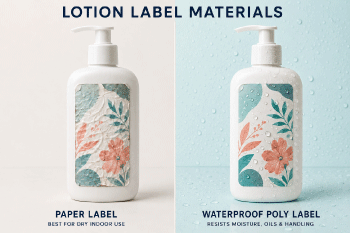
Waterproof Labels vs. Paper Labels for Lotion Bottles
Lotion packaging is regularly exposed to moisture, oils, product residue, bathroom humidity and repeated handling. For that reason, waterproof polypropylene materials are usually the strongest long-term choice.
| Material | Recommended Use | Moisture Protection |
|---|---|---|
| White Semi-Gloss Paper | Dry indoor products, samples and short-term testing | Limited |
| White High-Gloss Paper | Retail products stored away from moisture | Limited |
| White Matte Poly BOPP | Hand lotion, body lotion, bath and skincare products | Waterproof |
| White PolyGloss BOPP | Premium glossy packaging requiring moisture resistance | Waterproof |
| Clear Material | No-label appearance on compatible bottles | Not classified as waterproof |
Clear material may provide the desired visual appearance, but it should not be presented as a waterproof option. When waterproof performance is required, choose a material specifically designated as waterproof.
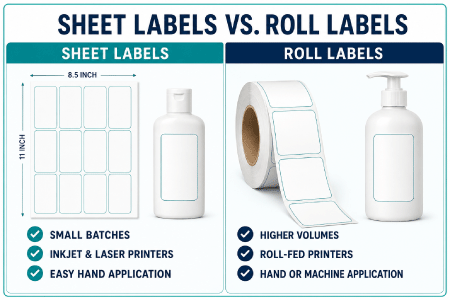
Sheet Labels vs. Roll Labels
| Sheet Labels | Roll Labels |
|---|---|
| Ideal for startups and smaller production runs | Ideal for medium- and high-volume production |
| Compatible with appropriate office inkjet and laser printers | Compatible with supported roll-fed inkjet and laser printers |
| Easy to print in small batches | Efficient for repeated production runs |
| Usually hand applied | Can be hand or machine applied depending on configuration |
| Useful for testing multiple products and designs | Useful for established product lines and production workflows |
Browse Blank Sheet Labels or Browse Blank Roll Labels.
Common Lotion Label Mistakes
- Choosing a label based only on bottle capacity instead of measuring the actual container.
- Extending the label onto a curved shoulder, bottom radius or sharply curved side.
- Using a wide rectangle on a tapered bottle without testing for wrinkles.
- Applying labels before the bottle surface is clean and dry.
- Using ordinary paper where lotion, oil, moisture or bathroom humidity is expected.
- Treating clear material as waterproof when it is not designated that way.
- Placing text, barcodes or QR codes too close to a curved edge.
- Forgetting to leave room for ingredients, directions, warnings and business information.
- Testing labels on an empty flexible bottle but not on the filled container.
- Ordering a large quantity before verifying the size, material and printer compatibility.
Buying Checklist
Before ordering lotion bottle labels, confirm:
- The bottle's actual usable label-panel width and height.
- Whether the bottle is round, oval, rectangular, flat-sided or tapered.
- Whether you need one label, separate front and back labels, or a partial wrap.
- The printer technology and whether it accepts sheets or rolls.
- Whether the label will encounter lotion, oil, water, humidity or refrigeration.
- The required finish: matte, gloss or clear.
- The application method: hand or machine.
- The amount of space needed for ingredients, directions, warnings, barcode and contact information.
- That a paper test label fits the filled bottle without reaching curved areas.
Related Label Size Guides
- What Size Label for Cosmetic Jars?
- What Size Label for Essential Oil Bottles?
- What Size Label for Soap Packaging?
- What Size Label for Water Bottles?
Shop Blank Labels for Lotion Bottles
LaserInkjetLabels.com offers blank sheet labels and roll labels in popular sizes and materials for hand lotion, body lotion, moisturizers, massage products, salon products and other personal-care packaging.
Browse Blank Sheet Labels Browse Blank Roll Labels Shop Waterproof Labels Custom Printed Labels
Frequently Asked Questions About Lotion Bottle Labels
What is the best label size for a lotion bottle?
The best size depends on the bottle's usable straight or flat panel. Common starting sizes range from 1.5" × 2" for travel bottles to 4" × 6" or larger for full-size pump bottles. Measure the actual bottle before ordering.
What label size fits a 4 oz lotion bottle?
Common starting options include 2" × 3", 2" × 4" and 3" × 4". Oval and tapered bottles may require the smaller option.
What label size fits an 8 oz lotion bottle?
Many 8-ounce bottles accept a 3" × 4", 3" × 5" or 4" × 5" label. The available panel depends on whether the bottle is round, oval, flat-sided or tapered.
What label size fits a 16 oz pump bottle?
Popular starting sizes include 4" × 5" and 4" × 6". A large flat-sided bottle may accept a 5" × 8" label, but this should be confirmed with a physical test.
Should lotion bottle labels be waterproof?
Waterproof polypropylene labels are usually recommended because lotion bottles are frequently exposed to moisture, oils, product residue and repeated handling.
What material is best for lotion labels?
White Matte Poly BOPP and White PolyGloss BOPP are durable options for lotion packaging. Premium Matte paper can work for dry indoor products and short-term samples.
Are clear labels waterproof?
No. Clear material should not automatically be described as waterproof. Choose a specifically designated waterproof material when moisture resistance is required.
Can I print lotion labels on an inkjet printer?
Yes. Choose a sheet or roll material manufactured for the specific inkjet technology being used and confirm the printer's supported dimensions and media configuration.
Can I print lotion labels on a laser printer?
Yes. Many blank sheet-label materials are compatible with laser printers. Confirm both printer and material compatibility before ordering.
Should lotion labels have rounded corners?
Rounded corners are often helpful because they resist lifting better than sharp corners, particularly on bottles that curve slightly or receive frequent handling.
Should I use front and back labels?
Separate front and back labels work especially well on oval and flat-sided bottles. The front can feature branding while the back carries ingredients, directions, warnings, barcode and company information.
Can I use a wraparound label?
A partial or full wrap can work on a straight cylindrical bottle. Leave an application gap and avoid extending onto the shoulder or bottom radius. Tapered bottles require careful testing.
How much clearance should I leave?
Leaving approximately 1/8 inch between the label and each curved edge is a useful starting point. More clearance may be needed on sharply curved or tapered bottles.
How do I test a lotion bottle label size?
Print the proposed label outline at 100% scale on plain paper, cut it out and place it on the filled bottle. Check the edges, shoulder, base, side curves and readability before ordering.
Do you offer custom printed lotion labels?
Yes. Professionally printed custom labels are available for lotion bottles and other personal-care packaging.
Can I request samples?
Yes. Samples allow you to test label fit, material appearance, adhesive performance and printer compatibility before placing a larger order.

