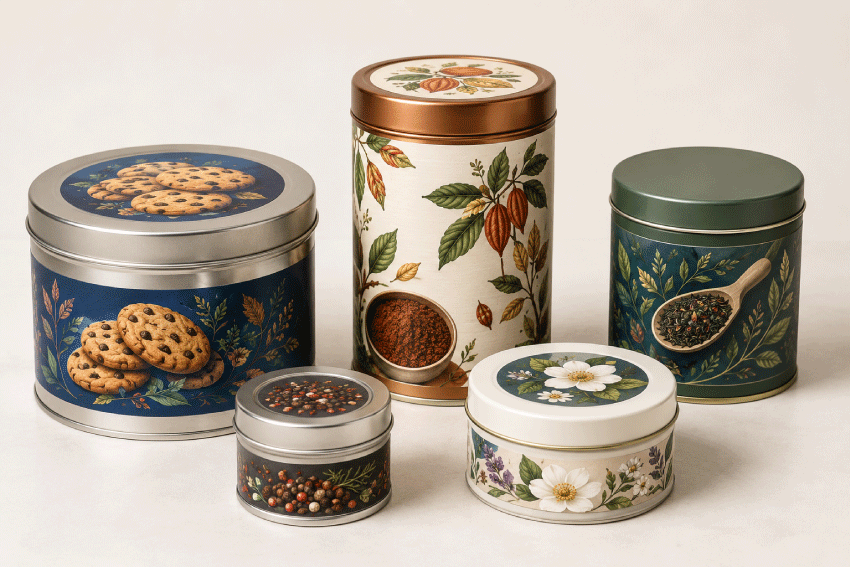
Tins and canisters are used for candles, spices, tea, coffee, cookies, candy, cosmetics, gifts and many other retail products. Their durable construction and reusable appearance make them excellent packaging, but selecting the right label size can be more complicated than measuring the overall container.
A tin may have a rolled rim, raised lid, recessed panel, side seam, tapered wall or decorative embossing that reduces the smooth labeling area. Two containers advertised with the same capacity can also have very different proportions. A short 8 oz candle tin, a tall 8 oz tea canister and a wide 8 oz food tin will not necessarily accept the same label.
This guide explains how to measure the actual container, choose front, lid, bottom or wraparound labels, compare practical starting sizes for common tins and canisters, and select materials for dry, refrigerated and frequently handled applications.
LaserInkjetLabels.com offers blank labels on sheets and rolls for compatible inkjet and laser printers, along with custom printed label options for businesses that want finished labels ready to apply.
Quick Answer
The best label size for a tin or canister depends on the smooth sidewall height, usable front width, circumference and flat lid diameter. Container capacity and outside diameter are useful starting references, but they do not guarantee a particular fit.
| Container Type | Popular Body-Label Starting Points | Popular Lid-Label Starting Points |
|---|---|---|
| Small spice, sample or cosmetic tin | 1" × 2" or 1.5" × 2" | 1.5" or 2" circle |
| 4 oz candle or gift tin | 1.5" × 3" or 2" × 2" | 2" or 2.5" circle |
| 8 oz candle, food or pantry tin | 2" × 3", 3" × 2" or 3" × 3" | 2.5" or 3" circle |
| Coffee or tea canister | 3" × 4", 4" × 3" or 3" × 5" | Measure the flat lid area |
| Large food or retail canister | 4" × 5", 4" × 6" or measured wraparound label | Measure the flat lid area |
Important: These dimensions are starting points rather than guaranteed fits. Always measure the production container and test a full-size paper copy before ordering labels.
At-a-Glance Recommendations
| Best All-Around Material | Premium White Matte for dry indoor products |
|---|---|
| Best Moisture-Resistant Choice | White Matte BOPP or Glossy BOPP |
| Best Natural Appearance | Brown Kraft |
| Best Reusable-Container Option | Removable adhesive, after testing on the actual finish |
| Most Versatile Body Shape | Rectangle with Rounded Corners |
| Best Lid Shape | Circle sized inside the flat lid area |
| Best for Small Batches | Blank Sheet Labels |
| Best for Repeated Production | Inkjet Roll Labels |
Common Tin and Canister Styles
The container’s construction often determines the safest label placement. Identify the style before deciding between a body label, lid label or wraparound layout.
| Container Style | Labeling Characteristics | Common Uses |
|---|---|---|
| Round Screw-Top Tin | Usually has a short sidewall and a broad lid; round lid labels are often prominent. | Spices, balms, samples, candy and gifts |
| Seamless Candle Tin | Short body panel with rolled top and bottom edges; front and lid labels are common. | Candles, wax products and gift sets |
| Tall Metal Canister | Provides a larger front panel or wrap area but may include a vertical seam. | Coffee, tea, cocoa and dry ingredients |
| Paperboard Canister | Often has a broad printable wall but may be slightly tapered or textured. | Snacks, drink mixes, powdered products and gifts |
| Plastic Canister | May have ribs, molded grips, shoulders or surface treatments that affect adhesion. | Food, supplements, household and retail products |
| Embossed or Hinged Tin | Decorative details, hinges and clasps reduce the usable labeling area. | Cookies, candy, tea, keepsakes and premium gifts |
Measure only the smooth section that will make complete adhesive contact. Avoid rolled edges, lid rims, hinges, clasps, raised lettering, deep ribs and sharp transitions.
How to Measure a Tin or Canister for Labels
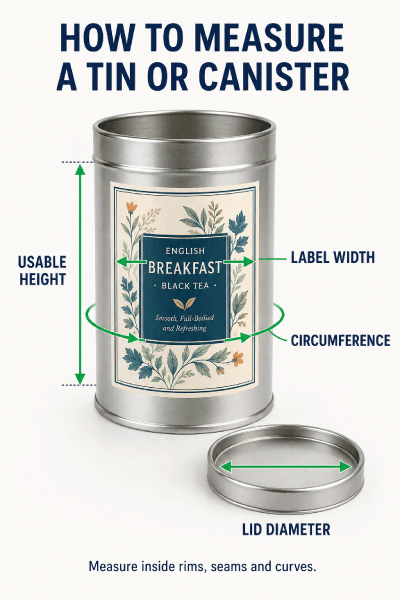
Measure an empty production container with the lid installed. Samples from another supplier may have different seams, coatings, dimensions or lid construction even when the advertised capacity is the same.
- Place the container upright and identify the smooth, uninterrupted body panel.
- Measure the vertical height between the rolled top rim and lower seam or curve.
- Leave approximately 1/8" clearance above and below whenever possible.
- For a front label, measure the visible width you want shoppers to see without turning the container.
- For a wrap label, measure the circumference around the exact height where the label will be applied.
- Subtract approximately 1/8" to 1/4" from the circumference to leave a small seam gap.
- For a lid label, measure only the flat area inside the raised or rolled rim.
- Check for hinges, clasps, vertical seams, embossing, powder coating and textured finishes.
- Print the proposed label outline at 100% actual size, cut it out and test it on the production container.
Wrap-label formula: final width is approximately the measured circumference minus the desired seam gap. Final height must remain inside the straight sidewall with clearance above and below.
Why Metal and Coated Surfaces Need Testing
Smooth bare metal often provides a good labeling surface, but tins and canisters may be coated, painted, powder-coated, varnished or lightly textured. Manufacturing oils, dust and fingerprints can also interfere with adhesive contact. Some reusable containers are intentionally finished with low-surface-energy coatings that require additional testing.
Clean the application area according to the container supplier’s recommendations and allow it to dry completely. Apply a sample label using firm, even pressure, then evaluate it after the adhesive has had time to build its bond. Test the container under realistic storage, handling and temperature conditions.
Best Label Sizes for Small Spice, Sample and Cosmetic Tins
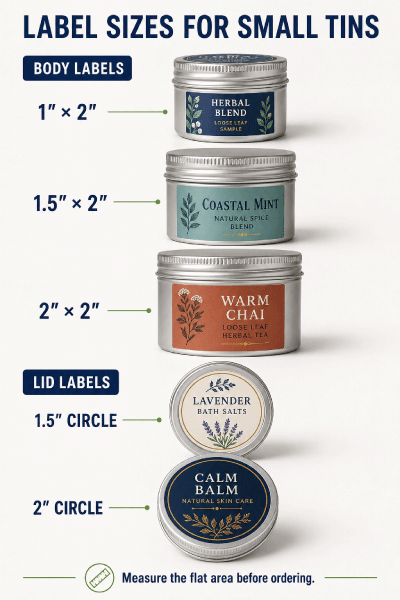
Small screw-top tins are frequently used for spices, salts, candy, samples, balms, solid products and promotional gifts. Their sidewalls may be too short for a large label, making the lid an important branding surface.
Recommended body-label starting points:
- 1" × 2" for very short or narrow side panels
- 1.5" × 2" when the straight wall is tall enough
- 2" × 2" for wider tins with sufficient height
Recommended lid-label starting points: 1.5" circle or 2" circle. Keep the label inside the flat top and away from the rolled rim.
A two-label system works well when the lid carries branding and the bottom carries directions, ingredients, warnings or a barcode. Test bottom-label adhesion because seams and recessed bases may reduce usable space.
Best Label Sizes for Candle Tins
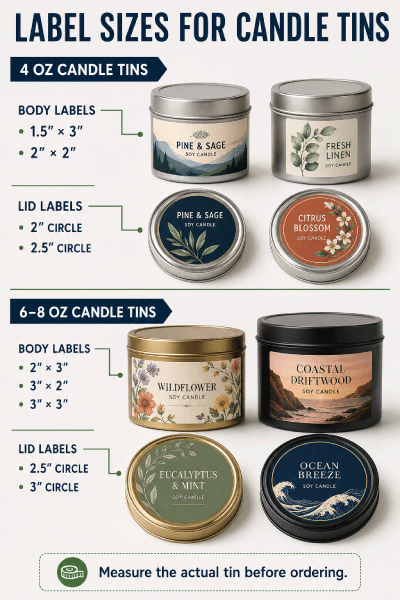
Candle tins are commonly sold in approximately 4 oz, 6 oz, 8 oz and larger capacities. The lid is often the most visible branding location, while the side or bottom label can carry scent details, net weight, company information and applicable safety information.
Recommended 4 oz candle-tin starting points:
- 1.5" × 3" body label
- 2" × 2" square front label
- 2" circle or 2.5" circle lid label
Recommended 6–8 oz candle-tin starting points:
- 2" × 3" body label
- 3" × 2" landscape body label
- 3" × 3" square label when the panel is large enough
- 2.5" circle or 3" circle lid label
Measure the actual candle tin rather than relying on wax weight. The stated capacity may refer to volume, container size or recommended fill weight, and those measurements do not identify the label panel.
Best Label Sizes for Coffee and Tea Canisters
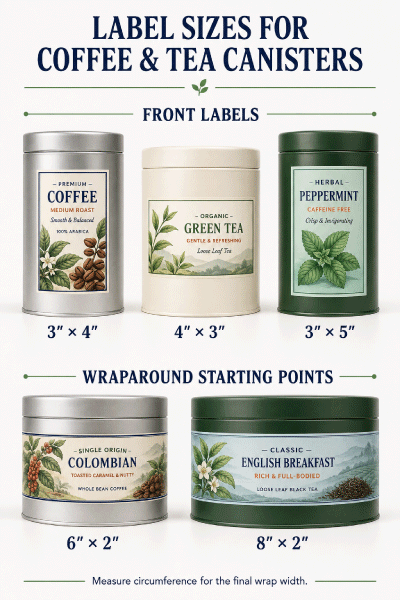
Coffee and tea canisters often provide enough height for detailed front labels. They may also use a separate back label for roast information, tasting notes, brewing directions, ingredients, storage guidance or a barcode. Tall cylindrical canisters can support wraparound labels when their walls are straight and the vertical seam is considered.
Recommended front-label starting points:
Wraparound starting points: 6" × 2" or 8" × 2" may fit some canisters, but the correct width must be calculated from the actual circumference.
Keep critical copy away from the container seam and the label seam. If the canister has a removable outer lid and an inner freshness seal, make sure the lid label does not interfere with opening or reclosing.
Best Label Sizes for Large Food, Cookie and Retail Canisters
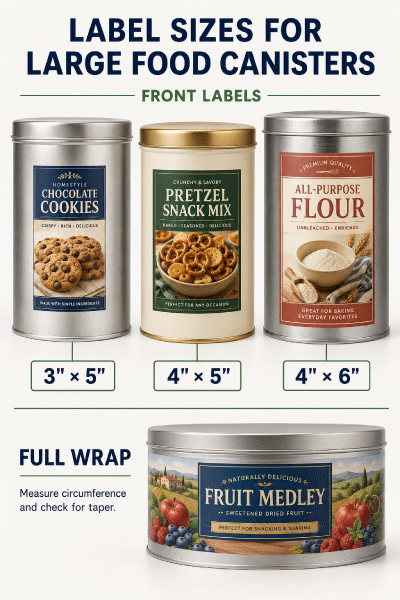
Large canisters are used for cookies, candy, snacks, drink mixes, powdered ingredients, gift assortments and bulk retail products. They offer substantial printable space, but oversized labels can bridge seams, embossing or subtle tapers.
Recommended front-label starting points:
For a full wrap, measure circumference at the exact label position. Large metal containers may not be perfectly cylindrical, and even a slight taper can cause a tall wrap label to wrinkle. A front-and-back layout may provide easier application and a cleaner appearance.
Large lids can support prominent circular labels, but lid diameters vary too widely for one standard recommendation. Measure the flat surface inside the rim and choose a circle slightly smaller than the usable diameter.
Front, Back, Lid, Bottom or Wraparound Labels?
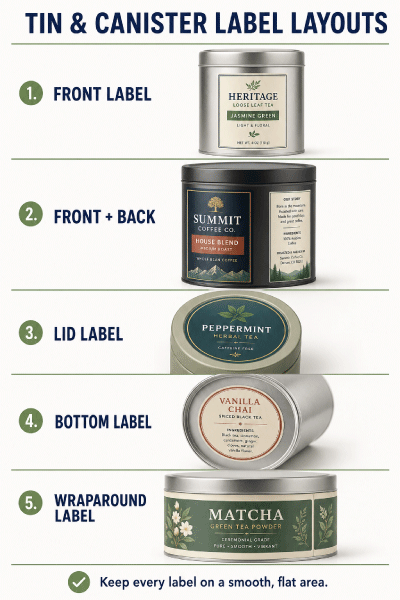
| Label Layout | Best Applications | Primary Consideration |
|---|---|---|
| Front Label | Brand, product name, variety, scent or flavor and net quantity. | Keep the main message visible without turning the container. |
| Front and Back Labels | Clean front branding with a separate information panel. | Align both labels and keep the back panel away from seams. |
| Lid Label | Short tins, top-facing retail displays and gift packaging. | Stay inside the flat lid area and away from the rim. |
| Bottom Label | Warnings, directions, lot codes or secondary information. | Check for recessed bases, seams and handling wear. |
| Wraparound Label | Straight cylindrical canisters requiring one continuous design. | Measure circumference, leave a gap and account for taper. |
Rectangles, squares, circles and ovals can all work well on tins and canisters. Rounded corners help reduce snagging and edge lifting. Place barcodes and QR codes on the flattest practical area and test scanning after application.
Planning Space for Product Information
Choose the label layout after listing everything the package needs to communicate. Depending on the product, this may include the brand, product identity, net quantity, ingredients, directions, warnings, barcode, lot number, contact information, fragrance or flavor, storage instructions and other applicable statements.
Small tins may need separate lid and bottom labels because one compact label cannot carry everything legibly. Larger canisters can use a front-and-back system or a measured wraparound layout. Keep required information readable and avoid placing critical copy over seams, around sharp curves or beneath removable lid overhangs.
Food businesses should review the current FDA Food Labeling Guide and obtain qualified regulatory review when appropriate. This label-size guide is not legal or regulatory advice.
Best Label Materials for Tins and Canisters
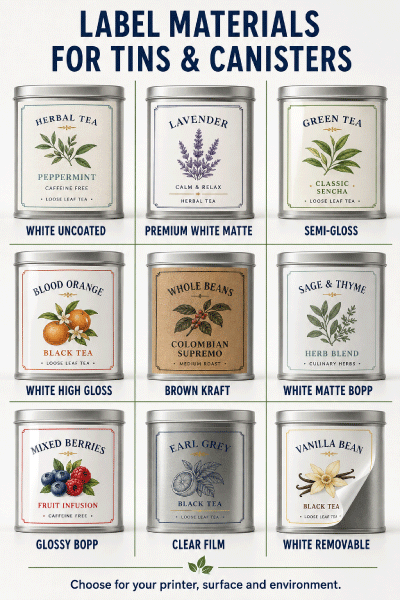
| Material | Recommended Use |
|---|---|
| White Uncoated Paper | Economical dry indoor products, samples and test packaging. |
| Premium White Matte | Upscale candles, tea, coffee, spices, gifts and artisan products. |
| Semi-Gloss Paper | Retail packaging that benefits from bright color and a moderate sheen. |
| White High Gloss | Vivid graphics and polished presentation in appropriately dry conditions. |
| Brown Kraft | Natural, rustic and handmade branding. |
| White Matte BOPP | Moisture resistance with a low-glare appearance. |
| Glossy BOPP | Moisture-resistant packaging with strong color and shine. |
| Clear Film | A no-label appearance on suitable metal, plastic or paperboard surfaces. |
| White Removable Paper | Temporary information or reusable tins when clean removal is required and testing confirms performance. |
Match the material to the printer. Inkjet and laser materials use different coatings, and an incompatible material can cause smearing, poor toner bonding or printer problems.
Important: Clear material is not automatically waterproof. Water resistance depends on the facestock, coating, adhesive, printed ink and exposure conditions.
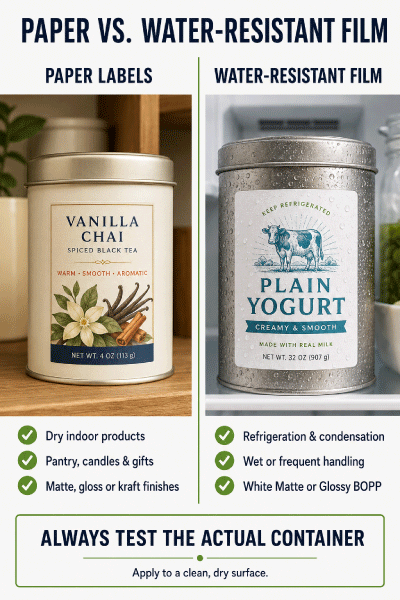
Water-Resistant Film vs. Paper Labels
Paper labels can perform very well on dry candles, tea, coffee, spices, cookies and gift products stored indoors. Film labels are a better starting point when the canister may face refrigeration, condensation, wet filling areas, oily contents, repeated wiping or frequent handling.
| Storage or Handling Condition | Recommended Starting Material |
|---|---|
| Dry pantry, shelf or gift packaging | White uncoated, premium matte, semi-gloss, high-gloss or kraft paper |
| Refrigerated food canister | White Matte BOPP or Glossy BOPP |
| Condensation or wet handling | Moisture-resistant film tested on the actual container |
| Oily or frequently wiped product | Film construction tested for the expected exposure |
| Reusable container needing temporary information | Removable adhesive tested for clean removal |
| Clear no-label appearance | Compatible clear film; separately verify water and ink durability |
Apply pressure-sensitive labels to a clean, dry surface at the recommended temperature. Condensation, wax, oil, dust and fingerprints can prevent full adhesive contact.
Sheet Labels vs. Roll Labels
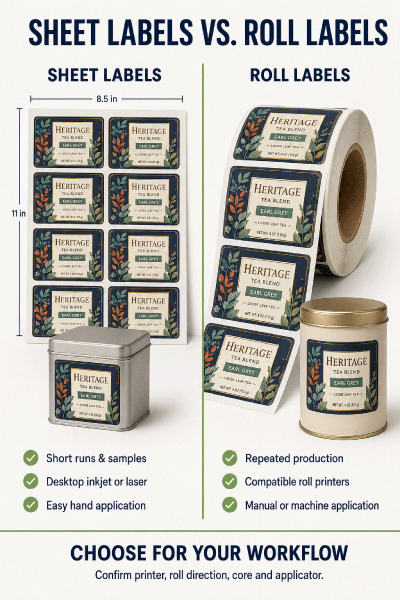
Both formats can produce professional tins and canisters. Choose according to the printer, production quantity and application method.
| Sheet Labels | Roll Labels |
|---|---|
| Ideal for samples, seasonal products, gifts and short runs. | Efficient for repeated production and growing order volumes. |
| Available for compatible desktop inkjet and laser printers. | Designed for compatible dedicated roll-fed label printers. |
| Easy to print only the quantity needed for each product. | Supports continuous printing and faster label handling. |
| Flexible orientation when labels are applied by hand. | Across-roll and into-roll dimensions must match the printer or applicator. |
| Convenient for testing multiple scents, flavors or designs. | Suitable for manual, semi-automatic or automatic application when configured correctly. |
If labels will be machine applied, confirm copy position, unwind direction, core size, outside roll diameter and gap before ordering. Test the applicator on the actual container because rims, tapers and seams can affect feeding and placement.
Common Tin and Canister Label Mistakes
- Choosing a label from container capacity without measuring the actual panel.
- Measuring the full sidewall height and ignoring rolled top and bottom seams.
- Sizing a lid label to the outside diameter instead of the flat area inside the rim.
- Applying labels over hinges, clasps, embossing, ribs or vertical seams.
- Making a wrap label equal to the exact circumference and creating an overlap.
- Using a tall wrap label on a tapered canister without testing for wrinkles.
- Applying labels to oily, dusty, waxy, cold or damp surfaces.
- Assuming painted and powder-coated tins have identical adhesive requirements.
- Using paper where refrigeration, moisture or frequent wiping requires film.
- Assuming a clear label is automatically waterproof.
- Placing barcodes or small text over a seam or strong curve.
- Ordering roll labels without confirming orientation and roll specifications.
- Skipping a full-size fit test and material sample on the production container.
Tin and Canister Label Buying Checklist
Before ordering, confirm:
- The exact container supplier, style, material and capacity.
- The smooth body-panel height and usable front width.
- The circumference if using a wraparound label.
- The flat lid diameter inside the raised rim.
- The location of seams, hinges, clasps, ribs and embossing.
- Whether the package uses a front, back, lid, bottom or wrap label.
- The information that must remain visible and readable.
- Whether moisture-resistant or removable material is required.
- The correct material for the intended inkjet or laser printer.
- Whether labels will be applied by hand or with an applicator.
- The roll direction, core and outside diameter when buying roll labels.
- A successful paper fit test and material adhesion test.
Related Label Size Guides
- What Size Label for Coffee Bags?
- What Size Label for Candle Jars?
- What Size Label for Spice Jars?
- What Size Label for Food Jars?
- What Size Label for Cosmetic Jars?
Shop Blank Labels for Tins and Canisters
Choose blank sheet or roll labels in the size, finish and material that fits your container, printer and production process. Request samples when testing a new tin coating or canister surface.
Browse Blank Sheet Labels Browse Blank Roll Labels Custom Printed Labels Shop Waterproof Labels
Frequently Asked Questions About Tin and Canister Labels
What is the best label size for a tin or canister?
The best size fits completely within the smooth body panel or flat lid area. Small tins may use 1" × 2" body labels or 1.5" circles, while large canisters may use 4" × 5", 4" × 6" or measured wraparound labels.
How do I measure a round tin for a body label?
Measure the straight vertical area between the rolled top and bottom edges. Leave clearance so the label does not extend onto either seam or curve.
How do I measure a canister for a wraparound label?
Measure the circumference at the exact label position with a flexible tape. Subtract approximately 1/8" to 1/4" for a seam gap and keep the label height inside the straight panel.
How large should a tin lid label be?
Measure the flat top inside the raised or rolled rim. Choose a circular label slightly smaller than that usable diameter so the edge remains flat.
What size label fits a 4 oz candle tin?
Common starting points include a 1.5" × 3" body label, a 2" × 2" square label and a 2" or 2.5" circular lid label. Measure the actual tin because dimensions and recommended fill weights vary.
What size label fits an 8 oz candle tin?
Many 8 oz tins can use a 2" × 3", 3" × 2" or 3" × 3" body label and a 2.5" or 3" lid label. The straight panel and lid inset determine the final fit.
What size label works on a coffee canister?
Popular front-label starting points include 3" × 4", 4" × 3" and 3" × 5". A wrap may also work when the canister is cylindrical and its circumference is measured.
Can one label size fit every container with the same capacity?
No. Capacity measures volume rather than label-panel dimensions. Short, tall, wide, tapered and seamed containers with the same capacity can require different labels.
Can I label a powder-coated metal tin?
Often, but coatings vary. Test the adhesive on the actual finish after cleaning and allow time for the bond to build before evaluating performance.
Can labels be applied over a metal seam?
It is better to avoid seams because they interrupt adhesive contact and can create a visible ridge. Place front labels between seams and position wrap-label joins away from critical copy.
Are rounded corners helpful on metal tins?
Rounded corners can reduce snagging and edge lifting, especially on frequently handled containers. Proper surface preparation and panel clearance remain equally important.
Should tin and canister labels be waterproof?
Paper can work well for dry indoor products. Water-resistant film is a better starting point for refrigeration, condensation, wet handling, oily contents or repeated wiping.
Are clear labels waterproof?
Not automatically. Clear describes appearance, not durability. Verify the facestock, coating, adhesive and printed ink under the expected storage and handling conditions.
What material is best for refrigerated food canisters?
White Matte BOPP or Glossy BOPP is a practical starting point for moisture resistance. Test adhesion on the actual container at the intended application and storage temperatures.
Can removable labels be used on reusable tins?
Yes, when the adhesive is compatible with the surface and removes cleanly. Test a sample because painted, printed and powder-coated finishes can respond differently.
Can I print tin labels with an inkjet printer?
Yes. Choose sheet or roll material specifically compatible with the exact inkjet printer and follow the recommended print and drying settings.
Can I print tin labels with a laser printer?
Yes, when the sheet label material is rated for laser printing. Do not put inkjet-only material through a laser printer.
Should I buy labels on sheets or rolls?
Sheets are convenient for samples, seasonal products and short batches. Rolls are efficient for repeated production, dedicated roll printers and compatible applicators.
Does roll-label orientation matter?
Yes. Across-roll and into-roll dimensions, unwind direction and copy position must match the printer and applicator. Confirm the complete roll configuration before ordering.
How should I test a tin or canister label before ordering?
Print the design at 100% size on paper and test the fit. Then apply a material sample to a cleaned production container and evaluate printing, adhesion, edge lifting, handling, moisture and removal when applicable.

