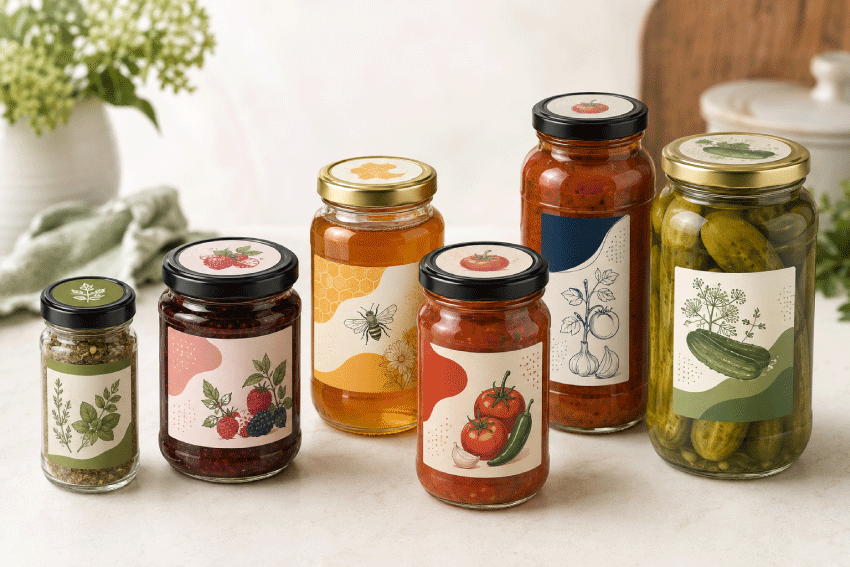
Choosing the right label size for a food jar is one of the most important steps in creating packaging that looks professional and stays readable. A well-fitted label follows the jar’s straight surface without wrinkling, lifting or disappearing around the sides. It must also provide enough room for branding, product details and the information required for the finished food package.
Food jars are sold by capacity, but capacity alone does not determine label size. Two 8 oz jars can have very different shapes: one may be short and wide with a large lid, while another is tall and narrow with a smaller front panel. Mason jars, straight-sided jars, hex jars, spice jars and sauce jars may all hold similar amounts while requiring different labels.
This guide explains how to measure the actual container, select front, back, lid or wraparound labels, compare common label sizes for jars from 1 oz through 32 oz, and choose materials for pantry, refrigerated and moisture-prone applications.
LaserInkjetLabels.com offers blank labels on sheets and rolls for printing food jar labels in-house with compatible inkjet and laser printers.
Quick Answer
The best label size for a food jar depends on the jar’s straight label-panel height, usable front width, circumference and lid diameter. Use capacity only to identify a practical starting range.
| Jar Capacity | Popular Body-Label Starting Points | Popular Lid-Label Starting Points |
|---|---|---|
| 1–2 oz | 1.5" × 2" or 2" x 1" | 1" or 1.5" circle |
| 4 oz | 1.5" × 2" or 2" × 2" | 1.5" or 2" circle |
| 8 oz | 2" × 2" or 2" × 3" | 2" or 2.5" circle |
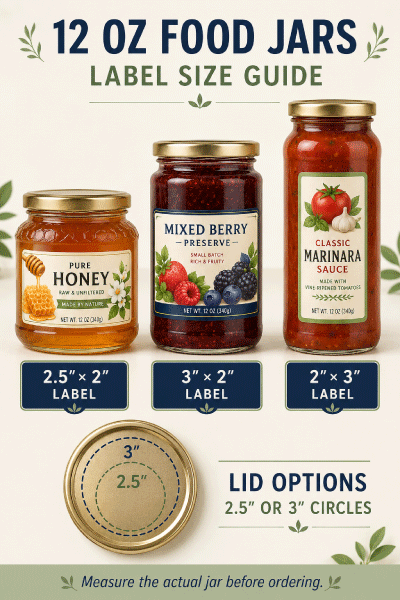
| 12 oz | 2.5" × 2", 3" × 2" or 2" × 3" | 2.5" or 3" circle |
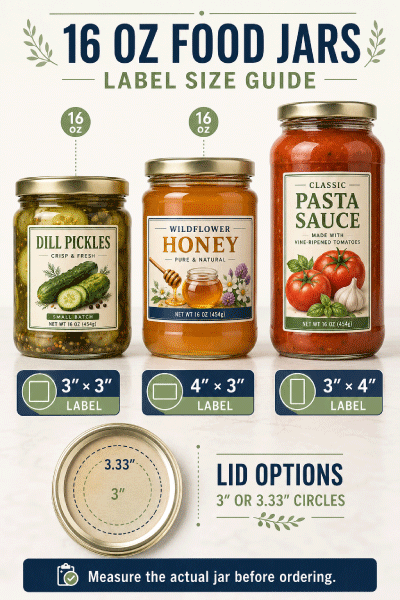
| 16 oz | 3" × 3", 4" × 3" or 3" × 4" | 3" or 3.33" circle |
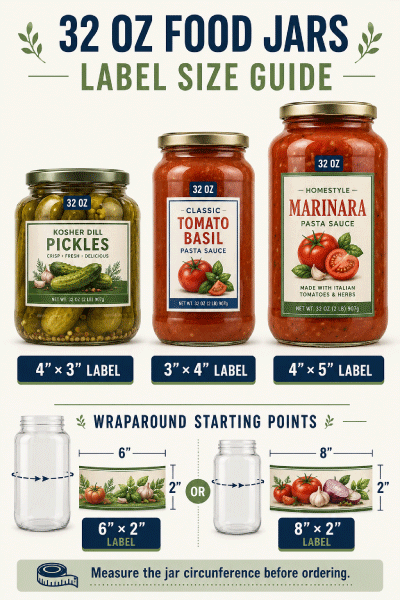
| 24–32 oz | 4" × 3", 3" × 4" or 4" × 5" | Measure the actual lid |
Important: These dimensions are starting points, not guaranteed fits. Always measure the production jar and cap, then test a full-size paper copy before ordering labels.
At-a-Glance Recommendations
| Best All-Around Material | Premium White Matte for dry, room-temperature packaging |
|---|---|
| Best Moisture-Resistant Choice | White Matte BOPP or Glossy BOPP |
| Best Economical Choice | White Uncoated Paper |
| Most Versatile Shape | Rectangle with Rounded Corners |
| Best Lid Shape | Circle sized smaller than the flat lid surface |
| Best Layout for More Information | Front-and-back labels or one measured wraparound label |
| Best for Small Batches | Blank Sheet Labels |
| Best for Repeated Production | Inkjet Roll Labels |
Common Food Jar Types and Labeling Surfaces
The name of the jar can be as important as its capacity. Before selecting a label, identify the shape and locate the uninterrupted surface where the label will actually sit.
| Jar Style | Labeling Characteristics | Common Foods |
|---|---|---|
| Straight-Sided Jar | Usually provides the easiest body panel for front, back and wrap labels. | Sauces, nut butters, spreads and condiments |
| Mason or Canning Jar | May include shoulders, molded lettering or textured glass that reduces usable space. | Jam, jelly, pickles, salsa and preserves |
| Hex or Faceted Jar | Flat faces favor smaller front labels; wide labels may bridge corners and lift. | Honey, jam, spices and gifts |
| Spice Jar | Tall, narrow panels often work with slim rectangles and small round lid labels. | Herbs, seasonings, salts and blends |
| Wide-Mouth Jar | Short body height may make the lid an important branding surface. | Dips, spreads, candy and dry snacks |
| Tapered or Shoulder Jar | Requires a label that remains entirely inside the straight central band. | Sauces, syrups and specialty foods |
Embossed logos, seams, ribs, handles and curves can interrupt adhesion. Measure only the smooth, straight area rather than the jar’s overall height or widest point.
How to Measure a Food Jar for Labels
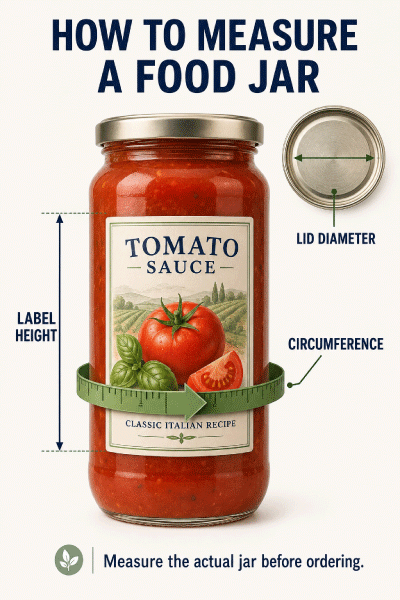
Measure an empty production jar with the lid installed. If possible, use the exact jar and closure from the final supplier because a sample from another manufacturer may have different dimensions.
- Place the jar upright and identify the smooth, straight body section.
- Measure the vertical height between the shoulder and the lower curve or base.
- Leave approximately 1/8" clearance at the top and bottom so the label does not cross onto a curve.
- For a front label, measure the visible width you want shoppers to see without rotating the jar.
- For a wrap label, measure the circumference with a flexible tape or a strip of paper.
- Subtract approximately 1/8" to 1/4" from the circumference to create a small gap between the label ends.
- For a lid label, measure the flat top surface inside any raised rim, groove or safety button.
- Print the proposed label outline at 100% actual size, cut it out and tape it to the jar.
Simple wrap-label formula: final label width is approximately the measured circumference minus the desired gap. Final label height must fit inside the straight vertical panel with clearance above and below.
Best Label Size for 1–4 oz Food Jars
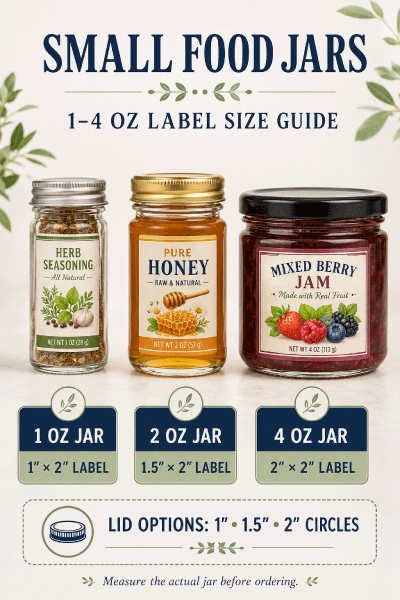
Small food jars are often used for spice blends, honey samples, jams, sauces, salts, tasting portions and party favors. The short body panel makes label height especially important. When the sidewall is very limited, a lid label can carry the brand while a smaller body or bottom label holds secondary information.
Recommended body-label starting points:
- 2" × 1" for compact or narrow panels
- 1.5" × 2" when additional height is available
- 2" × 2" for wider 4 oz jars with a tall enough panel
Recommended lid-label starting points: 1" circle, 1.5" circle or 2" circle, depending on the flat lid diameter.
Best Label Size for 8 oz Food Jars
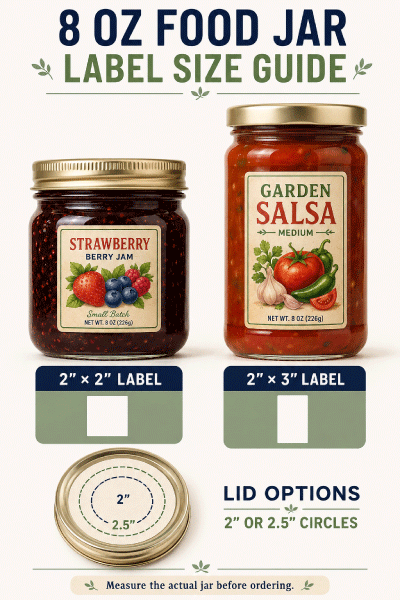
Eight-ounce jars are widely used for jam, jelly, honey, salsa, sauces, nut butter and specialty ingredients. A low-profile 8 oz jar may favor a square front label or lid label, while a taller straight-sided jar can support a portrait or landscape rectangle.
Recommended body-label starting points:
Recommended lid-label starting points: 2" circle or 2.5" circle.
Wraparound planning: measure the jar circumference rather than assuming a width. Many 8 oz molds fall near common 6" to 8" widths, but a difference of only a few tenths of an inch can affect the seam.
Best Label Size for 12 oz Food Jars
Twelve-ounce jars provide more front-facing area, but their shapes vary significantly. A tall sauce jar, a squat jam jar and a standard canning jar may all hold 12 oz while offering different usable panels.
Recommended body-label starting points:
Recommended lid-label starting points: 2.5" circle or 3" circle.
For faceted honey or preserve jars, keep the label completely within one flat face whenever possible. A label that crosses a sharp corner may bridge the glass instead of making full adhesive contact.
Best Label Size for 16 oz Food Jars
Sixteen-ounce jars are common for pickles, salsa, pasta sauce, jam, honey, nut butter and dry pantry products. The larger container can support a stronger shelf presence and more information, but mason-style shoulders and molded glass still restrict the true labeling area.
Recommended body-label starting points:
Recommended lid-label starting points: 3" circle or 3.33" circle, provided the label remains inside the usable flat top.
A separate front-and-back system often works well at this capacity. The front label can stay visually clean while the back panel carries ingredients, nutrition information, storage directions and a barcode.
Best Label Size for 24–32 oz Food Jars
Large jars used for sauces, pickles, bulk ingredients, snacks and family-size foods provide more printable space. They also increase the risk of wrinkles if a tall label reaches into a shoulder or base curve. A wider label is not always better; a clean, centered front panel can be easier to apply and read than an oversized wrap.
Recommended body-label starting points:
Wraparound starting points: 6" × 2" or 8" × 2" may suit some straight-sided jars, but only after the circumference and usable height are measured.
Large metal lids vary widely. Measure the flat top inside the rim and select a circle at least 1/8" smaller in diameter whenever practical.
Front, Back, Lid or Wraparound Labels?
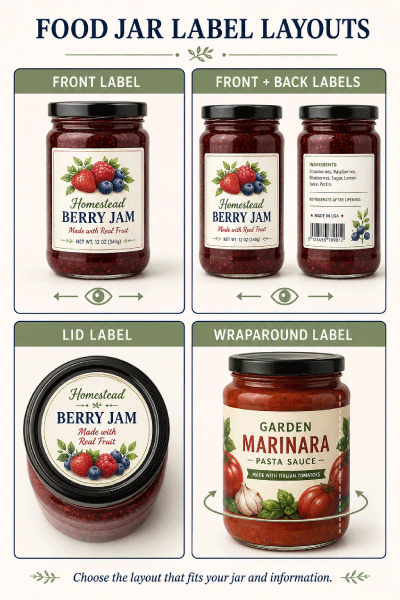
The best layout depends on the jar shape, the amount of required information, application method and the way customers will see the product.
| Label Layout | Best Applications | Primary Consideration |
|---|---|---|
| Front Label | Brand, product name, flavor or variety and net quantity. | Keep the main message visible without rotating the jar. |
| Front and Back Labels | Products needing a clean display panel plus a separate information panel. | Align both labels consistently during hand application. |
| Lid Label | Short jars, gift packaging, safety seals or top-facing retail displays. | Stay inside the flat area and away from the rim. |
| Wraparound Label | Straight-sided jars that need branding and information on one label. | Measure circumference, leave a seam gap and avoid curves. |
Rectangles, squares, circles and ovals all work well on food packaging. Rounded corners can reduce edge lifting on curved glass and plastic. Place barcodes, QR codes, ingredient text and other critical content on a smooth portion of the jar, not at a wrap seam or around a sharp facet.
For more information, jump to our Label Learning Center article: How to design and apply honey jar labels
Planning Space for Food Label Information
Food jar label size is not only a design choice. The package may need room for the product identity, net quantity, ingredient statement, allergen declarations, Nutrition Facts, business information and other statements that apply to the product. Required content and available exemptions depend on the food, package and applicable jurisdiction.
Plan the information hierarchy before choosing the label dimensions. The front panel usually needs clear product identification and net quantity, while an information panel may carry ingredients, allergen information, nutrition details, storage instructions, a barcode and manufacturer or distributor information. Small jars can require especially careful type and panel planning.
FDA notes that food-label rules and guidance can change and that businesses are responsible for staying current. Review the FDA Food Labeling Guide and the FDA’s current food allergen labeling guidance. Have final artwork reviewed by a qualified regulatory professional. This size guide is not legal or regulatory advice.
Best Label Materials for Food Jars
| Material | Recommended Use |
|---|---|
| White Uncoated Paper | Economical pantry products, dry goods and short-run test packaging. |
| Premium White Matte | Upscale artisan foods, spices, preserves and low-glare branding. |
| Semi-Gloss Paper | Retail packaging that benefits from brighter color and a light sheen. |
| White High Gloss | Vivid graphics and polished presentation in appropriately dry conditions. |
| Brown Kraft | Natural, handmade, rustic and farm-market branding. |
| White Matte BOPP | Moisture-resistant refrigerated or frequently handled food jars. |
| Glossy BOPP | Durable, moisture-resistant packaging with strong color and shine. |
| Clear Film | A no-label appearance when the jar and product provide suitable contrast. |
Match the material to the printer. Inkjet and laser printers use different coatings, and an incompatible material can cause poor ink adhesion, smearing, toner problems or printer damage. Always confirm the product specifications before printing.
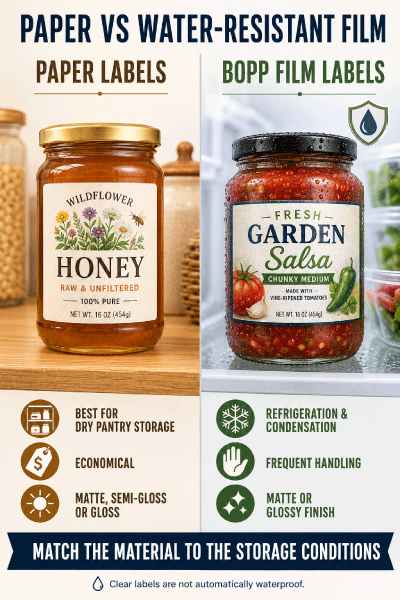
Important: Clear material is not automatically waterproof. Water resistance depends on the complete construction, including facestock, coating, adhesive, printed ink and exposure conditions.
Waterproof Labels vs. Paper Labels for Food Jars
Paper labels can perform very well on dry pantry products. Film labels are the better starting point for jars exposed to refrigeration, condensation, wet filling areas, oily ingredients, repeated wiping or frequent handling.
| Storage or Handling Condition | Recommended Starting Material |
|---|---|
| Dry pantry or shelf-stable product | White uncoated, premium matte, semi-gloss or high-gloss paper |
| Refrigerated after opening | White Matte BOPP or Glossy BOPP |
| Condensation-prone cold jar | Moisture-resistant film tested on the actual container |
| Oily sauce, spread or ingredient | Film construction tested for oil contact and edge exposure |
| Clear no-label appearance | Compatible clear film; verify ink durability and moisture performance |
Apply pressure-sensitive labels to a clean, dry surface at the recommended temperature. Condensation, cooking oil, dust, fingerprints and release agents can interfere with adhesive contact. Hot-fill and cold-fill processes may also require application testing because the jar surface changes temperature after labeling.
Sheet Labels vs. Roll Labels for Food Jars
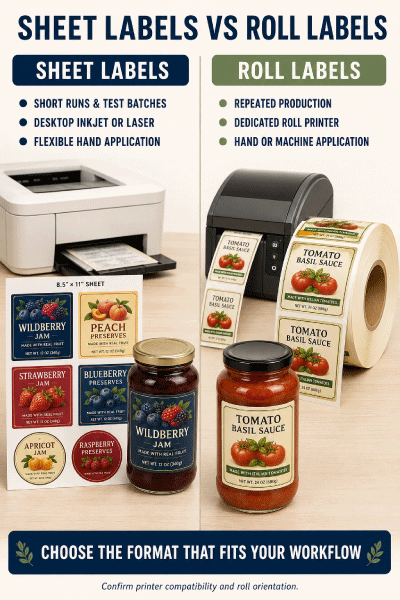
Both formats can produce professional packaging. Choose according to the printer, production quantity and application method rather than appearance alone.
| Sheet Labels | Roll Labels |
|---|---|
| Ideal for samples, farmers markets, seasonal products and short runs. | Efficient for repeated production and growing order volumes. |
| Available for compatible desktop inkjet and laser printers. | Designed for compatible dedicated roll-fed inkjet label printers. |
| Easy to print only the quantity needed for a batch. | Supports continuous printing and faster label handling. |
| Flexible orientation when labels are applied by hand. | Across-roll and into-roll dimensions must match the printer or applicator. |
| Convenient for testing several recipes, flavors or label designs. | Suitable for manual, semi-automatic or automatic application when configured correctly. |
If labels will be machine applied, confirm copy position, unwind direction, core size, outside roll diameter and gap before ordering. For hand-applied jars, sheet labels provide a simple starting point and make design changes easy.
Common Food Jar Label Mistakes
- Choosing a label from jar capacity without measuring the actual container.
- Measuring the full jar height instead of the straight label panel.
- Applying a label across shoulders, bottom curves, embossing or facets.
- Sizing a lid label to the full lid diameter instead of the flat area inside the rim.
- Making a wrap label equal to the exact circumference and creating an unwanted overlap.
- Placing a barcode, QR code or small text at the seam or around a corner.
- Using paper for refrigerated, wet or oily conditions without testing.
- Assuming every clear label is waterproof.
- Applying labels to damp, oily, dusty or very cold jars.
- Failing to reserve enough room for required food-label information.
- Ordering roll labels without confirming orientation and roll specifications.
- Skipping a full-size print and application test on a filled production sample.
Food Jar Label Buying Checklist
Before ordering, confirm:
- The exact jar supplier, style and capacity.
- The straight body-panel height and usable front width.
- The circumference if using a wraparound design.
- The flat lid diameter inside the rim or groove.
- Whether the package uses a front, back, lid or wrap label.
- The amount of space needed for branding and applicable food information.
- Whether the jar will be refrigerated, frozen, wiped, washed or exposed to oil.
- The correct material for the intended inkjet or laser printer.
- Whether labels will be applied by hand or with an applicator.
- The roll direction, core and outside diameter when buying roll labels.
- A successful paper fit test and material sample test on the production jar.
Related Label Size Guides
- What Size Label for Mason Jars?
- What Size Label for Cosmetic Jars?
- What Size Label for Supplement Bottles?
- What Size Label for Essential Oil Bottles?
- What Size Label for Lotion Bottles?
Shop Blank Labels for Food Jars
Whether you are labeling a small batch of preserves or preparing a growing food line for retail, choose blank sheet or roll labels in the size, finish and material that fits your jar and production process.
Browse Blank Sheet Labels Browse Blank Roll Labels Custom Printed Labels Shop Waterproof Labels
Frequently Asked Questions About Food Jar Labels
What is the best label size for a food jar?
The best size is one that fits completely within the jar’s smooth, straight panel. Common starting points range from 1" × 2" on sample jars to 4" × 5" on large jars, but capacity does not guarantee a fit.
What size label fits an 8 oz jar?
Many 8 oz jars can use a 2" × 2" or 2" × 3" body label and a 2" or 2.5" lid label. Short, wide and tall 8 oz molds differ, so measure the actual jar.
What size label fits a 12 oz jar?
Popular starting points include 2.5" × 2", 3" × 2" and 2" × 3". A 2.5" or 3" circle may fit the lid if it remains inside the flat top surface.
What size label fits a 16 oz jar?
Common starting sizes include 3" × 3", 4" × 3" and 3" × 4". Mason jar shoulders, embossed designs and different diameters can reduce the usable area.
How do I measure a jar for a front label?
Measure the height of the straight body section and leave clearance above and below. Then choose a width that keeps the primary branding visible when the jar faces forward.
How do I measure for a wraparound label?
Wrap a flexible tape or paper strip around the straight section. Subtract approximately 1/8" to 1/4" from the circumference for a small gap, and keep the height inside the straight panel.
How large should a lid label be?
Measure the flat area inside the raised rim, groove or safety button. Choose a circle smaller than that usable diameter so the edge remains flat and protected from handling.
Can I use one label size for every jar with the same capacity?
No. Jar capacity measures volume, not label-panel dimensions. Different manufacturers and molds can produce short, tall, round, square or faceted containers with the same capacity.
Are round labels good for food jars?
Yes. Round labels are especially useful on lids and on wide, flat front panels. Confirm that the entire circle stays on a smooth surface without crossing a curve or facet.
Are rounded-corner rectangles better for curved jars?
Rounded corners can help reduce snagging and edge lifting. Good surface preparation, material choice and keeping the label inside the straight panel are equally important.
Should food jar labels be waterproof?
Film labels are a good choice when jars face refrigeration, condensation, wet handling or oil. Paper can work well for dry shelf-stable products stored under controlled conditions.
Are clear labels waterproof?
Not automatically. Clear describes appearance, not performance. Confirm the facestock, coating, adhesive and printed ink, then test the finished label under expected conditions.
What label material is best for refrigerated jars?
White Matte BOPP or Glossy BOPP is a practical starting point for moisture resistance. Test adhesion on the actual jar at the intended application and storage temperatures.
Can labels be applied to cold or damp jars?
Adhesion may suffer on a cold or damp surface. Unless the product specifications say otherwise, apply labels to clean, dry jars within the recommended temperature range and test the process.
Can I print food jar labels with an inkjet printer?
Yes. Choose a sheet or roll material specifically coated for the exact inkjet printer and allow printed ink to dry or cure according to the material instructions.
Can I print food jar labels with a laser printer?
Yes, when the sheet material is rated for laser printing. Do not put inkjet-only label stock through a laser printer.
Should I buy labels on sheets or rolls?
Sheets are convenient for samples, seasonal products and short batches. Rolls are efficient for repeated production, dedicated roll printers and compatible label applicators.
Does roll-label orientation matter?
Yes. Across-roll and into-roll dimensions, unwind direction and copy position must match the printer and applicator. Confirm these specifications before ordering.
Where should I place a barcode on a jar label?
Place it on a smooth, readable section away from the wrap seam, sharp corners and strong curvature. Print at adequate contrast and test scanning after application.
How should I test a food jar label before ordering?
Print the design at 100% size on paper, cut it out and attach it to the production jar. Then test a material sample for printing, adhesion, condensation, handling and storage performance.

