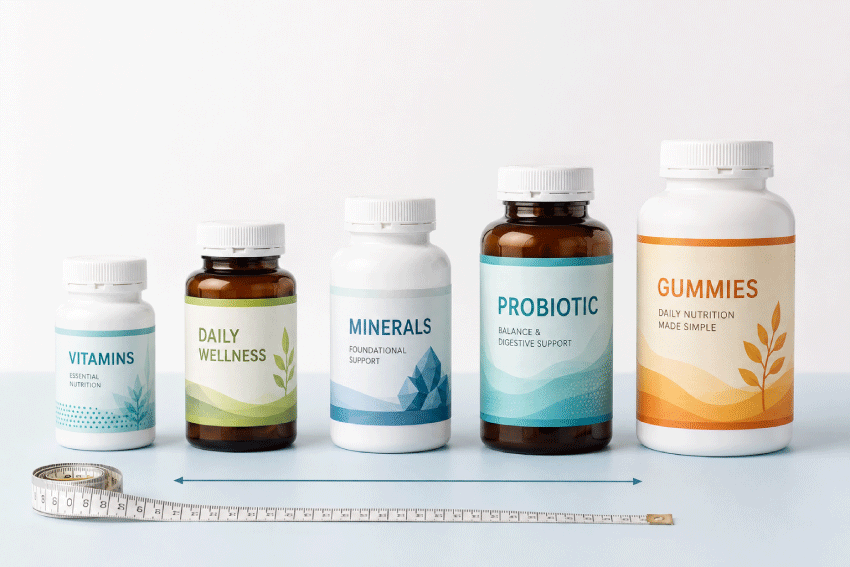
Whether you are packaging vitamins, capsules, tablets, gummies, herbal products, probiotics or powdered supplements, selecting the proper label size is essential for creating a professional package. The correct label must fit the straight section of the bottle without lifting or wrinkling while providing enough room for branding, directions, ingredients, required product information and a readable Supplement Facts panel.
Supplement bottles are commonly described by capsule count or capacity, but neither measurement guarantees a particular label size. A 60-count product may require a 100 cc, 120 cc, 180 cc or 200 cc bottle depending on the size and shape of the capsules. Bottle molds with the same capacity can also have different shoulders, diameters and usable label-panel heights.
This guide explains common supplement bottle capacities, recommended label dimensions, how to measure the actual container, front versus wraparound layouts, and which materials work best for products exposed to moisture, refrigeration and frequent handling.
LaserInkjetLabels.com manufactures premium blank sheet labels and roll labels compatible with inkjet and laser printers, making it easy to print professional supplement labels in-house.
Quick Answer
The best supplement bottle label depends primarily on the straight label-panel height and bottle circumference—not capsule count alone.
| Bottle Capacity | Recommended Front Label | Popular Layout |
|---|---|---|
| 60–100 cc | 1.5" × 2" or 2" × 1" | Small Rectangle |
| 120–150 cc | 1.5" × 2.5" or 2.5" × 2" | Wide Rectangle |
| 175–200 cc | 2.5" × 2" or 3" × 2" | Rectangle |
| 225–300 cc | 3" × 2.5" or 3.5" × 2" | Rectangle or Wrap |
| 350–500 cc | 3.5" × 2" or 4" × 3" | Large Rectangle or Wrap |
Important: These are starting points rather than guaranteed fits. Always measure the actual production bottle and test a paper sample before ordering labels.
At-a-Glance Recommendations
| Best All-Around Material | Premium White Matte |
|---|---|
| Best Waterproof Choice | White Matte Poly BOPP or White PolyGloss BOPP |
| Best Economical Choice | White Uncoated or White Matte Paper |
| Most Popular Shape | Rectangle with Rounded Corners |
| Best Layout for Required Information | Wraparound Label or Separate Front and Back Labels |
| Recommended Printing | Blank Sheet Labels or Inkjet Roll Labels |
| Most Common Finish | Matte or Semi-Gloss |
Common Supplement Bottle Sizes
Round packer bottles are among the most common containers used for vitamins, capsules and tablets. Capacity is measured in cubic centimeters, but actual dimensions vary by bottle manufacturer and mold.
| Bottle Capacity | Typical Diameter Range | Typical Label-Panel Height | Common Uses |
|---|---|---|---|
| 60–100 cc | Approximately 1.6"–2" | Approximately 1.25"–2" | Samples, small capsules, tablets |
| 120–150 cc | Approximately 1.75"–2.1" | Approximately 1.5"–2.25" | Common vitamin and capsule products |
| 175–200 cc | Approximately 2"–2.3" | Approximately 2"–2.75" | Medium-count capsules and tablets |
| 225–300 cc | Approximately 2.3"–2.7" | Approximately 2.25"–3.5" | Large-count products, gummies |
| 350–500 cc | Approximately 2.5"–3" | Approximately 2.5"–4" | Large capsules, gummies and high-count products |
These ranges are intended for planning only. A bottle with long sloped shoulders may have less usable height than a more compact bottle with the same capacity.
Why Capsule Count Does Not Determine Label Size
Capsules, tablets and gummies occupy different amounts of space. Even capsules are manufactured in several standard sizes. As a result, two products with the same count can require very different bottles.
For example, packaging guidance commonly places 60 size-1 capsules in a 100 cc bottle, 60 size-0 capsules in a 120 cc bottle, 60 size-00 capsules in a 180 cc bottle and 60 size-000 capsules in a 200 cc bottle. Choosing a label based only on "60 count" could therefore lead to the wrong dimensions.
Use the bottle capacity and manufacturer specifications as an initial reference, but make the final selection from the actual straight label panel.
How to Measure a Supplement Bottle for Labels
Always measure the actual container before ordering labels. Supplement bottles from different manufacturers often vary in diameter, shoulder design and available labeling area.
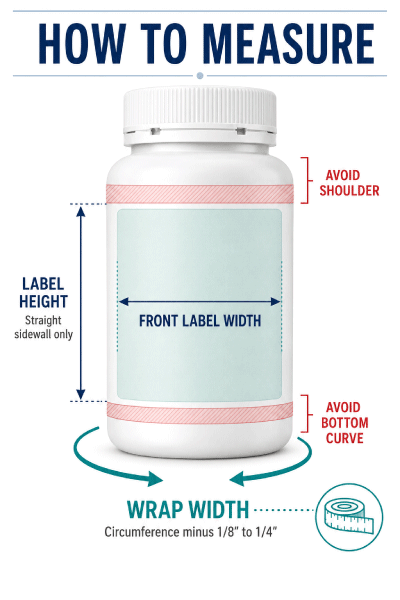
- Place the bottle upright and locate the straight section between the shoulder and bottom curve.
- Measure the height of this straight label panel.
- Leave approximately 1/8" clearance at the top and bottom whenever possible.
- For a front label, choose a width that keeps important branding visible from the front.
- For a wrap label, measure the bottle circumference with a flexible tape.
- Subtract approximately 1/8" to 1/4" from the circumference so the ends do not overlap.
- Print the design at full size on paper and test it on the production bottle.
Best Label Size for 60–100 cc Supplement Bottles
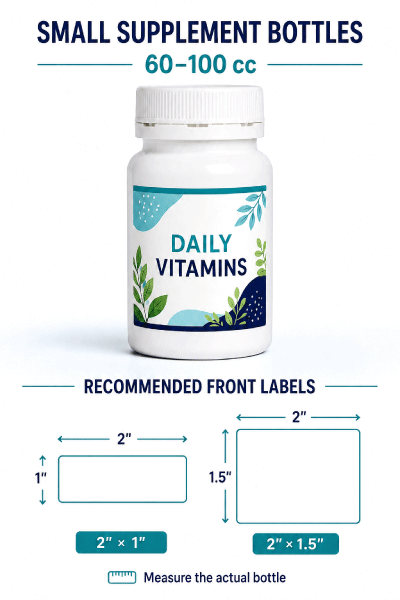
Small packer bottles are used for samples, specialized formulas, small tablets and compact capsules. Their limited straight sidewall makes conservative label height especially important.
Recommended front label sizes:
Wraparound starting point: approximately 4.75"–5.5" wide by 1.25"–1.5" high. Measure the circumference before selecting the final width.
Best Label Size for 120–150 cc Supplement Bottles
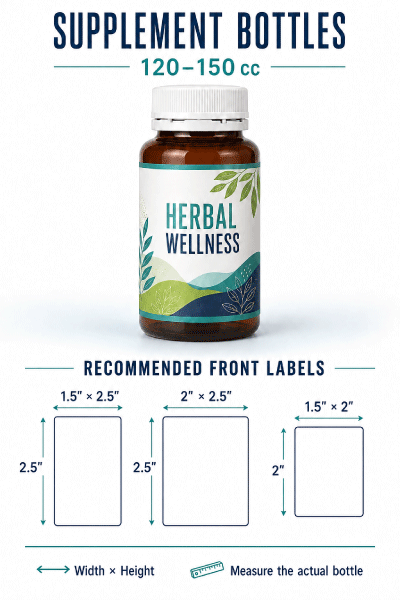
This is a popular capacity range for vitamin, herbal and capsule products. The bottle may still have only about 1.5" to 2" of comfortable label height, depending on its shoulder.
Recommended front label sizes:
- 1.5" × 2.5"
- 2.5" × 2"
- 1.5" × 2" for shorter panels
Wraparound starting point: approximately 5.25"–6" wide by 1.5"–1.75" high.
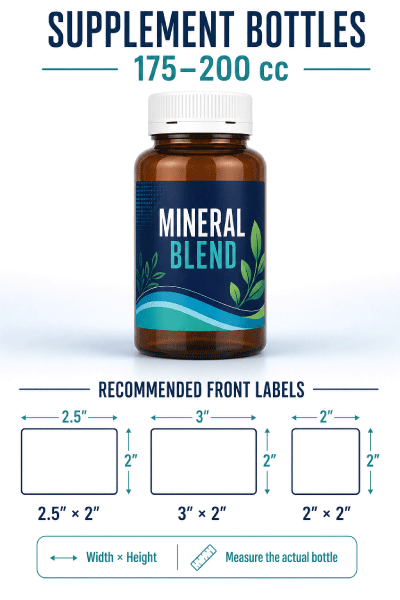
Best Label Size for 175–200 cc Supplement Bottles
Medium packer bottles provide more room for branding and product information. Many containers in this range can support a label approximately 2" high, but the straight panel must still be verified.
Recommended front label sizes:
Wraparound starting point: approximately 5.75"–6.75" wide by 2" high.
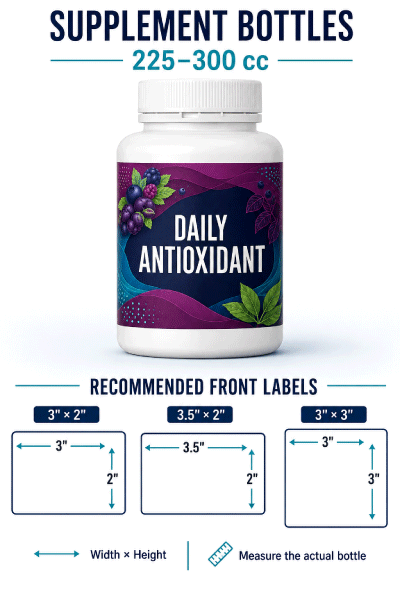
Best Label Size for 225–300 cc Supplement Bottles
Larger-count vitamins, gummies and bulky capsules often use bottles in this range. The wider bottle body provides a larger front panel and additional wraparound space for directions and required information.
Recommended front label sizes:
Wraparound starting point: approximately 6.5"–7.75" wide by 2.25"–2.5" high.
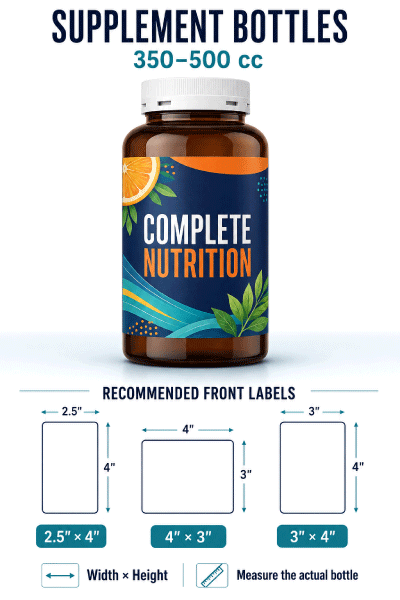
Best Label Size for 350–500 cc Supplement Bottles
Large supplement bottles are often used for high-count tablets, gummies and large capsules. Their increased surface area supports bold branding, larger Supplement Facts panels and more detailed directions.
Recommended front label sizes:
Wraparound starting point: approximately 7.5"–9" wide by 2.5"–3" high.
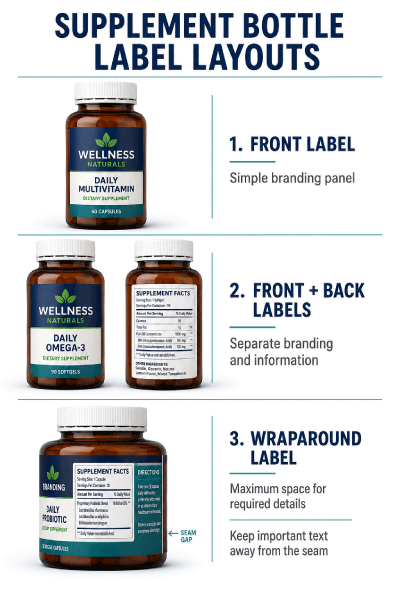
Front Labels, Front-and-Back Labels or Wraparound Labels?
The correct layout depends on the amount of information, application method and desired package appearance.
| Label Layout | Best Applications |
|---|---|
| Front Label | Product name, brand, benefit statement and capsule count. |
| Front and Back Labels | Hand-applied packaging that needs separate branding and information panels. |
| Wraparound Label | Supplement Facts, ingredients, directions, warnings, barcode and branding on one label. |
| Rectangle with Rounded Corners | Curved bottles where rounded corners help reduce edge lifting. |
When designing a wrap label, keep important content away from the seam. Barcodes, dosage directions and warnings should remain on a smooth, readable portion of the bottle.
Planning Space for Supplement Label Requirements
Supplement label size is not only a branding decision. FDA guidance identifies five basic statements required on dietary supplement labels: the statement of identity, net quantity of contents, nutrition labeling, ingredient list, and the name and place of business of the manufacturer, packer or distributor.
The statement of identity and net quantity of contents belong on the principal display panel. The Supplement Facts panel and other required information must follow applicable placement and formatting requirements. Because requirements and exemptions can be complex, have finished artwork reviewed by a qualified regulatory professional.
Official resources: FDA Dietary Supplement Labeling Guide and 21 CFR 101.36.
Best Label Materials for Supplement Bottles
| Material | Recommended Use |
|---|---|
| White Uncoated or White Matte Paper | Economical labels for dry products stored indoors. |
| Premium White Matte | Upscale vitamin, wellness and herbal packaging. |
| Semi-Gloss or White High Gloss | Retail packaging requiring vibrant colors and polished graphics. |
| Brown Kraft | Natural, herbal and artisan-style supplement branding. |
| White Matte Poly BOPP | Moisture resistance with a low-glare finish. |
| White PolyGloss BOPP | Durable, moisture-resistant packaging with a glossy finish. |
| Clear Film | Premium no-label appearance on clear or colored bottles. |
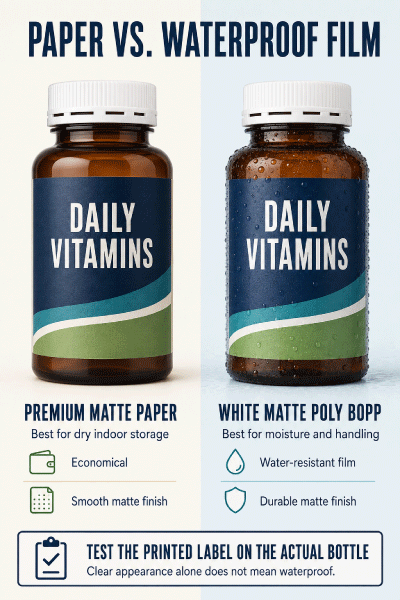
Clear material is not automatically waterproof. Water resistance depends on the facestock, coating, adhesive, printer ink and exposure conditions. Test the complete printed label on the actual bottle.
Waterproof Labels vs. Paper Labels
Many shelf-stable vitamin bottles stored in dry cabinets perform well with paper labels. Waterproof film materials are usually a better choice when the bottle may encounter refrigeration, condensation, damp gym bags, oily hands, repeated handling or routine wiping.
| Material | Recommended Use |
|---|---|
| Premium Matte Paper | Dry indoor vitamin and capsule bottles. |
| Semi-Gloss Paper | Retail products needing brighter printed colors. |
| White Matte Poly BOPP | Moisture, refrigeration and frequent handling. |
| White PolyGloss BOPP | Water-resistant, durable labels with vivid graphics. |
| Clear Film | No-label appearance; test construction and printed ink for required durability. |
Sheet Labels vs. Roll Labels
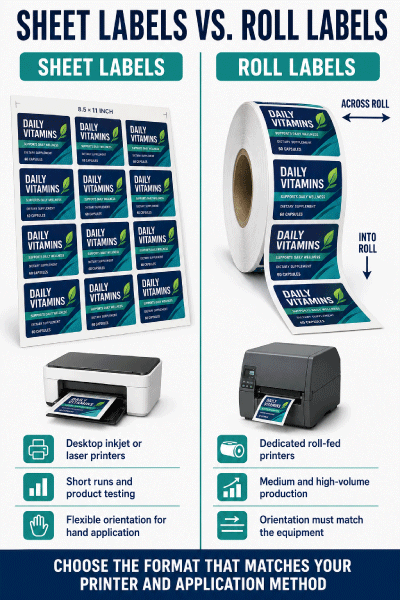
Both sheet labels and roll labels can produce professional supplement packaging. The best choice depends on printing equipment, order quantity and how the labels will be applied.
| Sheet Labels | Roll Labels |
|---|---|
| Ideal for startups, samples and short runs. | Best for medium and high-volume production. |
| Compatible with appropriate desktop inkjet and laser printers. | Designed for compatible dedicated roll-fed label printers. |
| Easy to print in small batches. | Efficient for repeated sequential printing. |
| Orientation is flexible when applied by hand. | Across-roll and into-roll orientation must match the printer or applicator. |
| Perfect for testing a new formula or design. | Well suited to automated or semi-automated application. |
Common Supplement Bottle Label Mistakes
- Choosing a label based only on capsule count.
- Measuring the entire bottle instead of the straight label panel.
- Allowing the label to extend onto the shoulder or bottom curve.
- Cutting a wrap label to the exact circumference and creating an unwanted overlap.
- Making a front label so wide that important branding disappears around the sides.
- Placing barcodes, warnings or directions at the wrap seam.
- Using paper labels where moisture or refrigeration requires a film.
- Forgetting to leave enough room for required product information.
- Ignoring label orientation when ordering roll labels.
- Skipping a full-size paper test on the production bottle.
Buying Tips
Before ordering supplement bottle labels, confirm:
- The exact bottle capacity, diameter and straight label-panel height.
- Whether the design uses a front label, front and back labels or a full wrap.
- The required printing technology and material compatibility.
- Whether waterproof or moisture-resistant film is needed.
- The desired finish: matte, gloss, kraft or clear.
- The amount of space required for the Supplement Facts panel and other information.
- The expected production volume.
- Whether labels will be applied by hand or machine.
- The required roll orientation, core and outside diameter when ordering roll labels.
Related Label Size Guides
- What Size Label for Cosmetic Jars?
- What Size Label for Lotion Bottles?
- What Size Label for Essential Oil Bottles?
- What Size Label for Mason Jars?
- What Size Label for Lip Balm Tubes?
Shop Blank Labels for Supplement Bottles
Whether you are launching a small wellness brand or producing supplements at scale, LaserInkjetLabels.com offers premium blank sheet labels and roll labels compatible with popular inkjet and laser printers.
Frequently Asked Questions About Supplement Bottle Labels
What is the best label size for a supplement bottle?
The ideal size depends on the bottle diameter and straight label-panel height. Small bottles often use 2" × 1.5" labels, medium bottles commonly use 2.5" × 2" or 3" × 2", and larger bottles may accept 3.5" × 2.5" or 4" × 3" labels.
What size label fits a 60-count vitamin bottle?
Count alone does not identify the bottle because capsule and tablet sizes vary. Many compact 60-count packages begin with a 2" × 1.25" or 2" × 1.5" front label, but the actual container must be measured.
What size label fits a 120-count supplement bottle?
A 120-count product may use several bottle capacities. Depending on the mold, 2.5" × 1.75", 2.5" × 2" or 3" × 2" may fit the front panel.
What size label fits a 200 cc packer bottle?
Many 200 cc bottles work with 2.5" × 2" or 3" × 2" front labels. Measure the label-panel height because shoulder designs differ.
What size label fits a 300 cc supplement bottle?
Common starting points include 3" × 2.25", 3.5" × 2.25" and 3" × 3". The correct height depends on the bottle’s straight sidewall.
How do I measure a round supplement bottle?
Measure the straight vertical panel for height. For a wrap label, measure around the body with a flexible tape and subtract approximately 1/8" to 1/4" to leave a small gap.
Should supplement labels wrap completely around the bottle?
A wrap can use most of the circumference, but leaving a small gap usually simplifies application and prevents unwanted overlap.
Can I use separate front and back labels?
Yes. Separate labels are useful for hand application. The front can feature branding while the back carries directions, warnings, barcode and other information.
Should supplement bottle labels be waterproof?
Paper is often suitable for dry indoor storage. Waterproof film is recommended when bottles may face condensation, refrigeration, damp environments, oily hands or repeated wiping.
What material is best for vitamin bottle labels?
Premium White Matte is a versatile paper option. White Matte Poly BOPP and White PolyGloss BOPP are better starting choices when moisture resistance and durability are required.
Are clear labels waterproof?
Not automatically. Clear appearance does not establish waterproof performance. Verify the exact facestock, coating, adhesive and printed ink under realistic conditions.
Can I print supplement labels on an inkjet printer?
Yes. Use sheet or roll materials specifically compatible with the exact inkjet printer and follow the recommended print settings.
Can I use a laser printer?
Many sheet label materials are compatible with laser printers. Confirm material compatibility before ordering and never run inkjet-only material through a laser printer.
Should I choose sheet labels or roll labels?
Sheet labels are ideal for startups, samples and smaller batches. Roll labels are generally more efficient for repeated production, dedicated roll printers and automated application.
Does roll-label orientation matter?
Yes. The across-roll and into-roll dimensions must match the printer and applicator. Orientation is usually less important for sheet labels applied by hand.
Can supplement labels be machine applied?
Yes. Roll labels can be configured for compatible automatic and semi-automatic applicators. Confirm roll direction, core size, outside diameter and copy position.
Where should the Supplement Facts panel go?
Placement and formatting depend on applicable FDA requirements and package design. Review current FDA guidance and have final artwork evaluated by a qualified regulatory professional.
Do rounded corners help on supplement bottles?
Rounded corners can reduce edge lifting and create a clean appearance on curved containers, particularly when the label is applied close to the edge of the straight panel.
Can I print QR codes and barcodes?
Yes. Maintain sufficient quiet space, contrast and resolution, and test every code after the label is applied to the curved bottle.
Can I request samples?
Yes. Samples allow you to test label fit, printer compatibility, ink drying, adhesion and material durability before placing a larger order.

