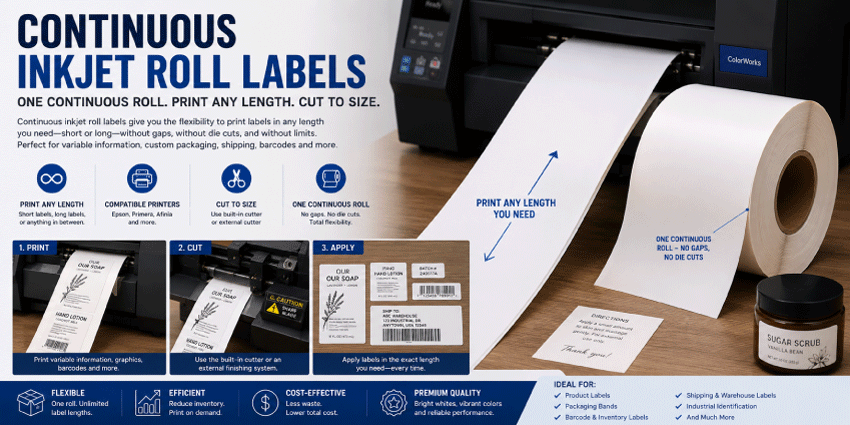
Continuous inkjet roll labels give businesses the flexibility to print labels at the length required for each product, package or application. Unlike pre-cut die-cut labels, continuous label material is supplied as an uninterrupted roll without individual label shapes cut into the face stock.
Compatible printers and finishing systems can print variable-length product labels, shipping labels, barcode labels, packaging bands, warehouse identification labels and other custom-length designs without requiring a separate die for every finished size.
LaserInkjetLabels.com offers continuous inkjet roll labels in a broad range of widths, materials, adhesives, core sizes and outside roll diameters for compatible Epson ColorWorks, Primera, Afinia, VIPColor, QuickLabel, NeuraLabel, Colordyne, SwiftColor, Kiaro, RapidLabel and other roll-fed color inkjet label-printing systems.
What Is a Continuous Roll Label?
A continuous roll label is a pressure-sensitive label material supplied without pre-cut individual shapes. The printer feeds and prints the material continuously, allowing the finished label length to be determined by the artwork, print job or compatible cutting system. The roll width remains fixed, while the printed length can change from one job to another.
Quick Navigation
Continuous Roll Labels: Quick Start Guide
Choosing the correct continuous roll label requires more than selecting a width. The label material, core diameter, outside roll diameter, roll direction, printer ink system and cutting method must all work with your equipment.
| Your Need | Recommended Starting Point | What to Confirm |
|---|---|---|
| Small barcode or identification labels | 1.5" to 2.5" continuous widths | Barcode size, cutter accuracy and minimum printable width |
| Product and package labels | 2.5" to 5" continuous widths | Package panel size, material finish and adhesive |
| Shipping, warehouse and carton labels | 4" to 6" continuous widths | Required print length, barcode scanning and surface type |
| Large packaging and industrial identification | 6" to 8.5" continuous widths | Printer maximum media width and roll capacity |
| Frequent short-run design changes | Inkjet-compatible continuous matte or gloss material | Ink compatibility, drying time and finished-use environment |
| Moisture-prone applications | Compatible synthetic poly material | Printed ink durability, adhesive performance and actual product exposure |
Before Ordering Continuous Roll Labels
Confirm your printer model, maximum media width, required core diameter, maximum outside roll diameter, winding direction, sensing requirements and cutting method. Requesting samples is strongly recommended when testing a new material, printer or application.
Why Use Continuous Inkjet Roll Labels?
Variable Label Lengths
Print short or long labels from the same roll width without purchasing a separate die-cut size for every design.
Reduced Die-Cut Inventory
A single continuous width may replace several pre-cut label lengths, helping reduce the number of stocked sizes.
Flexible Short Runs
Print limited quantities, seasonal designs, prototypes and changing product information as production requires.
Custom Packaging Bands
Produce extended labels and bands for boxes, bags, containers, trays and other packaging formats.
Variable Data Printing
Add changing barcodes, SKUs, serial numbers, dates, lot codes and personalized information.
On-Demand Production
Print labels when needed instead of storing large quantities of preprinted labels for every product variation.
Available Continuous Roll Label Widths
The roll width determines the maximum printable dimension across the web. The label length is controlled by the artwork, printer settings or compatible cutting system.
Our continuous inkjet roll label program begins at 1.5 inches wide because narrower continuous materials are less practical for our manufacturing process. The available range supports compact barcode labels through large industrial and packaging applications.
| Continuous Width | Common Applications |
|---|---|
| 1.5" | Barcodes, asset identification, small bottles and compact product labels |
| 1.75" | Small containers, narrow packages, barcode and inventory labels |
| 2" | Product identification, small package labels and variable-length bottle labels |
| 2.25" | Food packaging, bottles, barcode labels and small retail products |
| 2.5" | Coffee packaging, jars, bottles and general product labeling |
| 3" | Product packaging, warehouse identification, shipping and barcode labels |
| 3.5" | Jars, cartons, bags, boxes and promotional package labels |
| 4" | Shipping labels, carton labels, product packaging and warehouse operations |
| 4.5" | Large product labels, food packaging, pouches and cartons |
| 5" | Large containers, boxes, packaging bands and industrial identification |
| 5.5" | Large product panels, warehouse labels and extended packaging designs |
| 6" | Cartons, drums, large packages, industrial and logistics labels |
| 6.5" | Large packaging, warehouse signs and industrial product identification |
| 7" | Oversized package panels and large industrial labeling |
| 7.5" | Wide cartons, large containers and custom printed bands |
| 8" | Large industrial, chemical, warehouse and packaging applications |
| 8.25" | Wide-format packaging, industrial identification and large variable-length labels |
| 8.375" | Specialized wide-format printer and packaging applications |
| 8.5" | Full-width industrial, warehouse and product-packaging labels |
Individual width pages provide available materials, roll lengths, printer configurations and ordering options. Additional width links will be added to this hub as the remaining commercial pages are completed.
Continuous Roll Label Configurations
Continuous labels are offered in different core sizes and outside roll diameters to accommodate compact desktop printers, standard production printers and higher-capacity printing systems.
| Configuration | Core and Outside Diameter | Best For | Shop |
|---|---|---|---|
| Mini Rolls | 2" core with approximately 4" outside diameter | Compact desktop color label printers with limited roll capacity | View Mini Continuous Rolls |
| Standard Rolls | 3" core with approximately 6" outside diameter | General production printers and regular label-printing operations | View Standard Continuous Rolls |
| Double-Capacity Rolls | 3" core with approximately 8" outside diameter | Higher-volume printers, unwinders and production environments | View Double-Capacity Continuous Rolls |
| Triple-Capacity Rolls | Larger production roll configuration where available | Compatible external unwinders and high-volume production systems | Browse Inkjet Roll Label Configurations |
Why Roll Capacity Matters
A larger roll contains more material, reducing roll changes and operator interruptions. However, the largest roll is not automatically the right choice. The printer or external unwinder must support the core diameter, roll width, roll weight and outside diameter.
Never force a roll into a printer that was designed for a smaller configuration. Confirm the printer specifications before ordering.
Continuous Label Printer Compatibility
Continuous roll labels can be used with many color inkjet roll-label printers, provided the media width, core, outside diameter, sensing mode, ink system and cutting method meet the printer’s requirements.
| Roll Configuration | Compatible Printer Examples | Important Notes |
|---|---|---|
| 2" Core / 4" OD | Primera LX400 and LX500; Epson ColorWorks C3400, C3500 and C4000 series | Compact rolls for printers with limited internal roll capacity |
| 3" Core / 6" OD | Primera LX600, LX900, LX910, LX1000, LX2000 and LX3000 series; Epson C6000, C6500, C7500 and C8321; Afinia L301, L501, L701, L801 and L901; VIPColor VP700; compatible Colordyne, Kiaro, TrojanLabel, SwiftColor, QuickLabel and RapidLabel systems | Confirm printer media width, sensor setting and cutter support |
| 3" Core / 8" OD | Compatible Kiaro, TrojanLabel, Epson C831 and C6000 series, Afinia L501 and L801, Colordyne CDT-1600C, SwiftColor SCL-4000D, RapidLabel X1, QuickLabel/AstroNova QL-111 and QL-800, NeuraLabel 300X and 500E, and Kirk-Rudy systems | May require an external unwinder or printer designed for larger rolls |
Printer Compatibility Disclaimer
Printer models and configurations can vary. A model family may support different maximum widths, core sizes, roll diameters, sensors or cutters depending on the exact version. Verify the manufacturer’s current specifications and request material samples before ordering production quantities.
For additional guidance, visit our Inkjet Roll Label Printer Compatibility Guide.
Continuous Inkjet Roll Label Materials
Material choice affects print quality, appearance, durability, flexibility and resistance to moisture or handling. Use material specifically coated for the ink technology in your printer.
| Material | Appearance | Common Uses | Considerations |
|---|---|---|---|
| White Uncoated | Economical matte paper surface | General identification, shipping, warehouse and indoor product labels | Best for dry indoor conditions |
| Premium Matte | Smooth matte finish with professional color reproduction | Retail products, food packaging, cosmetics and branded labels | Verify compatibility with the printer’s ink system |
| Semi-Gloss | Moderate shine with polished appearance | Product packaging and retail labels | Paper construction is not intended for prolonged moisture exposure |
| ViVidGloss | High-gloss finish designed for vibrant graphics | Premium branding, colorful packaging and retail products | Allow appropriate drying time before handling |
| Brown Kraft | Natural brown, handmade appearance | Artisan foods, candles, soaps, coffee and natural products | Printed colors interact with the brown background |
| Matte Poly | Durable matte synthetic film | Moisture-prone packaging, industrial labels and frequently handled products | Test printed ink resistance with the actual application |
| PolyGloss | Glossy synthetic film with durable construction | Beverage, bath, food and moisture-resistant product labeling | Confirm ink and adhesive performance under real-use conditions |
Compare material specifications on our Inkjet Roll Label Materials page.
Choosing the Right Adhesive
Most continuous roll labels use a permanent pressure-sensitive adhesive suitable for clean, dry and relatively smooth surfaces. Adhesive performance depends on the package material, surface energy, temperature, moisture, dust, oils and application pressure.
Before Applying Continuous Labels
- Clean the surface to remove dust, oil, moisture and product residue.
- Apply labels at the recommended temperature.
- Use firm, even pressure across the entire label.
- Avoid severe curves, seams, ridges and recessed areas when possible.
- Allow the adhesive time to build its final bond before testing.
- Test samples on the actual package under normal storage and shipping conditions.
Specialty adhesives may be required for textured surfaces, low-surface-energy plastics, refrigerated products, freezer environments or unusually demanding industrial applications.
Common Uses for Continuous Roll Labels
Product Labels
Create different label lengths for bottles, jars, bags, boxes, cartons and other packages using a single continuous width.
Barcode and Inventory Labels
Print variable barcode lengths, SKUs, serial numbers, lot codes, locations and inventory information.
Shipping and Warehouse Labels
Produce custom-length carton labels, routing labels, pallet identification and logistics documentation.
Packaging Bands
Print extended branding bands for boxes, trays, clamshells, bags, sleeves and bundled products.
Industrial Identification
Label equipment, bins, shelves, drums, containers, parts and production areas with custom-length information.
Food and Beverage Packaging
Create product labels and packaging bands for coffee, baked goods, sauces, jars, bottles and specialty foods.
Chemical and Safety Labels
Print variable-length identification and warning information where compatible materials and regulatory requirements are met.
Prototype and Short-Run Labels
Test new products and packaging designs without ordering a new die-cut label size for every prototype.
Continuous Roll Labels vs. Die-Cut Roll Labels
Continuous and die-cut labels serve different production needs. The better choice depends on finished shape, application speed, cutter availability and the number of label sizes your operation requires.
| Feature | Continuous Roll Labels | Die-Cut Roll Labels |
|---|---|---|
| Finished length | Variable | Fixed by the die-cut size |
| Finished shape | Usually rectangular after cutting | Rectangles, squares, circles and ovals |
| Inventory flexibility | One width can support multiple lengths | Separate roll required for each finished size |
| Cutting requirement | Requires a compatible printer cutter or finishing method | Individual labels are already separated by the die cut |
| Application speed | Depends on cutting and finishing workflow | Often more convenient for dispensing and application |
| Best use | Changing lengths, prototypes, packaging bands and flexible production | Repeating fixed-size labels and efficient application |
When Continuous Labels Are the Better Choice
- You regularly print several label lengths with the same width.
- Your product information changes from one job to another.
- You need extended packaging labels or bands.
- You want to reduce the number of stocked die-cut sizes.
- Your printer includes or supports an appropriate cutter.
When Die-Cut Labels May Be Better
- You repeatedly print one established label size.
- You need circles, ovals or other pre-cut shapes.
- Labels will be applied with a dispenser or automatic applicator.
- Consistent finished dimensions are essential.
- You do not have a practical cutting or finishing method.
How to Order Continuous Inkjet Roll Labels
Step 1: Confirm the Printer Model
Record the complete printer model and configuration. Printers within the same family may have different media-width, core, sensor or cutter specifications.
Step 2: Determine the Required Width
The continuous roll width should match the finished label dimension across the media. Select a width that fits the package while remaining within the printer’s supported media range.
Step 3: Choose the Roll Configuration
Determine whether the printer requires a 2-inch or 3-inch core and identify its maximum outside roll diameter. Larger rolls may require an external unwinder.
Step 4: Select the Material
Choose matte, gloss, kraft or synthetic material according to the desired appearance, printer ink system, surface and environment.
Step 5: Confirm the Cutting Method
Determine whether the printer includes an automatic cutter, manual tear bar or separate finishing system. The cutting method affects workflow and finished label consistency.
Step 6: Test Samples
Print and apply samples before ordering production quantities. Test image quality, drying, cutting, feeding, adhesion and finished-use durability.
Need Help Selecting a Continuous Roll?
Provide your printer model, desired width, material preference, core size and maximum outside roll diameter. Our team can help narrow the available choices and provide samples for testing.
Contact Customer ServiceWhy Buy Continuous Roll Labels from LaserInkjetLabels.com?
- Broad width selection: Continuous materials from 1.5 inches through large wide-format options.
- Multiple roll configurations: Options for compact, standard and higher-capacity printing systems.
- Printer-focused guidance: Support for customers using Epson, Primera, Afinia and other roll-label printers.
- Material choices: Matte, gloss, kraft and synthetic options for a wide range of applications.
- Sample testing: Test materials before committing to larger production quantities.
- Blank and custom options: Print in-house or explore professionally printed roll-label services.
- Made for business production: Continuous media for product manufacturers, warehouses, fulfillment operations and industrial users.
Frequently Asked Questions About Continuous Roll Labels
What are continuous roll labels?
Continuous roll labels are pressure-sensitive label materials supplied without individual labels die cut into the roll. The material can be printed and cut to different lengths using compatible equipment.
Can continuous labels be printed at any length?
The printable length can vary, but practical limits may be imposed by the printer driver, software, cutter, artwork or application. Review your printer specifications before designing unusually long labels.
Can Epson ColorWorks printers use continuous labels?
Many Epson ColorWorks models can use compatible continuous media, but supported widths, sensors, cutters, core sizes and roll diameters vary by model. Confirm the exact specifications for your printer.
Can Primera printers use continuous labels?
Certain Primera printers can use continuous media. Verify the printer’s minimum and maximum media width, roll capacity, sensing options and cutting capabilities.
Do I need a cutter?
A cutter or other finishing method is normally required to separate continuous material into individual labels. Some printers have an integrated cutter, while others use a manual tear bar or external finishing equipment.
What is the smallest continuous width available?
Our commercial continuous roll program begins at 1.5 inches wide. Narrower widths are not currently prioritized because they are less suitable for our manufacturing process.
What is the widest continuous roll available?
Continuous widths are available through approximately 8.5 inches for compatible wide-format roll-label printing systems. Printer capability must be confirmed before ordering.
Are continuous labels waterproof?
Continuous labels are available in both paper and synthetic materials. Synthetic poly options provide greater resistance to moisture, but final durability depends on the face stock, adhesive, printer ink and actual exposure conditions.
Can continuous labels be used for shipping labels?
Yes. Continuous media can be useful for shipping, warehouse and logistics labels when a compatible printer, material and cutting method are used.
Can I print barcodes on continuous labels?
Yes. Continuous labels can be used for variable barcodes, serial numbers, inventory codes and shipping information. Test barcode contrast, quiet zones and scanning performance on the finished label.
What core size do I need?
Compact printers commonly use 2-inch cores, while many production printers use 3-inch cores. Confirm the printer or unwinder specification rather than selecting a core based only on the brand.
Can I use a larger roll to reduce roll changes?
Yes, when the printer or external unwinder supports the larger core, outside diameter, width and weight. Larger rolls should not be used in equipment that is not designed to accommodate them.
Can continuous labels be applied automatically?
Continuous media normally must first be printed and separated into finished labels. Die-cut labels are often more convenient for conventional automatic application systems.
Can I request samples?
Yes. Sample testing is recommended to verify printer feeding, print quality, drying, cutting, adhesive performance and durability.
Do you offer custom printed continuous labels?
Custom printed label options depend on the required construction, finished format and production method. Contact customer service with your dimensions, material, artwork and quantity requirements.
Shop Continuous Inkjet Roll Labels
Choose continuous label material by width, printer configuration, core size, outside roll diameter and material. Request samples when evaluating a new printer or application.
Mini Rolls Standard Rolls Double-Capacity Rolls Request SamplesRelated Blank Roll Label Resources
- Blank Roll Labels
- Blank Inkjet Roll Labels
- Inkjet Roll Label Printer Compatibility Guide
- Inkjet Roll Label Materials
- Labels for Primera Roll Label Printers
- Labels for Epson Roll Label Printers
- Labels for Afinia Roll Label Printers
- Blank Laser Roll Labels
- LED Color Laser Printer Roll Labels
- Custom Printed Roll Labels
- Shop All Blank Inkjet Roll Labels