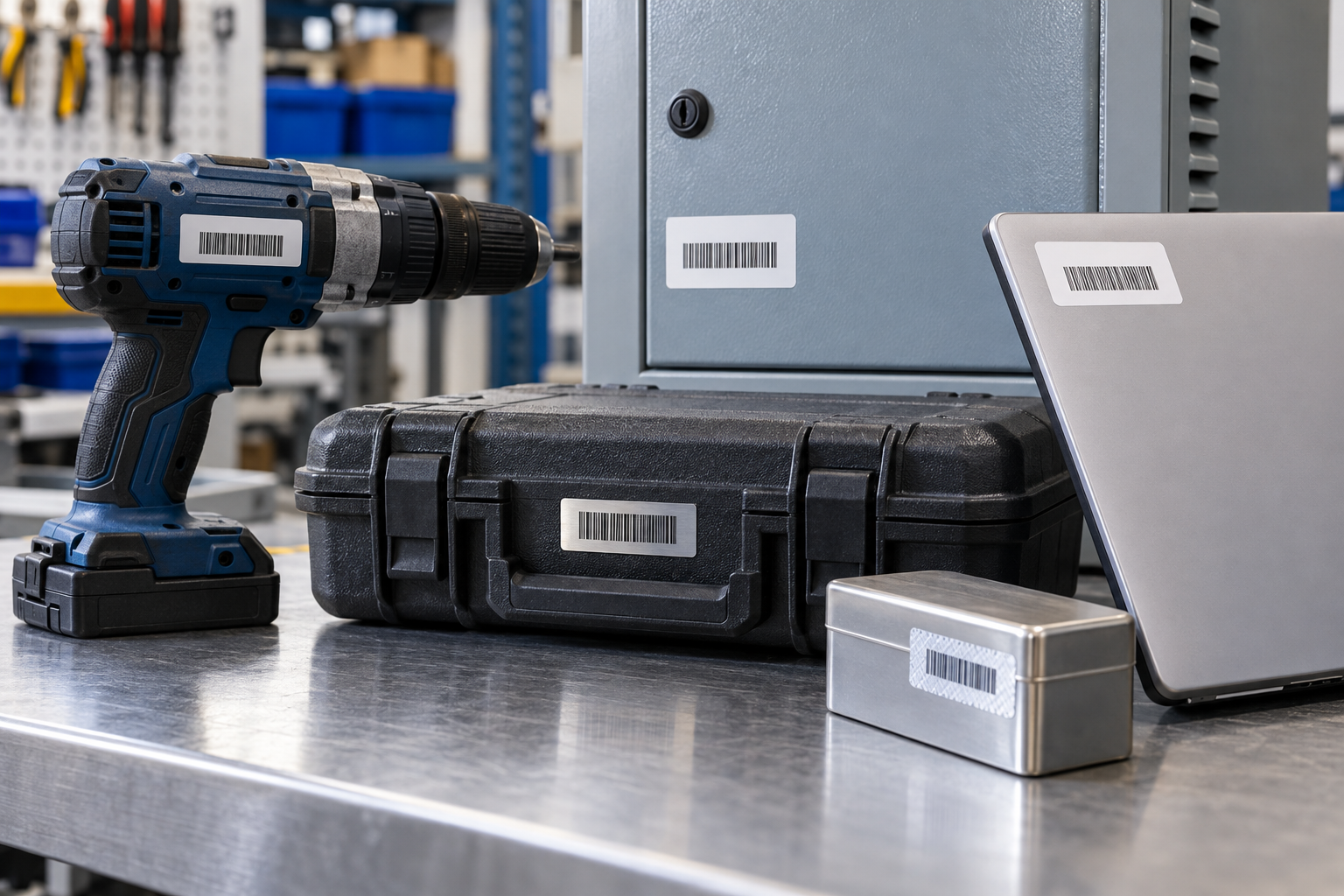
Equipment labels and asset tags identify tools, machinery, electronics and facility assets. The right label depends on the application surface, printer, moisture and chemical exposure, temperature, abrasion, security needs and expected service life. No single material is best for every piece of equipment.
Choose blank printable sheets when you need to create labels on demand. Choose custom printed labels when you need finished branding, barcodes, serial numbers, weather-resistant construction or tamper evidence without printing them in-house.
Shop White Poly Laser Labels | Shop White PolyGloss Labels | Explore Custom Weather-Resistant Labels
Quick Answer: Which Equipment Label Should You Choose?
| Application | Good Starting Point | Check Before Ordering |
|---|---|---|
| Indoor tools, computers and office assets | Printable polyester or BOPP label with permanent adhesive | Printer compatibility, surface texture, abrasion and label size |
| Machinery exposed to water, oil or cleaning | Polyester, BOPP or a custom weather-resistant construction | Exact liquid, contact time, wiping and printed-image durability |
| Outdoor equipment | Custom printed weather-resistant label selected for the exposure | Sunlight, temperature range, rain, abrasion and expected service life |
| IT assets and items where label transfer is a concern | Custom destructible tamper-evident label | Surface compatibility, cure time and whether visible residue is required |
| Assets tracked with barcodes or serial numbers | Blank printable or custom printed asset label | Scanner distance, barcode size, contrast and variable-data requirements |
Test first: Apply a sample to the actual cleaned surface and expose it to the real handling, moisture, temperature and cleaning conditions. A label that works on smooth painted metal may perform differently on textured plastic, powder coating or an oily surface.
Blank Printable Equipment Labels
White Poly Laser Labels
White Poly Laser labels use a durable polyester facestock and are designed for laser printers, not inkjet printers. They are a practical option for on-demand asset IDs, barcodes and equipment information where paper labels may not provide enough resistance to water, oils, chemicals, tearing or abrasion. Confirm that the permanent adhesive is suitable for the exact metal, plastic, glass or painted surface.
Compare White Poly Laser label sizes
White PolyGloss BOPP Labels
White PolyGloss is a glossy white BOPP film that can be printed with compatible inkjet or laser printers. It sheds water better than paper and is useful when you want glossy color plus a moisture-resistant synthetic facestock. It should not be described as universally waterproof: the printed result also depends on the ink or toner, adhesive, abrasion and duration of exposure. Test cleaning chemicals, oils and outdoor use rather than assuming resistance.
Compare White PolyGloss label sizes
Custom Printed and Tamper-Evident Equipment Labels
Custom Weather-Resistant Labels
Custom printed labels are useful when you need a finished design, company branding or a construction selected for outdoor and demanding environments. Provide the application surface, expected sunlight, temperature, moisture, cleaners and abrasion when requesting a recommendation. Ask whether barcodes, variable data or sequential numbering are available for your order.
Explore custom weather-resistant labels
Destructible Tamper-Evident Labels
Destructible labels fragment when removal is attempted, making it difficult to move an asset label intact from one item to another. They can help identify interference with IT equipment, electronics, tools and other controlled assets. They are not a substitute for a complete security or inventory system, and they should be tested on the actual surface before production.
Explore custom destructible tamper-evident labels
Match the Label to the Equipment Surface and Environment
- Identify the surface. Note whether it is smooth or textured metal, plastic, glass, powder coating or painted material.
- Clean and dry the application area. Remove dust, oil, moisture and residue with a cleaner that will not damage the equipment. Allow the surface to dry completely.
- Define the exposure. Record indoor or outdoor use, temperature changes, water, oils, cleaning agents, abrasion and handling.
- Choose the printer and material together. White Poly Laser is laser-only. White PolyGloss works with compatible inkjet or laser printers. Always verify the product specification.
- Apply with firm, even pressure. Avoid seams, rivets, sharp bends and frequently rubbed edges. Allow the adhesive time to build its bond before testing.
- Run a real-use test. Check adhesion, print readability and barcode scanning after the expected cleaning, handling and exposure.
Equipment Label Size, Layout and Barcode Tips
- Measure the flat application area and leave clearance around curves, vents, seams and moving parts.
- Use the largest practical text and barcode for the viewing and scanning distance.
- Keep strong contrast between the barcode and its background, and preserve the required blank space around the code.
- Include only information that helps identify or service the asset, such as asset number, department, contact information or inspection date.
- Print a paper sample first to confirm size and placement before using the final material.
Use the label size guides | Find a label template | Ask for material or sample help
Frequently Asked Questions
What type of label is best for equipment?
Choose the label according to the surface and exposure. Polyester or BOPP can be a good starting point for durable indoor identification, while custom weather-resistant constructions are better candidates for outdoor equipment. Use destructible material when attempted transfer or removal needs to be visible.
Are equipment labels waterproof?
Some synthetic facestocks resist water better than paper, but the finished label is only as durable as its facestock, ink or toner, adhesive and exposure conditions. Treat “waterproof” as an application-specific performance claim and test the complete printed label before production.
Can I print equipment labels with an inkjet or laser printer?
Yes, when the material is made for that printer. White Poly Laser is for laser printers only. White PolyGloss works with compatible inkjet or laser printers. Confirm the product specification and test drying, toner bonding and abrasion resistance.
Will equipment labels stick to metal or plastic?
Permanent adhesives commonly bond to clean, smooth metal and many plastics, but textured surfaces, powder coatings, oily equipment and low-surface-energy plastics can be difficult. Test the exact label on the cleaned asset and allow time for the adhesive bond to develop.
How should I prepare equipment before applying a label?
Remove dust, grease, moisture and cleaner residue without damaging the equipment. Let the surface dry, avoid touching the adhesive, apply the label with even pressure and wait before exposing it to cleaning or harsh conditions.
What size should an asset label be?
Use a size that fits a flat area without covering vents, controls, seams or safety information. The text and barcode must remain readable at the intended viewing or scanning distance. Test a paper mockup on the asset before ordering.
Can equipment labels include barcodes or serial numbers?
Yes. Blank printable labels can be used with your own barcode or asset-management software. Custom printed options may support barcodes, variable data or sequential numbers; provide the data and scanning requirements when requesting a quote.
When should I use tamper-evident equipment labels?
Use tamper-evident or destructible labels when you want removal or attempted transfer to be noticeable. They are useful for IT assets, electronics, tools and controlled equipment, but should be combined with normal inventory and security procedures.
Shop Equipment and Asset Label Options
Compare blank printable materials or contact us with the surface, environment, printer, size and quantity. Testing a sample on the actual equipment is the most reliable way to confirm fit.