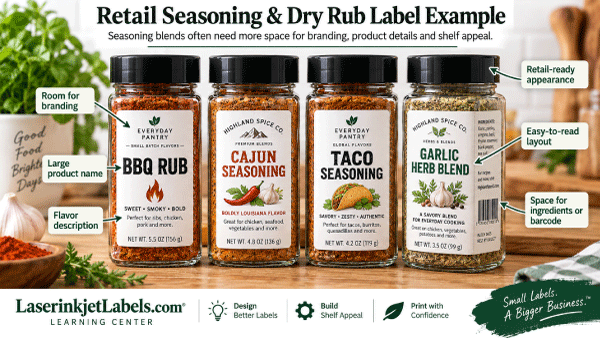
A good spice jar label needs to do more than identify what’s inside the container. For businesses selling spices, herbs, dry rubs and seasoning blends, the label also plays an important role in branding, product presentation and helping customers quickly distinguish one product from another.
For home kitchens and pantry organization, the priorities may be simpler: a clean design, easy-to-read spice names and labels that fit neatly on the jars.
Whether you need spice bottle labels for retail packaging, blank seasoning labels for short runs, or printable spice jar labels for pantry organization, the same sizing and material principles apply. This guide also explains when professionally printed custom spice labels are the better choice.
Whether you’re labeling a few jars at home or producing hundreds of seasoning products for retail, choosing the right spice jar labels starts with four decisions:
- Label size and placement
- Label material
- Sheet or roll format
- How the labels will be printed
This guide will walk through each choice and help you decide which type of label makes the most sense for your spice jars.
Quick Guide to Choosing Spice Jar Labels
| Need | Good Starting Point |
|---|---|
| Simple spice name | Small rectangular front label |
| Pantry organization | Front label, round lid label, or both |
| Retail spice jars | Larger rectangular front label |
| Spice jar lids | Round labels |
| Tall spice bottles | Vertical rectangular label |
| Ingredients and product information | Larger front or side label |
| Higher-volume production | Roll labels |
| Small batches or many varieties | Sheet labels |
| Finished labels ready to apply | Custom printed labels |
| Exposure to moisture or frequent handling | Moisture-resistant label material |
Because spice jars vary considerably in diameter, height and shape, always measure the actual container before ordering.
For detailed size recommendations, see our Spice Jar Label Size Guide.
What Makes a Good Spice Jar Label?
Spice packaging presents a few unique challenges.
The containers are often small, which means there is limited space for a label. At the same time, the most important information needs to remain easy to read.
A successful spice label usually creates a clear visual hierarchy.
The spice or seasoning name should normally be the easiest element to identify. Branding, variety information, ingredients and other details can then be arranged around it according to the amount of available space.
For a retail seasoning blend, for example, you may need room for:
- Product name
- Company logo
- Flavor or variety
- Ingredients
- Net weight
- Directions or suggested uses
- Barcode
- QR code
- Website or contact information
- Lot or batch information
A jar used only for home pantry organization may need nothing more than Basil, Oregano or Smoked Paprika printed in a clear, consistent style.
The right label depends heavily on how the jar will be used.
Front Labels, Lid Labels or Both?
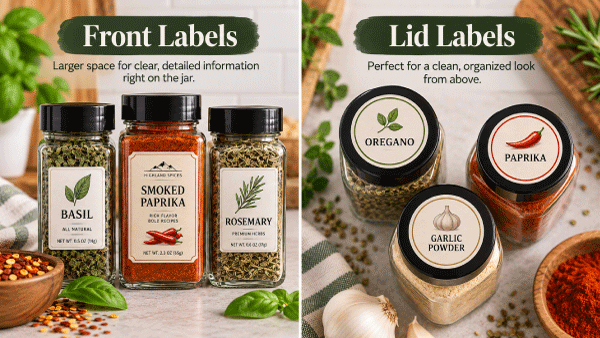
One of the first decisions is where your spice label should go.
Front Spice Jar Labels
A rectangular label on the front of the jar provides the most visible branding when jars are displayed on shelves.
Front labels work particularly well for:
- Retail spice jars
- Seasoning blends
- Dry rubs
- Specialty salts
- Dried herbs
- Small-batch food products
- Farmers market products
- Gift sets
Rectangular labels also provide more room than most lid labels for ingredients, branding and product information.
Spice Jar Lid Labels
Round labels are an excellent choice for lids.
They’re especially useful when spice jars are stored in a drawer, countertop rack or cabinet where customers or family members may view the jars from above.
A lid label can display:
- Spice name
- Flavor
- Logo
- Color coding
- Product variety
Small spice containers may use only a lid label.
Using Both
For retail packaging or an organized pantry, using both can create an especially polished appearance.
For example:
Front label:
SMOKED PAPRIKA
Brand name and product information
Lid label:
SMOKED PAPRIKA
The customer can identify the product whether viewing it from the front or from above.
What Size Label Works Best on Spice Jars?
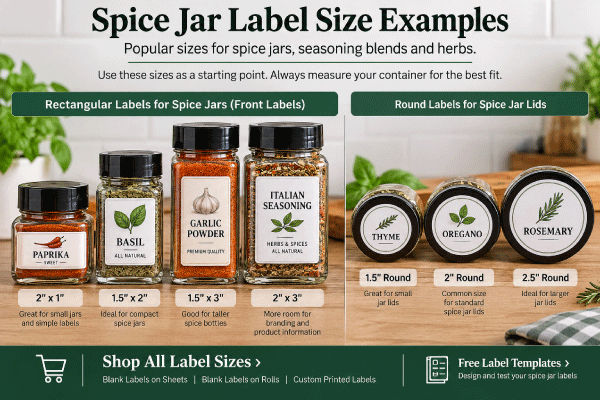
There isn’t one standard spice jar size, so there isn’t one universal label size.
However, several smaller label sizes work particularly well for common spice containers.
- 2″ x 1″ for small jars and simple spice names
- 1.5″ x 2″ for compact front labels
- 1.5″ x 3″ for taller spice bottles
- 2″ x 3″ when additional branding or information is needed
- 1.5″ round for small lids
- 2″ round for standard lids
- 2.5″ round for larger lids
These should be treated as starting points rather than guaranteed fits.
Jar designs differ between manufacturers, even when the advertised container capacity is the same.
Test the Size Before Ordering
A simple way to test a label is to print the proposed size on plain paper.
Cut it out and place it against the actual spice jar.
Check that:
- The label stays within the smooth portion of the container.
- The edges don’t extend onto heavily curved areas.
- The product name remains easy to read.
- Important information isn’t wrapped too far around the side.
- The label looks proportionate to the container.
You can also use our free label templates to test common label sizes before purchasing your blank labels.
For a more detailed chart, visit our Spice Jar Label Size Guide.
Choosing a Label Material for Spice Jars
Once you know the size, the next question is material.
The best material depends on the appearance you want and the environment where the jar will be used.
White Matte or Uncoated Labels
White labels are one of the most versatile choices for spice packaging.
They’re a good option for:
- Pantry labels
- Small spice businesses
- Ingredient labels
- Retail products
- Test batches
- Short production runs
A white background also gives you a neutral surface for printing logos, colors and photographs.
Gloss Labels
Gloss materials can give retail spice packaging a more polished appearance.
They’re particularly useful when your artwork includes:
- Bright colors
- Detailed logos
- Product photography
- High-contrast graphics
A glossy finish can help seasoning blends and specialty spices stand out on a retail shelf.
Kraft Labels
Brown kraft labels can complement products positioned around a handmade, natural, rustic or small-batch appearance.
They can work especially well for:
- Artisan seasoning blends
- Barbecue rubs
- Specialty salts
- Farm-produced herbs
- Farmers market products
- Gift sets
Remember that the brown background becomes part of the design, so artwork that looks good on white stock may need to be adjusted for kraft.
Moisture-Resistant Materials
Spice jars aren’t normally exposed to the same conditions as refrigerated beverage containers, but kitchen environments can still involve moisture, cooking residue, oils and frequent handling.
For products that may encounter these conditions, consider a more durable or moisture-resistant material.
It’s always wise to test the actual label stock with your container and printer before committing to a large production run.
Sheet Labels vs. Roll Labels for Spice Jars
Both formats can work well. The better choice depends primarily on your printer and production volume.
Blank Sheet Labels
Blank labels on sheets are a good choice when you want to print labels using a compatible standard laser or inkjet printer.
Sheets make sense for:
- Small batches
- Home spice organization
- Startup spice businesses
- Frequently changing varieties
- Seasonal products
- Test products
- Short production runs
For example, a small seasoning company might print several sheets of taco seasoning today, garlic herb tomorrow and barbecue rub later in the week.
That flexibility can make sheet labels very practical.
Blank Roll Labels
Blank labels on rolls are intended for compatible roll label printers.
Roll labels become especially attractive when you’re printing higher quantities or using dedicated color label printers such as compatible Epson ColorWorks, Primera or Afinia systems.
They’re useful for:
- Growing spice businesses
- Larger production runs
- Frequent label printing
- Many product varieties
- Production environments
- Businesses already using a roll label printer
Roll-fed printing also eliminates the need to feed individual sheets through the printer.
Custom Printed Spice Labels
If you don’t want to print labels yourself, another option is to have them professionally printed.
Custom printed labels arrive finished and ready to apply to your spice jars.
This can make sense when:
- Your artwork doesn’t change frequently.
- You’re producing larger quantities.
- You don’t want to maintain your own label printer.
- You want labels ready for production when they arrive.
Printing Spice Jar Labels In-House
Printing your own labels can be particularly useful for spice and seasoning companies because product lines often contain many different varieties.
One company might sell:
- Garlic powder
- Onion powder
- Smoked paprika
- Cajun seasoning
- Taco seasoning
- Italian seasoning
- Steak seasoning
- Barbecue rub
- Lemon pepper
- Specialty salts
If every variety required a separate large order of preprinted labels, inventory could become difficult to manage.
Printing blank labels as needed lets you maintain blank label inventory and produce the specific design you need.
This is especially helpful for:
- Limited-production flavors
- Seasonal products
- New product testing
- Private-label products
- Small-batch seasoning blends
Designing Spice Labels That Are Easy to Read
Small containers require disciplined design.
Trying to fit too much information onto the front of a small spice jar can make the label difficult to read.
Start with the information customers need to see first.
Make the Spice Name Prominent
Someone standing in front of a spice rack should quickly be able to distinguish:
BASIL
from
OREGANO
from
THYME
Avoid making the brand name so dominant that the actual spice becomes difficult to identify.
Use Consistent Design Across the Product Line
If you’re selling multiple seasonings, a consistent label system makes the entire product line look more professional.
Keep elements such as these consistent:
- Logo placement
- Font family
- Label size
- Product-name location
- Barcode location
- Net-weight placement
Then distinguish products using controlled changes such as color, imagery or flavor names.
Don’t Overcrowd the Front Label
If ingredients or other information make the front difficult to read, consider using a second label on the back or side.
The front can concentrate on the product name and branding while the secondary label carries supporting information.
Spice Labels for Seasoning Blends and Dry Rubs
Seasoning blends often need more label space than single-ingredient spices.
A jar labeled simply Ground Cinnamon may require relatively little explanation.
A specialty barbecue seasoning may need room for:
- Product name
- Flavor description
- Ingredients
- Suggested uses
- Preparation instructions
- Company information
- Barcode
- Website
- QR code
For these products, consider a larger rectangular label rather than trying to force everything onto a small decorative label.
Tall spice bottles can be particularly useful because they often provide additional vertical space for label information.
Using QR Codes on Spice Jar Labels
A QR code allows a small jar to connect customers with information that doesn’t fit comfortably on the label.
A spice company might link a QR code to:
- Recipes
- Cooking instructions
- Product information
- Reorder pages
- Videos
- Social media
- Related seasonings
For example, a taco seasoning label could link customers directly to recipes using that blend.
Make sure the code is large enough to scan reliably and always test it after printing.
Barcodes on Retail Spice Labels
If your spice product will be sold through retail stores, you may also need space for a barcode.
Smaller spice containers make barcode placement particularly important.
Before finalizing the design:
- Determine how much room your barcode requires.
- Keep the barcode away from heavily curved portions of the container when possible.
- Maintain adequate contrast around the barcode.
- Print and test the finished label.
- Verify the code scans after the label has been applied to the actual jar.
Don’t assume that a barcode that scans perfectly on a computer screen will perform exactly the same after being reduced and printed.
Common Spice Jar Label Mistakes
A few simple mistakes can create unnecessary production problems.
Choosing the Label Before Choosing the Jar
Select your production container first whenever possible.
Then measure the actual jar.
Changing container suppliers later can also change the usable label area.
Placing Labels Across Curves
Labels generally perform best on the smoothest available portion of the jar.
Avoid positioning an edge directly over a strong shoulder, ridge or curve.
Making Text Too Small
Just because information technically fits doesn’t mean customers can comfortably read it.
Prioritize important information and use additional label space when necessary.
Using the Wrong Material for the Printer
Label materials may be designed specifically for inkjet, laser or particular roll-fed printing systems.
Always confirm material and printer compatibility before ordering.
Printing a Full Production Run Without Testing
Print several test labels first.
Check:
- Color
- Alignment
- Text size
- Barcode scanning
- QR-code scanning
- Adhesion
- Overall appearance
A five-minute test can prevent wasting an entire production run.
Popular Uses for Spice Jar Labels
Spice jar labels aren’t limited to traditional grocery-store spices.
The same types of labels can be used for:
- Dried herbs
- Seasoning blends
- Barbecue rubs
- Specialty salts
- Pepper blends
- Baking spices
- Tea blends
- Dry mixes
- Chili powders
- Taco seasonings
- Restaurant prep containers
- Farmers market products
- Gift sets
- Wedding favors
- Pantry organization
- Private-label food products
This makes small rectangular and round labels useful sizes to keep available if your business produces multiple types of packaged products.
Where to Start
If you’re still deciding which spice jar label you need, start with the container.
- Measure the usable flat area.
- Decide whether you want a front label, lid label or both.
- Determine how much information needs to appear on the label.
- Choose a material appropriate for your printer and environment.
- Test the proposed label size using a paper template.
- Choose sheet labels, roll labels or custom printed labels based on your production process.
For specific size recommendations, visit our Spice Jar Label Size Guide.
Shop Labels for Spice Jars
LaserInkjetLabels.com offers blank labels for businesses printing their own spice labels, along with custom printed options for businesses that want finished labels ready to apply.
Shop Blank Label Sheets
Print your own spice labels with compatible laser or inkjet printers.
Shop Blank Roll Labels
Print spice and seasoning labels with compatible roll-fed inkjet label printers.
Custom Printed Labels
Have your spice labels professionally printed and delivered ready to apply.
Free Label Templates
Set up your artwork and test label placement before printing.
Frequently Asked Questions About Spice Jar Labels
What size labels are best for spice jars?

Common starting points include 2″ x 1″, 1.5″ x 2″, 1.5″ x 3″ and 2″ x 3″ rectangular labels. Round labels such as 1.5″, 2″ and 2.5″ are commonly used for lids. Because jar dimensions vary, measure your actual container before ordering.
What type of label should I use for spice jars?
White matte or uncoated labels are versatile for everyday spice labeling, while gloss materials can provide a more polished retail appearance. Kraft labels can create a rustic appearance. For jars likely to encounter moisture, oils or frequent handling, consider a more durable moisture-resistant material.
Can I print my own spice jar labels?
Yes. Blank label sheets can be printed using compatible laser or inkjet printers, while blank roll labels can be printed using compatible roll-fed label printers. Make sure the material you select is designed for your particular printer.
Are round or rectangular labels better for spices?
Rectangular labels generally provide more room for product names, ingredients and branding on the front of the jar. Round labels are particularly useful on spice jar lids. Many products use both.
Should I use sheet or roll labels?
Sheet labels are convenient for smaller runs and businesses using standard compatible printers. Roll labels can be more efficient for higher-volume production with dedicated roll label printers.
Can I use spice jar labels for seasoning blends?
Yes. The same labels work well for seasoning blends, barbecue rubs, herbs, specialty salts, dry mixes and similar packaged food products.
Can I add barcodes and QR codes to spice labels?
Yes. Both can be incorporated into the design if enough label space is available. Always test printed barcodes and QR codes on the finished jar before beginning a full production run.
How can I test a spice label size before ordering?
Download a free label template, print the proposed size at 100% actual size, cut it out and position it on your spice jar. This gives you a simple real-world preview of the size and placement.
Where can I find exact spice jar label size recommendations?
See our complete Spice Jar Label Size Guide for recommended sizes for small, standard, tall and larger spice containers.
