Handmade soap can look beautiful on its own, but the label helps a shopper identify the scent, recognize the brand and understand what is inside the package. A soap bar sold at a farmers market has different labeling needs from a boxed bar on a retail shelf or a solid shampoo bar packaged in a tin. The right choice depends on the packaging surface, the information you need to display and the way the finished product will be stored and handled.
This buying guide explains how to select soap bar labels for paper belly bands, full wraps, cartons, shrink-wrapped bars and round tins. You will also learn how to measure a band, compare white paper, kraft and synthetic films, and decide between sheet labels, roll labels or custom printing. For a detailed lookup of individual dimensions, see the Soap Bar Label Size Guide. To compare products ready to purchase, visit Soap Labels.
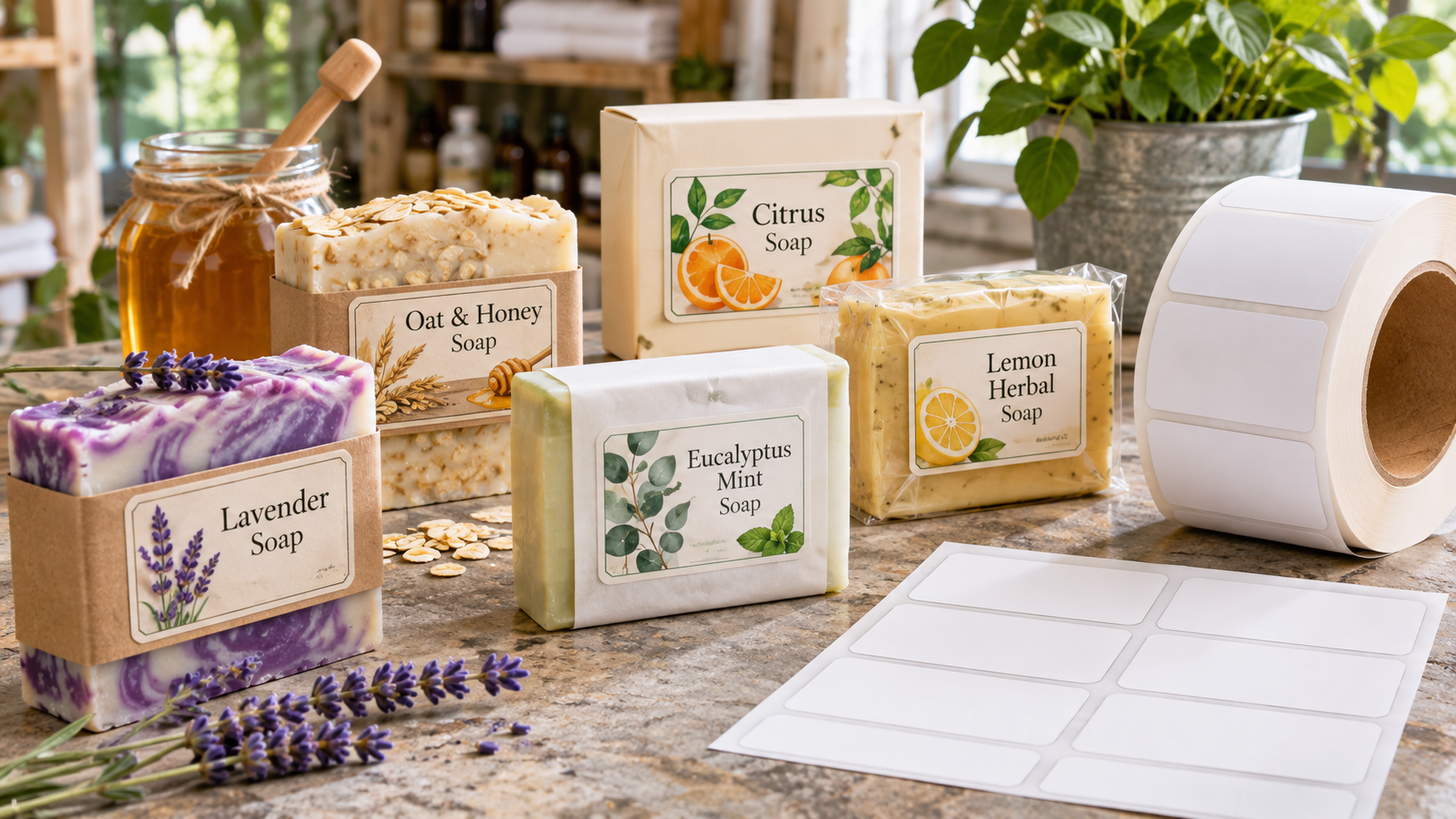
Quick Start Guide: Which Soap Labels Should You Choose?
Start with the package, not only the weight of the bar. A four-ounce square bar, a long narrow bar and a rounded artisan bar may all weigh the same but need different label dimensions. Choose the packaging method first, then measure it.
| Soap package | Common sizes to test | What to check |
|---|---|---|
| Paper belly band | 2″ × 6″, 2″ × 8″ or 3″ × 8″ | Full path around the bar, overlap and how the band closes |
| Front label on a soap box | 2″ × 3″, 3″ × 3″ or 3″ × 4″ | Actual flat panel, corners and room for the brand |
| Shrink-wrapped or sleeved bar | 2″ × 3″ or 2″ × 4″ | Film compatibility, smoothness and readability |
| Ingredient or back panel | 2″ × 4″ or 2″ × 5″ | Amount of information and printed legibility |
| Round soap tin or package seal | 2″, 2½″ or 3″ circle | Flat lid diameter inside any rim |
At a Glance
Rustic handmade look: kraft paper. Versatile small-run choice: compatible white matte/uncoated sheet labels. Moisture-prone package: test printer-compatible synthetic film. Roll-fed production: blank roll labels. No in-house printer: custom printed labels. First action: cut a plain-paper sample and test it on the real finished package.
Quick Soap Bar Label Size Chart
Use the following dimensions as paper-cutout tests, not guaranteed fits. The available labeling area depends on the bar shape, outer wrapper, box and closure. Product availability and printer requirements can also differ between sheets and rolls.
| Packaging method | Suggested test sizes | Primary use | Common pitfall |
|---|---|---|---|
| Guest soap or sample | 1½″ × 2″, 2″ × 2″, 2″ × 3″ | Small logo or fragrance identifier | Too much copy on a small front |
| Standard artisan bar, front label | 2″ × 3″, 2″ × 4″, 3″ × 3″ | Brand, scent, product identity | Label extends onto uneven soap or wrapper |
| Narrow belly band | 2″ × 6″, 2″ × 8″ | Centered wrap that leaves soap exposed | Band too short to close securely |
| Wide belly band / sleeve | 3″ × 8″, 3″ × 11″ | Additional brand or information space | Band hides decorative top or tears on a corner |
| Soap box label | 2″ × 3″, 3″ × 4″, 3″ × 5″ | Flat front-panel branding | Printing too near folds or box edges |
| Ingredient panel | 2″ × 4″, 2″ × 5″ | Supporting product information | Unreadably small type |
| Solid shampoo tin or seal | 2″, 2½″, 3″ circle | Lid branding and product identification | Circle crosses a raised lid edge |
For more sizing examples, see the dedicated soap bar size guide. When you know your dimensions, use free label templates and compare matching materials through our soap-label options.
How to Measure Soap for a Belly Band or Front Label
Measure the finished, sale-ready soap after it has completed its intended curing and packaging process. A sample taken before a bar has reached its normal final dimensions can give a misleading wrap length. Handmade bars are not always perfect rectangles, so use the widest and thickest points that the band must pass over.
Measuring a front label
- Choose the exact application surface. For a box, measure the flat front panel. For shrink film, use the smooth portion of the wrapped package rather than the underlying bar.
- Record usable width and height. Stay away from seams, folds, wrinkles, taper and rounded edges.
- Leave a little clearance. A small visible border makes centering easier and reduces lifting where labels meet corners.
- Make a physical sample. Print a rectangle at actual size, cut it out and tape it in place.
Measuring a belly band
A belly band travels around a chosen cross-section of the bar. For a rectangular bar, the starting wrap path is approximately two times the width plus two times the thickness (or, when wrapping the other direction, two times the length plus two times the thickness). Add enough closure allowance for the design and adhesive method. The band’s other dimension controls how much of the bar it covers.
Worked example: A bar measuring 3½″ long × 2½″ wide × 1″ thick is wrapped around its 2½″ × 1″ cross-section. The approximate path is 2 × (2½″ + 1″) = 7″. Adding ¼″–½″ of overlap gives a starting band length of roughly 7¼″–7½″. A 2″ × 8″ label may be worth testing, but the actual overlap and closure must be checked. The extra stock could be trimmed or folded only if compatible with the intended product and application.
This is a geometry example, not a universal recommendation. A thick, textured or irregularly shaped bar may require more allowance, and a paper band with an external seal behaves differently from a fully adhesive wrap. Check that any adhesive seam attaches to the intended material and does not become the first point of failure when the product is handled.
Packaging Tip
Test one bar from the middle of a production batch and a few of the largest finished bars. A band that closes on the smallest bar but pops open on a larger one is not production-ready.
Choose the Packaging Format Before the Label
1. Paper belly bands for handmade soap
Belly bands are popular when the bar’s color, texture or decorative swirl is part of the product appeal. They can be narrow and simple, or wide enough to carry a logo, scent, net weight and secondary text. A kraft band complements natural-looking bars, while white paper gives more predictable color reproduction.
For a self-adhesive band, confirm that the label stock, backing and seam work on the chosen packaging. With an uncoated paper sleeve, the closure may instead use a separate label or seal. A paper belly band is not the same thing as a waterproof label: keep the packaged product away from prolonged moisture until it is sold.
2. Boxed soap with a front and back label
Boxes offer flat, dependable surfaces and make it easier to organize product information. A front label can emphasize the brand and scent while a second side or back panel presents the information consumers need. Choose a label that remains clear of the carton’s folds, opening flap and closure. A 2″ × 3″ front label or larger rectangle can be a good cutout to test, depending on the box.
Boxed soaps are also useful for multiple scents that share the same carton. Changing only the front label reduces the number of unique boxes a business must store, provided every package still carries the correct product information.
3. Shrink-wrapped and clear-sleeved soap
Clear film lets the soap remain visible while protecting the bar from handling. Labels usually go on the film rather than on an uneven soap surface. The correct material depends on the actual shrink film, any heat involved in wrapping, the finished surface texture and how the product will be stored. Test printed labels after wrapping, not just on a flat sample of unused film.
4. Full wraps and printed sleeves
Full wraps use more printable area and can create a uniform retail look. They may be suitable for branding systems with many fragrance variations and substantial information requirements. The trade-off is greater design complexity: the seam must sit where it will not obscure important text, and the graphics need to align after the wrap is closed. When an adhesive label spans a corner, its material and adhesive must tolerate the fold.
5. Round soaps, solid shampoo bars and tins
Specialty products often fit round containers better than standard soap boxes. A circular top label can identify the fragrance or product type, while an additional bottom label provides supporting information. Measure inside raised tin rims, and consider how moisture or oils will affect the label after the package is opened.
| Packaging | Strength | Potential drawback | Good starting point |
|---|---|---|---|
| Belly band | Shows the actual soap | Wrap fit and closure | 2″ × 8″ cutout |
| Folding carton | Flat branding and info space | Additional packaging cost | 2″ × 3″ front cutout |
| Clear sleeve | Protects and showcases product | Film/adhesive compatibility | 2″ × 3″ on finished film |
| Full wrap | More graphic area | Seam design and folds | Measure full wrap path |
| Round tin | Reusable and compact | Small label surface | 2″–3″ circle test |
Best Soap Label Materials: Matte, Kraft, Gloss, Clear and Film
Material choice should follow the package and exposure, not just a preferred appearance. Soap can be stored in dry gift packaging, on a humid bathroom shelf, or in a shower after purchase. Those are different label environments. A label on a disposable carton may never contact water, while a label on a reusable tin may be handled with damp hands every day.
White uncoated or matte paper
White uncoated labels are a practical option for dry indoor packaging, especially soap boxes, information panels and everyday retail branding. Their non-gloss surface works well with clear typography and designs that allow handwritten batch or scent notes. Choose stock approved for your specific printer; not every matte stock is interchangeable between inkjet and laser equipment.
Brown kraft paper
Kraft communicates a rustic, handcrafted aesthetic and works well with earthy colors and minimally printed wraps. Because the stock is brown, ink colors can appear darker or less vivid than they do on white material. Run a color proof before committing to a large order. Kraft paper is generally not the choice for persistent wet contact.
White semi-gloss or high-gloss paper
Gloss finishes can make bright citrus fragrances, colorful botanicals and premium gift designs stand out. Check compatibility with the actual ink or toner system, and test for scuffing during shipping and at market displays. A glossy appearance alone does not make paper waterproof.
Clear films
Clear film labels create a low-visibility look on smooth packaging, particularly clear bags, tins and transparent cartons. The background still matters: a transparent label over busy soap colors may reduce text contrast. Most standard desktop printers do not print white ink, so light elements may disappear against a dark soap or wrapper.
Water-resistant synthetic film
Polypropylene and compatible polyester-film constructions are worth testing for labels exposed to damp hands, condensation, handling or bathroom storage. However, water-resistant face stock does not automatically mean the finished printed label is waterproof. Ink durability, coating, adhesive, package surface and application conditions all influence performance.
| Material | Typical application | What to test |
|---|---|---|
| White uncoated | Boxes, back panels, paper wraps | Print quality and dry rub |
| Brown kraft | Artisan belly bands, rustic packaging | Color contrast and closure |
| Gloss / semi-gloss | Bright retail branding | Ink or toner compatibility and scuffs |
| Clear film | Transparent sleeves and premium packaging | Contrast, adhesive visibility and bubbles |
| White synthetic film | Moisture-prone, frequently handled packaging | Water resistance of the finished print and bond |
Moisture Testing Tip
Make test packages with the actual printed stock and adhesive. Handle them with dry and damp hands, rub the printed surface, and inspect edges after normal storage. Choose based on the finished package, not the label-material name alone.
Should Soap Makers Buy Sheet Labels, Roll Labels or Custom Printed Labels?
The best format is the one that matches the printer, number of variations, application method and batch size. A growing business does not need to switch to rolls simply because it has grown—especially if it makes many scents in short runs. Conversely, a smaller shop may prefer rolls if it already owns a compatible roll-fed printer or applicator.
Blank labels on sheets
Sheet labels are convenient when printing on an approved desktop inkjet or laser printer. You can make a small batch of lavender soap labels, switch to citrus and then print a seasonal gift label without changing the production setup. Use the correct sheet template, printable material and printer settings. Print a plain-paper test at 100% before using adhesive sheets.
Blank roll labels
Rolls work well with compatible Epson, Primera, Afinia and other roll-label printers. They may improve workflow when printing larger volumes or using an applicator, but you must verify core size, maximum outside diameter, gap or black-mark sensing, feed direction and roll orientation. For roll labels, the width across the roll and the feed length are separate dimensions. A correct label size can still be supplied in an orientation that does not suit the printer or applicator.
Custom printed labels
If you do not want to print in-house, professionally printed labels can arrive ready for application. This can be appealing for consistent retail packaging or wholesale programs, particularly when brand colors and repeatability matter more than frequent design changes. Confirm minimum quantities, proofing, finishing, material and application specifications before ordering.
| Feature | Blank sheet labels | Blank roll labels | Custom printed |
|---|---|---|---|
| Printer needed | Compatible desktop printer | Compatible roll printer | No |
| Frequent scent changes | Easy to handle in short runs | Works with suitable setup | May require separate print quantities |
| Continuous production | More manual reloading | Often efficient | Ready to apply |
| Artwork control | In house | In house | Approved before printing |
| Critical check | Sheet layout and media | Core, OD, gap, direction | Proof, lead time, specification |
Explore blank labels for inkjet and laser printers, blank roll labels, and the ready-to-buy selections on the Soap Labels page.
Design Soap Labels That Look Good and Remain Readable
Give the front label one main job
A shopper should recognize the soap and fragrance quickly. Use the front panel for the product name, scent or variant and clear brand identity. Avoid shrinking everything to fit a detailed ingredient list onto a tiny belly band. A back or side label, carton panel or alternate wrap may be better for supporting details.
Plan information before choosing a label size
Depending on the product’s classification and selling market, packaging may need product identity, net quantity, business identification, ingredients and other information. Do not assume that a decorative soap band or template automatically fulfills those obligations. Reserve sufficient room in the package design, then evaluate final print legibility at actual size.
Understand the difference between soap, cosmetics and drugs
U.S. labeling requirements depend on how the product is made and represented. The U.S. Food and Drug Administration explains that a product meeting the specific definition of traditional soap and marketed only as soap is generally handled under the Consumer Product Safety Commission framework. Products marketed with cosmetic claims—such as moisturizing or deodorizing—or drug claims may fall under different FDA requirements. A cleansing bar containing synthetic detergents may be treated as a cosmetic even if sold as “soap.” Review the FDA’s soap/cosmetic/drug explanation and its Cosmetics Labeling Guide, and obtain product-specific compliance review as needed.
This is practical packaging guidance, not a legal determination about a particular formula or claim.
Barcodes, QR codes and batch codes
A barcode needs sufficient physical size, quiet zones and contrast to scan on the finished package. Avoid placing it across a belly-band fold or seam. A QR code should lead somewhere useful, such as product details, directions or a reorder page, and should be tested on a real package using several phones. If you print batch or lot codes after your main labels are made, leave a dedicated writable or variable-print area.
Design consistency across scents
A coordinated system helps customers distinguish a lavender bar from citrus or unscented varieties while recognizing the same brand. Keep the basic layout and typography consistent, then vary a small, controlled color or illustration element. This approach can also simplify template management and make proofing easier.
Apply and Test Labels Before a Large Production Run
- Choose a finished sample. Apply the proposed label to a fully packaged, representative bar.
- Clean the package surface if appropriate. Follow the packaging supplier’s guidance; do not use aggressive solvents that may damage film or carton finishes.
- Align the first edge. For a belly band, start square to the bar and wrap evenly, without forcing the paper to stretch over irregular edges.
- Close the seam deliberately. Verify that the overlap or seal uses an adhesive construction suitable for what it contacts.
- Test the actual environment. Include shelf handling, packing friction, temperature changes and any expected humidity.
- Check the printed information. Read it at actual size, scan any barcodes and inspect image quality after normal handling.
Look again after a day or two, not just immediately after application. Adhesive bond development and the stresses of shipping or display may reveal issues that a quick bench test misses.
Common Soap Labeling Mistakes to Avoid
| Mistake | Why it causes trouble | Better approach |
|---|---|---|
| Choosing by soap weight alone | Different shapes can share a weight | Measure the finished packaged bar |
| Not allowing a belly-band closure | The band may not meet or stay closed | Test the wrap path plus seam allowance |
| Using paper in prolonged moisture | Paper can weaken or lift | Use an appropriate film when wet use is expected |
| Using printer-incompatible stock | Poor print or feed performance | Match the material to the actual printer |
| Printing over folds and edges | Readability and adhesion suffer | Keep important information in flat panels |
| Overloading a tiny front label | Text becomes hard to read | Use a separate information panel or larger package |
| Assuming “soap” is a single legal category | Product claims can change classification | Review the actual formula, claims and applicable rules |
| Skipping a production test | Issues appear after a big print order | Test several actual finished packages |
Five-Step Soap Label Buying Checklist
- Choose packaging. Decide between a belly band, shrink film, carton, full wrap or tin before comparing label sizes.
- Measure and test. Record width, height and—when applicable—the complete band path and closure allowance. Print at full physical size.
- Choose material. Match paper, kraft, gloss or film to the actual surface and expected moisture/handling.
- Match the printing workflow. Confirm desktop sheets, blank rolls or custom printed stock; verify printer and application compatibility.
- Review the finished package. Check design, required information, scanability, adhesive hold and repeatability before ordering production quantities.
Ready to Choose Labels for Your Soap?
Compare paper, kraft, gloss and durable films in popular shapes and sizes. Shop blank sheet labels for desktop printing, blank rolls for compatible roll-fed printers or custom printed labels ready to apply.
Browse Soap Labels by Size and Material | Find Free Label Templates
Frequently Asked Questions About Soap Bar Labels
What is the best label size for handmade soap?
There is no single best size because a belly band, box front and clear sleeve require different dimensions. Common starting tests include 2″ × 3″ front labels and 2″ × 8″ belly bands. Measure the actual finished package before ordering.
How long should a soap belly band be?
Measure the path around the intended cross-section of the bar, then add closure allowance. For a rectangular bar, begin with twice the cross-section width plus twice its thickness. Confirm fit with a paper cutout.
Should I choose a belly band or a full wrap?
Belly bands allow shoppers to see more of the soap and suit artisan products. A full wrap provides greater space for graphics and information but requires more attention to seams, folds and closure.
Are kraft soap labels waterproof?
No. Traditional kraft paper is generally intended for dry packaging. For labels expected to face moisture or frequent damp handling, test a compatible synthetic film.
Should handmade soap have a waterproof label?
Not necessarily. A dry boxed bar or gift package may work well with paper. Labels on bathroom tins or damp-handled packaging may benefit from durable film. Test both the material and finished print.
What label works best on a soap box?
Rectangular and square paper labels often work well on smooth cartons. Try 2″ × 3″ or 3″ × 4″ as cutout examples, then choose based on the box’s true flat panel and the information you need to print.
Can I print soap labels on a home inkjet printer?
Yes, if the label stock and sheet layout are approved for that printer. Use the matching template and test at actual size before printing adhesive labels.
Can I use a laser printer for soap labels?
Yes, using laser-compatible materials designed to withstand your printer’s process. Do not run unsupported inkjet-only adhesive stock through a laser printer.
When do blank roll labels make sense for soap businesses?
They can be efficient with a compatible roll-fed label printer, continuous production or suitable applicators. Verify roll core, OD, sensing, and orientation before buying.
Can a soap label go directly on an uncovered bar?
Test cautiously. Uneven texture, moisture and oils can make direct adhesion unreliable. A belly band, shrink film or box generally provides a more consistent surface.
Can I use clear labels on soap packaging?
Yes, especially on smooth transparent packaging. Check text contrast against the actual soap color and remember that standard desktop printers often cannot print white ink.
What label material looks most professional?
That depends on the brand. Kraft supports rustic designs, matte white offers versatility, gloss emphasizes vivid graphics and clear film produces a minimal look. Fit and readability matter more than choosing one universally “best” finish.
Do I need ingredients on a soap label?
Requirements depend on the product’s actual regulatory classification, claims and market. Review the relevant FDA or CPSC framework and have the final package checked for your product rather than assuming the word “soap” determines every rule.
Can I put barcodes on soap labels?
Yes. Leave enough room for the barcode and quiet zones, avoid folds and curves, and verify that the printed code scans on the packaged item.
How can I prevent soap-label edges from lifting?
Keep labels on clean, compatible, relatively flat packaging surfaces; verify adhesive performance and avoid crossing stressed folds or uneven corners. Test the finished package under normal handling conditions.
Are sheet labels or custom printed labels better for a new soap brand?
Sheets give flexibility for low-volume seasonal scents and in-house changes. Custom printing removes the need for production equipment and may suit a stable design with repeat orders. Compare total workflow, not only price per label.
Need More Help Selecting a Soap Label?
Start with four decisions: (1) belly band, box, sleeve or tin; (2) the exact finished packaging dimensions; (3) expected moisture and handling; and (4) your printing method. If you are unsure of the size, print a full-scale test using a matching label template and compare it with a real soap package.
For dimensions by soap-packaging type, visit What Size Label for Soap Bars?. When you’re ready to compare available products, browse Soap Labels or the broader Blank Labels selection.
